

Market Overview
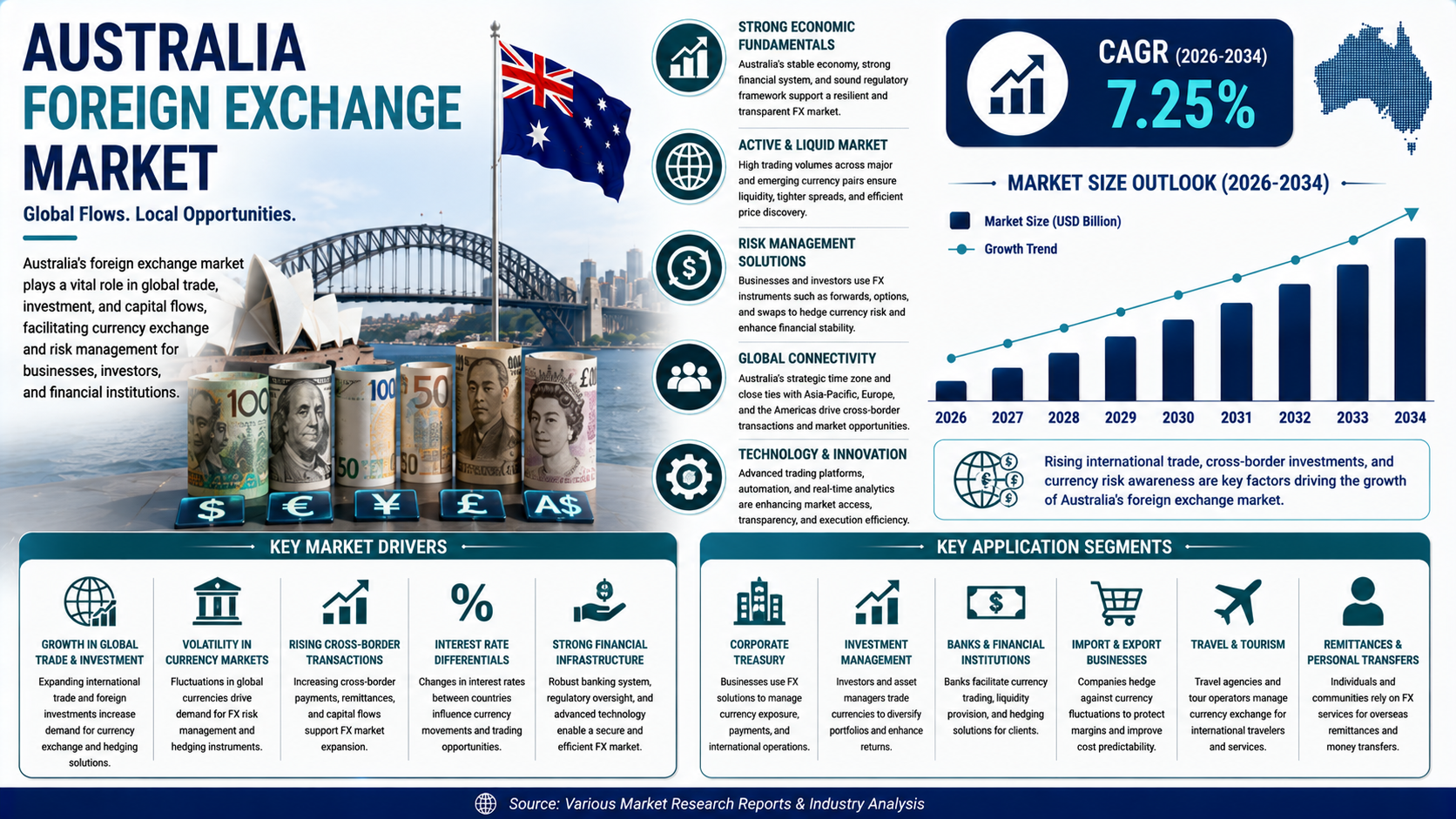
The Australia foreign exchange market is characterized by robust liquidity, driven by institutional players, retail brokers, and increasing demand for hedging and speculative trading, supported by technological advancements, global trade relationships, and the country's strong economic ties to the Asia-Pacific region. The market size reached USD 172.3 Billion in 2025 and is projected to reach USD 329.6 Billion by 2034, growing at a compound annual growth rate (CAGR) of 7.25% from 2026 to 2034.
The market is strategically important to Australia's economy as it enables international trade and investment, supports the country's resource-driven export economy, provides hedging opportunities for businesses, and positions Australia as a key financial hub between Western markets and fast-developing Asian nations.
Request a Sample Report for In-Depth Market Insights: https://www.imarcgroup.com/australia-foreign-exchange-market/requestsample
Australia Foreign Exchange Market Summary
The Australia foreign exchange market encompasses a system where currencies are traded, exchanged, and hedged through various counterparties (reporting dealers, non-financial customers, other financial institutions) using instruments such as currency swaps, outright forwards and FX swaps, and FX options.
These foreign exchange services are valued for their role in facilitating international trade, managing currency risk, enabling cross-border investment, providing liquidity for global markets, and offering speculative trading opportunities.
The ecosystem includes reporting dealers (financial institutions, investment banks), non-financial customers (businesses, governments, corporations), other financial institutions (hedge funds, asset managers), forex brokers (Pepperstone, CMC Markets, OANDA), regulatory bodies (ASIC, RBA), technology providers, and retail traders.
Major segments identified in the market include counterparty (reporting dealers, non-financial customers, other financial institutions), type (currency swap, outright forward and FX swaps, FX options), and region (Australia Capital Territory & New South Wales, Victoria & Tasmania, Queensland, Northern Territory & Southern Australia, Western Australia).
The market is benefiting from commodity-driven economic influence (iron ore, coal, natural gas exports to China, India, Japan), liberalized market structure and financial infrastructure, rising foreign investment and international trade relationships, expansion of algorithmic and high-frequency trading, and rise of sustainable and ESG investing.
The Australian government supports the market through sensible regulatory oversight (ASIC), infrastructure support (New Payments Platform), and international market integration through free trade agreements.
PORTER'S FIVE FORCES ANALYSIS — AUSTRALIA FOREIGN EXCHANGE MARKET
Bargaining Power of Suppliers — Low
The foreign exchange market is highly liquid with numerous liquidity providers, including global banks, financial institutions, and market makers. The presence of multiple suppliers reduces any single supplier's bargaining power.
Reporting dealers (financial institutions, central banks) are integral as middlemen, but the fragmented nature of the market with many participants competing for order flow limits individual supplier leverage.
Technology providers and trading platform vendors have moderate bargaining power as forex brokers increasingly rely on advanced algorithmic trading solutions, AI analytics, and cloud infrastructure (e.g., CMC Markets partnering with HPE GreenLake).
Bargaining Power of Buyers — Moderate to High
Buyers include non-financial customers (businesses, governments, corporations) and other financial institutions (hedge funds, asset managers). Large institutional buyers have significant bargaining power due to trade volumes.
Retail brokers cater to individual investors by offering easy-to-use online platforms and competitive spreads, democratizing forex trading and increasing buyer choice. The growing number of fintech firms using AI and blockchain provides more options.
Non-financial customers use the market for hedging purposes to protect from fluctuations in foreign exchange rates, but can choose between multiple forex brokers and financial institutions for these services.
Threat of New Entrants — Moderate
The Australian forex market is supported by a liberalized and open financial system with well-developed infrastructure, lowering barriers for new fintech entrants. Australia's early adoption of real-time payment systems (New Payments Platform) has paved the way for quicker FX transactions.
However, regulatory oversight by ASIC requires licensing and compliance with high operational and disclosure standards, creating barriers for foreign-based brokers seeking to operate within Australia.
Competition is based on technology, speed of execution, and customer service. New entrants must invest in sophisticated trading platforms, cybersecurity, and regulatory compliance.
Threat of Substitutes — Low
Foreign exchange has no direct substitute for converting currencies for international trade, cross-border investment, and currency risk management.
Cryptocurrencies (Bitcoin, Ethereum, stablecoins) allow fast, low-cost international transfers and have emerged as alternatives for some cross-border transactions. Integration of cryptocurrencies in forex trading is growing, with brokers offering cryptocurrency pairs.
However, the Australian dollar (AUD) remains one of the most traded currencies globally, and the deep liquidity of traditional forex markets makes substitution limited for institutional participants.
Competitive Rivalry — High
The competitive landscape is composed of a heterogeneous mix of institutional players, retail brokers, and market makers striving for a larger share of the market. Institutional OTC operations exist with big financial groups engaging in forex services for corporate clients and governments.
Retail brokers cater to individual investors by offering easy-to-use online platforms and competitive spreads, democratizing forex trading. Competition is based on technology, speed of execution, and customer service.
The market is characterized by a growing number of fintech firms utilizing advanced technologies like AI and blockchain to provide more efficient, secure, and transparent trading solutions. In January 2025, Pepperstone partnered with Aston Martin Aramco Formula One® Team as their Global Forex and Trading Partner.
MARKET GROWTH DRIVERS
Commodity-Driven Economic Influence
Australia's economy is heavily driven by its position as a prime commodity exporter, with iron ore, coal, natural gas, and agriculture being major exports. The fortunes of these industries have a lot to do with influencing the value of the Australian dollar (AUD), which is one of the most traded currencies in the world. Global demand for Australian exports, specifically from large trading partners such as China, India, and Japan, has direct impacts on currency movements and participation in the market.
This close connection between commodity exports and currency valuation provides speculative and hedging opportunities for participants in the market. A standout feature of Australia is that its economy is small in scale but highly exposed to international commodity cycles, whereby foreign exchange activity tends to react quickly to shifts in market sentiment. This highly dynamic quality makes the AUD a draw for institutional traders and financial institutions seeking to profit from the currency's sensitivity to economic releases, commodity prices, and trade-related geopolitics.
Liberalized Market Structure and Financial Infrastructure
Australia's foreign exchange market is facilitated by a liberalized and open financial system underpinned by well-developed infrastructure and robust institutional governance. A regime of floating exchange rates is in place, where market forces are relied upon to set the value of the Australian dollar without government intervention. This openness presents fertile ground for domestic and international investors alike to participate in currency trading.
The Reserve Bank of Australia (RBA), though not responsible for managing the currency per se, has a stabilizing influence on its value through its monetary policy and market operations communicated carefully and adhered to worldwide. Moreover, Australia's location in the time zone positions it strategically between the close of the U.S. trading day and the beginning of Asia's, meaning Sydney is among the first markets to open every day. This positioning puts the Australian foreign exchange market in a special position to offer early price discovery and liquidity for global markets. With properly regulated financial institutions and access to sophisticated trading platforms, Australia provides a secure and desirable venue for foreign exchange activity.
Rising Foreign Investment and International Trade Relationships
The growing international trade and investment links are fundamental growth drivers of the region's foreign exchange market. The nation's attractiveness as a foreign direct investment destination, especially in industries such as mining, education, and property, generates ongoing demand for Australian currency. Australia also has an array of free trade arrangements and bilateral economic pacts that make it easy to flow capital and promote cross-border transactions.
Specifically, Australia's commercial relationship with the Asia-Pacific region is a constant source of FX market expansion, with the nation serving as a financial bridge between Western economies and fast-developing Asian nations. The increase in Australia's position as a destination for multinational companies and institutional investors also contributes to foreign exchange trading volumes, as these firms participate in hedging activities, profit repatriation, and portfolio rebalancing. With its strong legal framework and economic soundness, these elements make Australia a key hub in the global currency trading system.
Expansion of Algorithmic and High-Frequency Trading
Algorithmic trading and high-frequency trading (HFT) have dramatically transformed the Australian foreign exchange market. These techniques rely on sophisticated mathematical models and algorithms to analyze market data and execute trades in milliseconds, ensuring that traders capitalize on even the smallest price fluctuations. As a result, market participants—particularly institutional investors—have become more efficient in executing trades at high volumes, leading to improved liquidity and narrower spreads.
In August 2023, ASIC extended transitional relief for foreign financial services providers (FFSPs), allowing them to provide services to Australian wholesale clients without an Australian financial services license. Moreover, with the rise of machine learning, algorithms are also becoming increasingly self-adaptive, allowing them to adjust their strategies based on market trends. This has opened the door for both larger institutions and retail investors to benefit from a more dynamic and faster-paced market environment.
Rise of Sustainable and ESG Investing
The heightening importance of Environmental, Social, and Governance (ESG) factors is emerging as a key trend in the Australian foreign exchange market. As investors place greater emphasis on sustainability, currency markets are seeing growing interest in the Australian dollar, particularly in sectors aligned with eco-friendly energy, renewable resources, and sustainable development. Australia, with its vast natural resources and growing commitment to environmental protection, is becoming an attractive destination for foreign investors looking to align their portfolios with ESG goals.
For example, in 2024, Airwallex introduced its Australian-first 'Yield' account, enabling businesses to earn up to 4.07% returns on USD and AUD balances, surpassing the big banks' rates, without any lock-up periods. Moreover, the integration of ESG considerations into forex trading is encouraging more socially responsible capital flows, with forex brokers offering ESG-based currency trading options. In turn, this shift influences the Australian economy, as foreign capital inflows into sectors such as clean technology and sustainable agriculture increase demand for the Australian dollar.
AUSTRALIA FOREIGN EXCHANGE MARKET SEGMENTATION
Counterparty Insights:
Reporting Dealers
Non-financial Customers
Other Financial Institutions
Type Insights:
Currency Swap
Outright Forward and FX Swaps
FX Options
Regional Insights:
Australia Capital Territory & New South Wales
Victoria & Tasmania
Queensland
Northern Territory & Southern Australia
Western Australia
COMPETITIVE LANDSCAPE
The competitive landscape of the Australian foreign exchange market is composed of a highly heterogeneous mix of institutional players, retail brokers, and market makers striving for a larger share of the market. Institutional over-the-counter operations exist with big financial groups engaging in forex services such as trading, hedging, and investment solutions for their corporate clients as well as governments. Retail brokers cater to individual investors by offering easy-to-use online platforms and competitive spreads, thereby democratizing forex trading. The competition is based on technology, speed of execution, and customer service. The market is also characterized by the growing number of fintech firms utilizing advanced technologies like artificial intelligence and blockchain to provide more efficient, secure, and transparent trading solutions.
Key players include:
Pepperstone
CMC Markets
OANDA Global Corporation
Westpac
Airwallex
REGIONAL ANALYSIS
Australia Capital Territory & New South Wales: This region is the central point of the country's foreign exchange activity, where Sydney is its financial capital. Major financial institutions, investment banks, and forex brokers are located here, significantly impacting liquidity and volume of forex transactions. The area is at a favorable time zone for conducting international transactions with Asia-Pacific markets. With a concentration of financial services and a robust economic base, it is a dominant player in the Australian forex market.
Victoria & Tasmania: Victoria & Tasmania are seeing active growth in forex volume, primarily underpinned by Melbourne as a financial center. The region has well-developed trade infrastructure for international trade, especially manufacturing and agriculture, which often involve cross-border transactions needing foreign exchange. Tasmania, with its smaller economy, is increasingly being pulled into international markets, particularly natural resources and tourism, experiencing growing demand for foreign exchange services.
Queensland: Queensland is a major player in Australia's forex market due to its diversified economy including mining, agriculture, and tourism. Brisbane has become a financial services hub encompassing forex trading and investment management. The state's export market, especially to Asia, contributes to currency exchange. Increasing international trade relations and infrastructure projects are raising demand for foreign exchange services.
Northern Territory & Southern Australia: These regions are smaller players in forex activity but contribute to the overall Australian market through engagement in resource extraction activities including energy and minerals. The Northern Territory benefits from proximity to Southeast Asia, creating demand for foreign exchange in trade and investment. South Australia, through strong agricultural exports and emerging defense industries, requires foreign exchange for international transactions. These areas are vital for specialized forex services linked to their industries.
Western Australia: Western Australia is an enormous contributor to Australia's foreign exchange market because the state boasts a resource-driven economy. The state is one of the leading mining and natural resources producers worldwide, exporting commodities like iron ore, gold, and natural gas. This drives enormous demand for foreign exchange services, especially for currency conversion related to international trade. Perth is a financial center for the mining and energy sectors, and its economic ties with Asia-Pacific markets further increase the region's role in forex transactions.
RECENT INDUSTRY DEVELOPMENTS
June 2026: The Metro Manila residential market showed improving fundamentals, with remaining condominium inventory life falling to 6.8 years from a peak of 13.4 years in mid-2025, indicating stronger absorption of unsold units and a gradual recovery in demand.
June 2026: The Philippine real estate sector continued to recover despite macroeconomic challenges. Colliers reported approximately 2,000 units of net residential take-up in Q1 2026, representing a 765% increase from 228 units recorded in the same period of 2025.
May 2026: Industry analysts reported that the Metro Manila residential sector experienced a sharp rebound in preselling activity during the first quarter of 2026, driven by improved buyer sentiment and faster inventory absorption. Developers projected approximately 8,000 preselling residential unit take-up for the full year.
April 2026: Property outlook reports indicated that more than 1.5 million square meters of office space are scheduled for completion through 2029, primarily in Quezon City, Taguig, and Ortigas, supporting long-term growth in the commercial real estate segment.
March 2026: Banking sector data showed that real estate loans extended by Philippine banks and trust institutions reached approximately PHP 3.2 trillion as of December 2025, reflecting an annual increase of nearly 7% and demonstrating continued financing support for property development and acquisition.
February 2026: Investor sentiment toward Asia-Pacific real estate strengthened significantly, with a CBRE survey showing net buying intentions for 2026 reaching their highest level in four years, supporting foreign and institutional interest in Philippine property assets.
January 2026: Market data highlighted sustained property price growth, with residential property prices in the Philippines increasing 7.6% year-over-year in Q1 2025, providing a strong foundation for residential real estate activity entering 2026.
Note: If you need any specific information that is not covered currently within the scope of the report, we will provide the same as a part of customization.
Speak to an analyst: https://www.imarcgroup.com/request?type=report&id=21958&flag=C
About Us
IMARC Group is a global management consulting firm that helps the world's most ambitious changemakers to create a lasting impact. The company provides a comprehensive suite of market entry and expansion services. IMARC offerings include thorough market assessment, feasibility studies, company incorporation assistance, factory setup support, regulatory approvals and licensing navigation, branding, marketing and sales strategies, competitive landscape and benchmarking analyses, pricing and cost research, and procurement research.
Contact Us
IMARC Group
134 N 4th St., Brooklyn, NY 11249, USA
Email: [email protected]
Tel No: (D) +91 120 433 0800
United States: +1-201-971-6302
Comments
Log in or sign up to join the conversation.