

Market Overview
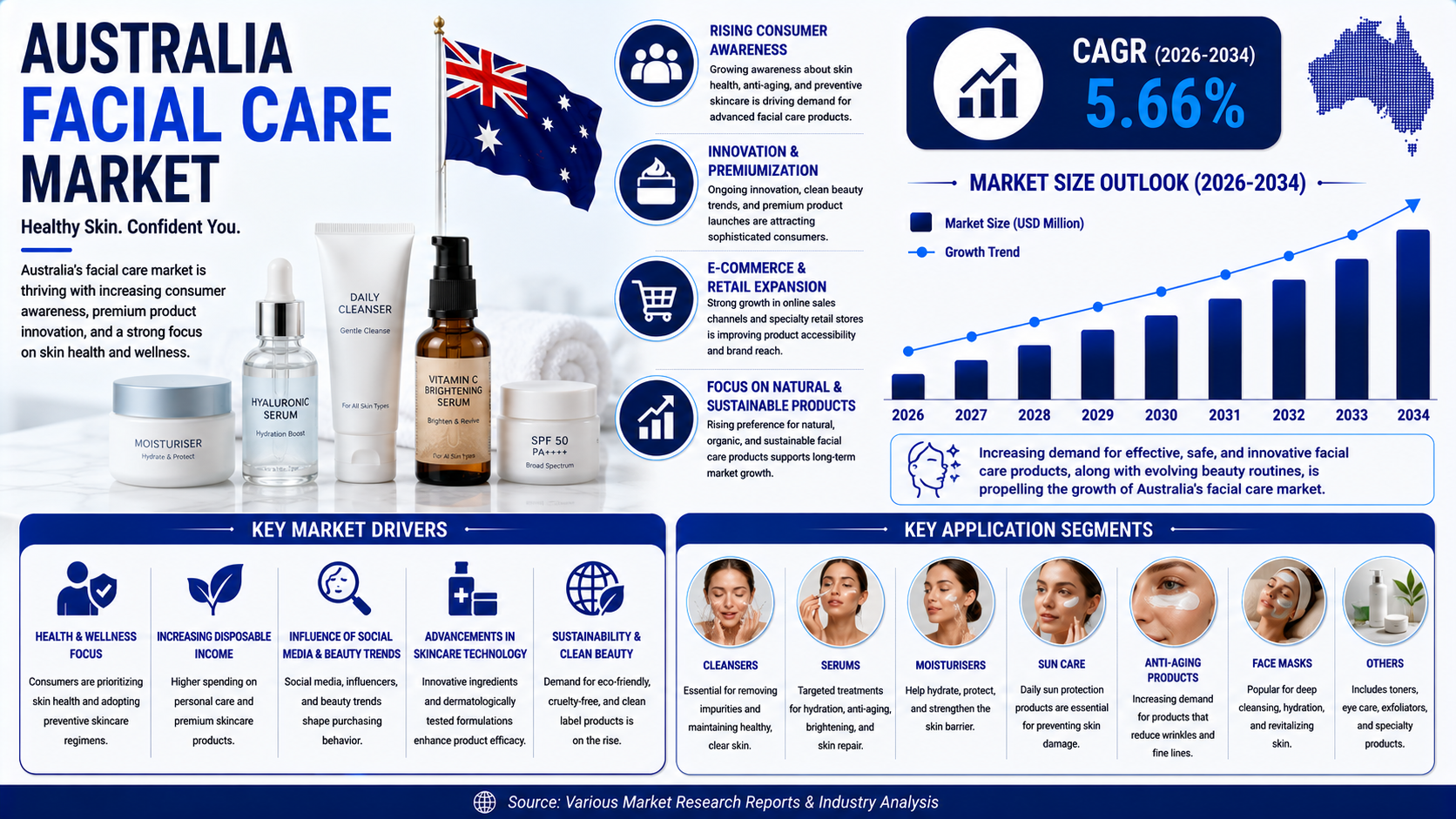
The Australia facial care market is being driven by the rising demand for facial care to prevent skin damage, increasing demand for natural and organic products, and the wide availability of facial care products. The market size reached USD 3.1 Billion in 2025 and is projected to reach USD 5.2 Billion by 2034, growing at a compound annual growth rate (CAGR) of 5.66% from 2026 to 2034.
The market is strategically important to Australia's economy as it supports local manufacturing, retail, and e-commerce sectors, promotes the use of indigenous botanicals, and enables consumers to maintain skin health in Australia's high-UV environment.
Request a Sample Report for In-Depth Market Insights: https://www.imarcgroup.com/australia-facial-care-market/requestsample
Australia Facial Care Market Summary
The Australia facial care market encompasses a system where facial care products (facial cleansers, moisturizers, anti-agers, skincare sets, face masks, and others) with different ingredients (chemical, natural) for various genders (male, female, unisex) are distributed through channels (supermarkets and hypermarkets, beauty parlors and salons, multi-branded retail stores, online, exclusive retail stores, and others).
These facial care products are valued for their role in enhancing skin appearance, providing nourishment, treating acne and pigmentation, preventing UV damage and sunburn, reducing signs of aging, and protecting skin from environmental damage.
The ecosystem includes facial care manufacturers (Beiersdorf, Colgate-Palmolive, Johnson & Johnson, Kao, L'Oreal, P&G, Revlon, Estée Lauder, Unilever), retailers (supermarkets, beauty salons, online platforms), ingredient suppliers, and consumers across Australian regions.
Major segments identified in the market include product type (facial cleansers — largest segment, moisturizers, anti-agers, skincare sets, face masks, others), ingredient (chemical — largest segment, natural), gender (male, female, unisex), distribution channel (supermarkets and hypermarkets, beauty parlors and salons, multi-branded retail stores, online, exclusive retail stores, others), and region (New South Wales — largest market, Western Australia, Queensland, Victoria, Rest of Australia).
The market is benefiting from rising demand for organic and natural products (avoidance of parabens, sulfates, harmful chemicals), increase in disposable income (allocation of more funds toward premium skincare), rising popularity of sunscreen-infused skincare (high UV exposure in Australia), climate and high UV exposure, increased demand for locally produced and plant-based products (indigenous botanicals: Kakadu plum, tea tree oil, eucalyptus, finger lime, quandong, macadamia oil), and digital engagement and personalization (skin quizzes, AI analysis, virtual consultations).
The Australian Radiation Protection and Nuclear Safety Agency (ARPANSA) identifies Australia's UV radiation as among the highest in the world.
PORTER'S FIVE FORCES ANALYSIS—AUSTRALIA FACIAL CARE MARKET
Bargaining Power of Suppliers — Moderate
Facial care suppliers include raw material providers (natural extracts, botanical oils, chemical ingredients), packaging manufacturers, and contract manufacturers. Australia's rich biodiversity provides indigenous botanicals (Kakadu plum, tea tree oil, eucalyptus, finger lime, quandong, macadamia oil), giving local ingredient suppliers moderate leverage.
The shift toward natural, organic, and plant-based products means suppliers of certified natural ingredients have increased bargaining power.
However, the presence of multiple global and local suppliers across different ingredient categories gives manufacturers options, reducing dependency on any single supplier.
Bargaining Power of Buyers — Moderate to High
Buyers include individual consumers, beauty salons, and retailers. The wide range of facial care products across price segments gives consumers significant choice.
With more financial flexibility due to rising disposable income, Australians are investing in high-quality facial care items, but also have the ability to compare products across brands and channels.
Digital engagement through social media, beauty influencers, and online platforms provides consumers with product information and reviews, increasing buyer power. The availability of AI skin quizzes and virtual consultations further empowers consumers.
Threat of New Entrants — Moderate
The facial care market has moderate barriers to entry. New entrants require investment in product development, branding, and distribution. The trend toward natural, organic, and clean beauty creates opportunities for entrants with locally sourced indigenous botanicals.
Digital platforms allow smaller, niche brands to create online communities and access markets without widespread physical stores. In August 2023, The Beauty Health Company expanded its collaboration with Sephora for Hydrafacial treatments in Australia, demonstrating that new treatment formats can enter through retail partnerships.
However, established global brands (L'Oreal, Estée Lauder, P&G, Unilever) have significant brand recognition, R&D capabilities, and distribution networks, creating barriers for unestablished entrants.
Threat of Substitutes — Low
Facial care products have no direct substitute for their core functions (cleansing, moisturizing, anti-aging, sun protection).
Medical procedures (laser treatments, chemical peels, Botox) are partial substitutes for anti-aging and skin resurfacing but cannot replace daily cleansing, moisturizing, and sun protection.
The high UV exposure in Australia makes sunscreen-infused facial care products essential, reducing substitution for sun protection functions.
Competitive Rivalry — High
The Australia facial care market features intense competition among global giants (L'Oreal, Estée Lauder, P&G, Unilever, Beiersdorf, Johnson & Johnson, Kao, Revlon, Colgate-Palmolive) and local natural brands.
Differentiation occurs through product type (cleansers, moisturizers, anti-agers, masks), ingredient claims (natural, organic, chemical-free), gender targeting, distribution channel, and digital engagement (skin quizzes, AI analysis).
The Beauty Health Company's expansion of Hydrafacial treatments in Sephora Australia (August 2023) demonstrates innovation-driven competition in the professional treatment space.
MARKET GROWTH DRIVERS
Rising Demand for Organic and Natural Products
In Australia, there is a growing consumer preference for organic and natural skincare products, with most Australians opting for skincare items that incorporate natural ingredients. This shift is primarily due to increased awareness about the health benefits associated with organic products and the desire to avoid synthetic chemicals in skincare. As consumers become more educated about the ingredients in their skincare products and their potential impacts on health and the environment, there is a noticeable move toward products that are free from parabens, sulfates, and other harmful chemicals.
This trend is significantly influencing the skin care industry, encouraging brands to develop and market facial care products that meet these natural and organic criteria. Furthermore, the market is dedicated to clean, green beauty solutions that cater to health-conscious consumers looking to maintain skin health with minimal environmental impact, which is increasing the Australia facial care market share.
Increase in Disposable Income
There has been a notable increase in the average weekly household income in Australia. Additionally, the rising disposable income enables consumers to allocate more funds toward premium skincare products. Moreover, with more financial flexibility, Australians are investing in high-quality facial care items that promise better results and often come with higher price tags.
The trend is driven by a growing consumer perception that premium products offer superior formulations, enhanced effectiveness, and often, more ethical sourcing and manufacturing practices. As a result, the market is witnessing a rising demand for luxury skincare products that offer these added benefits, underscoring how economic factors influence consumer buying habits, thereby providing a positive Australia facial care market outlook.
Rising Popularity of Sunscreen-Infused Skincare
The high exposure to ultraviolet (UV) radiation in Australia, identified by the Australian Radiation Protection and Nuclear Safety Agency (ARPANSA) as among the highest in the world, there is an increasing demand for skincare products with built-in SPF protection. This need is critical as Australians seek ways to protect their skin from the harmful effects of UV rays, including skin aging and cancer.
Moreover, sunscreen-infused skincare products, such as moisturizers with SPF, have witnessed a significant annual growth rate. These products offer a dual benefit as they hydrate the skin and provide necessary sun protection. Along with this, the convenience of combining sun protection with daily skincare routines is appealing to consumers looking to streamline their beauty practices while ensuring they are shielded from the sun's damaging rays.
Climate and High UV Exposure
Australia's harsh sun exposure and distinctive climatic conditions contribute significantly towards driving growth in the facial care industry. With amongst the highest UV radiation intensity on the globe, Australian consumers are extremely aware of skin injury, premature ageing, and risk of skin cancer. This has increased the relevance of daily facial care routines that include SPF protection, moisturizing, and after-sun repair. Consequently, sunscreens for the face, anti-pigmentation creams, and barrier-restoring creams are some of the most popular skincare products.
Further, the changing weather conditions in the nation—ranging from dry heat in the interior states to sea-coast moisture—lead customers to desire specially formulated skincare products for their surroundings. Domestic players have taken this cue and come up with products adapted to these weather conditions using local ingredients such as Kakadu plum, tea tree oil, and eucalyptus.
Increased Demand for Locally Produced and Plant-Based Products
According to the Australia facial care market analysis, a robust cultural predisposition toward wellness, sustainability, and health is pushing consumers toward facial care that is organic, natural, and domestic. With increased awareness about the safety of ingredients, consumers are rejecting synthetic additives and opting for plant-based, cruelty-free, and environmentally friendly alternatives.
The rich biodiversity of Australia presents a distinctive edge in this market, with indigenous botanicals such as finger lime, quandong, and macadamia oil becoming signature ingredients in a lot of skincare products. Local businesses are keeping up with the trend by emphasizing sustainable sourcing, minimal processing, and clean-label transparency, which gains immense traction among environmentally and socially aware consumers.
AUSTRALIAN FACIAL CARE MARKET SEGMENTATION
Product Type Insights:
Facial Cleansers (largest segment)
Moisturizers
Anti-Agers
Skincare Sets
Face Masks
Others
Ingredient Insights:
Chemical (largest segment)
Natural
Gender Insights:
Male
Female
Unisex
Distribution Channel Insights:
Supermarkets and Hypermarkets
Beauty Parlors and Salons
Multi Branded Retail Stores
Online
Exclusive Retail Stores
Others
Regional Insights:
New South Wales (largest market)
Western Australia
Queensland
Victoria
Rest of Australia
COMPETITIVE LANDSCAPE
The Australia facial care market features intense competition among global giants and local natural brands. Leading players differentiate through product type, ingredient claims (natural, organic, chemical-free), gender targeting, distribution channel, and digital engagement (skin quizzes, AI analysis, virtual consultations). The trend toward natural, organic, and plant-based products is driving innovation in indigenous botanical ingredients.
Key players include:
Beiersdorf AG
Colgate-Palmolive Company
Johnson & Johnson
Kao Corporation
L'Oreal S.A.
Procter & Gamble
Revlon Inc.
The Estee Lauder Companies Inc
Unilever PLC
REGIONAL ANALYSIS
New South Wales: New South Wales was the largest market for Australia facial care. Some of the factors driving the New South Wales facial care market included the rising concern for overall appearance, increasing demand for toxin-free products, and wide availability of facial care products. Sydney's concentration of beauty salons, multi-branded retail stores, and exclusive retail outlets supports market dominance.
Victoria: Victoria, anchored by Melbourne, is a key facial care market with strong consumer demand for premium and natural skincare products. Melbourne's beauty and wellness culture supports growth in beauty parlors, salons, and exclusive retail stores. The region's health-conscious consumers drive demand for natural and organic products.
Queensland: Queensland's facial care market is driven by high UV exposure (Gold Coast, Brisbane) and the resulting demand for sunscreen-infused facial care products and after-sun repair. The state's warm climate and outdoor lifestyle support demand for lightweight, hydrating facial care products. Tourism supports beauty retail.
Western Australia: Western Australia's facial care market is driven by Perth's growing population, high UV exposure, and demand for sun protection facial care products. The state's affluent consumer base supports demand for premium skincare brands. Local distribution channels include supermarkets, beauty salons, and online platforms.
Rest of Australia (including Tasmania, Northern Territory, South Australia): These regions contribute to the facial care market through growing consumer awareness of skincare benefits and increasing availability of facial care products through online channels. The Australian Capital Territory (Canberra) has high disposable income supporting premium skincare consumption.
RECENT INDUSTRY DEVELOPMENTS
June 2026: Sustainability continued to influence Australia's facial care sector. The Australian beauty and personal care industry, valued at approximately AUD 17.25 billion in 2025, faced growing pressure to reduce packaging waste, with an estimated 95% of cosmetic packaging discarded and 60% made from hard-to-recycle plastic, encouraging brands to adopt refillable and eco-friendly packaging solutions.
June 2026: Australian skincare innovation remained focused on daily sun protection, personalized skincare, and skin-health-oriented formulations. The broader Beauty & Personal Care market in Australia is expected to generate approximately US$7.9 billion in revenue in 2026, supporting continued investment in facial care products.
May 2026: Consumer demand for science-backed skincare accelerated, with facial care brands increasingly focusing on advanced peptides, microbiome-supporting ingredients, targeted anti-aging solutions, and personalized skincare regimens. These trends are reshaping product development across the Australian facial care market.
May 2026: Australia's facial care segment continued benefiting from the country's strong focus on skin health and UV protection. Industry data highlighted that skincare remains the dominant category within Australia's beauty and personal care market due to growing awareness of aging, pigmentation, acne, and sun-related skin concerns.
April 2026: Men's facial care gained further momentum as specialized skincare brands expanded offerings tailored to male consumers. One Australian men's skincare brand reported annual revenue of approximately US$3 million and a customer base exceeding 40,000 users, reflecting growing demand for dedicated facial care solutions.
January 2026: Global skincare trends influencing Australia showed skincare products accounted for approximately 44% of total beauty industry retail sales, reinforcing the importance of facial care products within consumer beauty routines and supporting continued category growth.
Note: If you need any specific information that is not covered currently within the scope of the report, we will provide the same as a part of customization.
Speak to an analyst: https://www.imarcgroup.com/request?type=report&id=5008&flag=C
About Us
IMARC Group is a global management consulting firm that helps the world's most ambitious changemakers to create a lasting impact. The company provides a comprehensive suite of market entry and expansion services. IMARC offerings include thorough market assessment, feasibility studies, company incorporation assistance, factory setup support, regulatory approvals and licensing navigation, branding, marketing and sales strategies, competitive landscape and benchmarking analyses, pricing and cost research, and procurement research.
Contact Us
IMARC Group
134 N 4th St., Brooklyn, NY 11249, USA
Email: [email protected]
Tel No: (D) +91 120 433 0800
United States: +1-201-971-6302
Comments
Log in or sign up to join the conversation.