

Market Overview
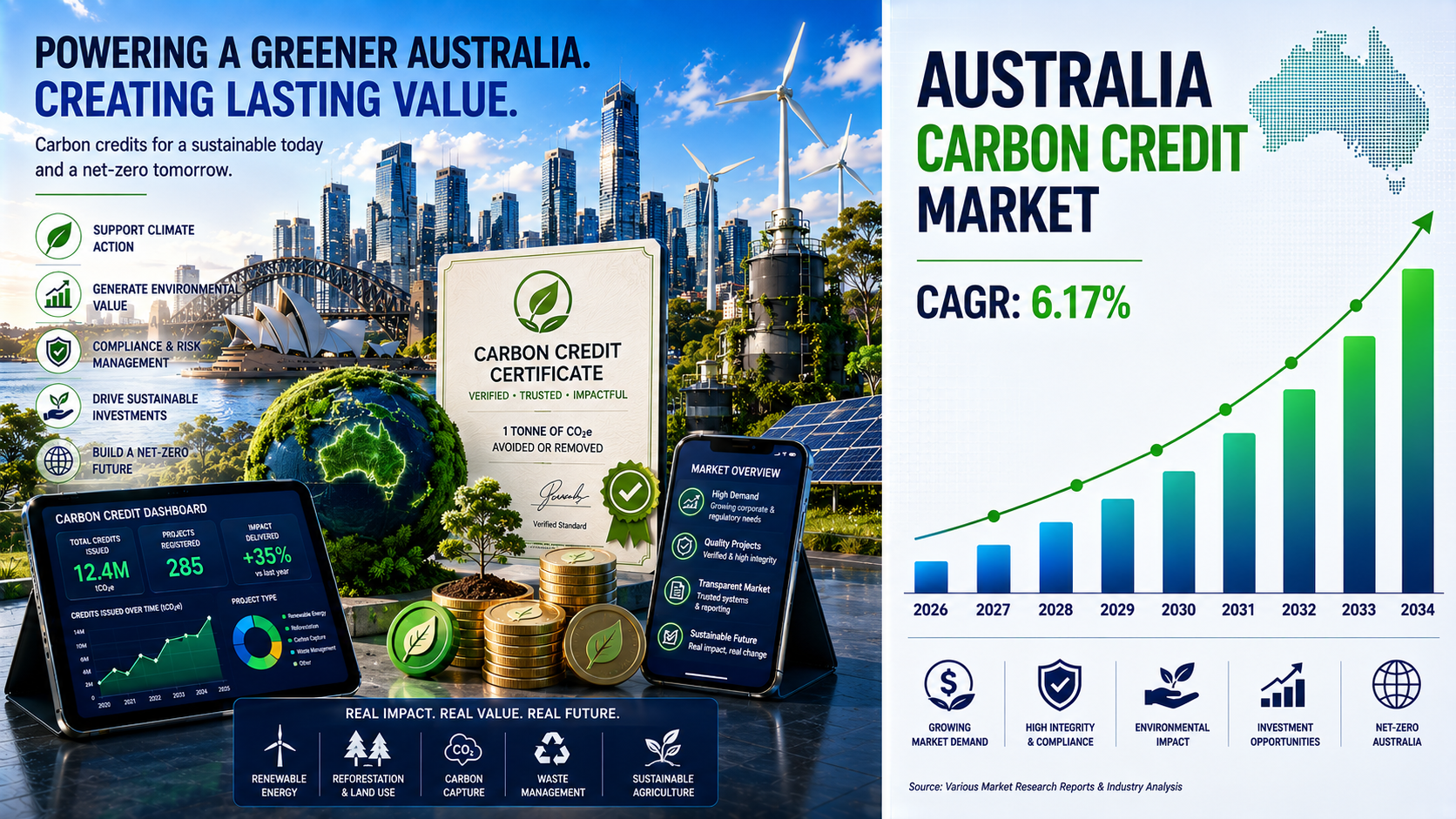
The Australia carbon credit market is experiencing robust growth, driven by the reformed Safeguard Mechanism, which now mandates annual emissions baseline reductions across large industrial facilities in Australia's highest-emitting sectors. The market size reached USD 19.5 Million in 2025 and is projected to reach USD 33.3 Million by 2034, growing at a compound annual growth rate (CAGR) of 6.17% from 2026 to 2034.
In 2025, total Australian Carbon Credit Unit (ACCU) issuances reached a record 21.64 million units, representing a 15% year-on-year increase from 18.78 million in 2024. This growth reflects structural compliance demand surges and proliferating land-based supply projects underpinning the Australia carbon credit market share. The market is strategically important to Australia's economy as it enables the nation to meet its legislated emissions reduction targets while creating new revenue streams for landholders and supporting the transition to a low-carbon future.
Request a Sample Report for In-Depth Market Insights: https://www.imarcgroup.com/australia-carbon-credit-market/requestsample
Australia Carbon Credit Market Summary
The Australia carbon credit market encompasses a system where carbon credits (Australian Carbon Credit Units or ACCUs) are generated through verified emissions avoidance or sequestration projects and purchased by entities needing to offset their emissions.
These credits are valued for their role in helping Australia meet its legislated emissions reduction targets and are used across compliance and voluntary applications.
The ecosystem includes project developers (GreenCollar, AgriProve, LMS Energy), the Clean Energy Regulator, compliance buyers under the Safeguard Mechanism, voluntary corporate buyers (Qantas, Rio Tinto, BHP), financial intermediaries (Xpansiv), and landholders participating in carbon farming projects.
Major segments identified in the market include type (compliance at 62.3%, voluntary), project type (avoidance/reduction projects, removal/sequestration projects at 48.6% including nature-based and technology-based), and end-use (power at 28.4%; energy, aviation, transportation, buildings, industrial, and others).
The market is benefiting from Australia's reformed Safeguard Mechanism overseen by the Clean Energy Regulator, which mandates annual emissions baseline reductions for the nation's 215 largest industrial emitters.
Rising corporate net-zero commitments, institutional capital entering the carbon farming sector (AUD 250 million Meldora platform launched in September 2025), and growing demand for high-integrity nature-based credits are driving sustained expansion across all application categories.
PORTER'S FIVE FORCES ANALYSIS—AUSTRALIA CARBON CREDIT MARKET
Bargaining Power of Suppliers—Moderate
ACCU supply is distributed across thousands of landholders and project developers, but large aggregators like GreenCollar (46.3 million ACCUs delivered by January 2026) control significant market share.
The Clean Energy Regulator's accreditation framework standardizes ACCU quality, reducing individual supplier differentiation.
Institutional capital entering the carbon farming sector, including the AUD 250 million Meldora platform (September 2025), is creating new large-scale supply sources.
Bargaining Power of Buyers—Moderate to High
The Safeguard Mechanism creates mandatory compliance buyers, with 142 facilities incurring a combined liability of 9.2 Mt CO₂-e above baselines in FY2024, collectively surrendering 7.1 million ACCUs and 1.4 million Safeguard Mechanism Credits.
Corporate net-zero commitments from Qantas, Rio Tinto, and BHP are driving voluntary demand, with these three committing AUD 80 million to the Silva Carbon Origination Fund (August 2024).
Buyers can choose between compliance and voluntary credits, creating price sensitivity in the voluntary segment.
Threat of New Entrants—Moderate
ACCU project registration requires approved methodologies and Clean Energy Regulator approval, creating barriers for smaller participants.
The Clean Energy Finance Corporation and institutional investors are actively funding new entrants, as seen with the AUD 250 million Meldora platform launched in September 2025.
Indigenous land participation is expanding, with savanna fire management projects providing economic and cultural co-benefits.
Threat of Substitutes—Low
ACCUs are the primary compliance instrument under Australia's Safeguard Mechanism, with no direct substitute for meeting mandatory emissions reduction requirements.
International carbon credits face recognition barriers within Australia's domestic compliance framework.
Technology-based removals like CCS (Santos Moomba project) are complementary rather than substitutive.
Competitive Rivalry—Moderate (Healthy)
The market features specialized environmental developers (GreenCollar, AgriProve), energy sector participants (LMS Energy, Santos), and financial intermediaries (Xpansiv).
Differentiation occurs through proprietary methodologies, land portfolios, institutional partnerships, and compliance relationships.
The anticipated launch of the Australian Carbon Exchange will further enhance market liquidity and competition.
MARKET GROWTH DRIVERS
Reformed Safeguard Mechanism Creating Structural Compliance Demand
The reformed Safeguard Mechanism applies mandatory 4.9% annual baseline decline rates to Australia's 215 largest emitters by 2030, creating a structural and growing floor of ACCU demand. In FY2024, the first full compliance year, 142 facilities incurred a combined liability of 9.2 Mt CO₂-e above their assigned baselines, collectively surrendering 7.1 million ACCUs and 1.4 million Safeguard Mechanism Credits to the Clean Energy Regulator. The cost containment mechanism is indexed annually to the consumer price index plus 2%, with the 2025-26 price set at USD 82.68 per ACCU, providing a regulated compliance floor that underpins structural demand growth through 2030 and beyond.
Corporate Net-Zero Commitments and ESG Reporting Pressure
Australia's major corporations are embedding ACCU procurement into long-term climate strategies, spurred by investor scrutiny and mandatory climate risk disclosures for listed companies. In August 2024, Qantas, Rio Tinto, and BHP each committed as foundation investors to the Silva Carbon Origination Fund, collectively providing AUD 80 million toward a fund targeting AUD 250 million to originate high-integrity nature-based ACCUs. Banks, superannuation funds, and specialist carbon funds are structuring ACCU-backed financial products and offtake arrangements, increasing secondary market liquidity and improving long-term price discovery.
Nature-Based Supply Expansion Across the Land Sector
GreenCollar established an AUD 100 million (approximately USD 64.9 million) fund to create Environmental Plantings ACCU projects in November 2025, with projects designed to support nature-based carbon sequestration in early 2026. Regeneration projects like human-induced regeneration, soil carbon sequestration, and savanna fire management are expanding. Long-term supply agreements between key industrial players and ACCU project developers are locking in multi-year credit pipelines, mitigating price risk, and driving new project registrations. The vast rangelands of Aboriginal people are producing ACCUs via endorsed savanna fire management, providing environmental, cultural, and economic benefits.
Digital Registry Infrastructure and Market Transparency
The Australia carbon credit market is being transformed by investments in digital measurement, reporting, and verification infrastructure that strengthen ACCU integrity and traceability. In December 2023, the Clean Energy Regulator signed a contract with Trovio Group to develop the new Unit and Certificate Register. Registry upgrades were deployed in three stages between May and July 2025, adding crediting period dates, permanence period start dates, and voluntary project proponent disclosures. These digital improvements enhance buyer confidence and support premium pricing for high-integrity credits.
AUSTRALIA CARBON CREDIT MARKET SEGMENTATION
Type Insights:
Compliance (62.3% share in 2025)
Voluntary
Project Type Insights:
Avoidance/Reduction Projects
Removal/Sequestration Projects (48.6% share in 2025)
Nature-based
Technology-based
End-Use Insights:
Power (28.4% share in 2025)
Energy
Aviation
Transportation
Buildings
Industrial
Others
Regional Insights:
Australia Capital Territory & New South Wales (34.2% share in 2025)
Victoria & Tasmania
Queensland
Northern Territory & Southern Australia
Western Australia
COMPETITIVE LANDSCAPE
Australia's carbon credit market features a competitive landscape of specialized environmental market developers, land management companies, energy sector participants, and financial intermediaries. Leading players differentiate through proprietary project methodologies, large-scale land portfolios, institutional capital partnerships, and established compliance relationships with major Safeguard-covered industrial emitters.
Key players include:
GreenCollar Group (TerraCarbon): Australia's largest land-based ACCU developer; 46.3 million ACCUs delivered by January 2026; launched AUD 100 million Environmental Plantings ACCU fund in November 2025.
AgriProve Pty Ltd: Pioneer in scientifically validated soil carbon sequestration; operates projects across Queensland, NSW, and South Australia; developer of proprietary measurement technology for soil carbon quantification.
LMS Energy Pty Ltd: Australia's largest landfill gas ACCU operator; led national ACCU issuances in multiple months of 2025.
Greenfleet Australia
Xpansiv
Corporate Carbon Group of Companies
Clean Earth Capital
South Pole (Australia)
Carbon Neutral
Climate Impact Partners
APA Group
Santos Limited
Santos achieved a record carbon credit allocation at its Moomba carbon capture and storage project in November 2025, receiving 614,133 ACCUs from the Clean Energy Regulator for verified emissions reductions achieved between September 2024 and March 2025.
REGIONAL ANALYSIS
Australia Capital Territory & New South Wales (34.2% share): These regions anchor the Australia carbon credit market through Sydney's concentration of ACCU market infrastructure, legal and financial advisory services, and headquarters of major project developers and corporate buyers. The northwest NSW rangelands host the highest density of human-induced regeneration projects in the country, exemplifying the commercial viability of agricultural carbon integration.
Victoria & Tasmania: These regions represent a high-value market anchored by significant Safeguard Mechanism compliance obligations from industrial emitters in the aluminum smelting, steel, chemicals, and cement sectors, concentrated in the Melbourne-Geelong corridor and the Latrobe Valley. Melbourne's status as Australia's second-largest corporate hub generates substantive voluntary ACCU procurement from companies meeting ESG disclosure requirements.
Queensland: Queensland's carbon credit market is among the most diverse, combining savanna fire management ACCUs from the state's tropical north, soil carbon and HIR projects in the western rangelands, and industrial compliance demand from its large minerals, LNG, and resources sector. The state has committed to reducing emissions by 75% below 2005 levels by 2035, providing a clear policy mandate for accelerated land-based carbon project development.
Northern Territory & Southern Australia: The Northern Territory is Australia's most significant source of savanna fire management ACCUs, with Indigenous communities operating fire management projects across vast tropical rangelands. Savanna fire management methods accounted for 1.59 million ACCUs nationally in 2025, representing 7.3% of total annual issuances, with the Northern Territory contributing the dominant share of these credits.
Western Australia: Western Australia is home to some of Australia's largest industrial emitters under the Safeguard Mechanism, including major LNG export facilities and iron ore operations that generate substantial ACCU compliance demand. The state also produces significant land-based ACCU supply from its extensive rangelands, positioning it as a major dual supply-and-demand state anchoring national ACCU volumes.
RECENT INDUSTRY DEVELOPMENTS
May 2026: The Australian Government began considering options to resume purchasing Australian Carbon Credit Units (ACCUs) as part of ongoing reforms to the national carbon market framework. The discussions are aimed at strengthening market stability and supporting Australia's emissions reduction objectives.
May 2026: Australia's carbon market continued to mature, with industry participants preparing for upcoming reviews of the Safeguard Mechanism and reforms to the ACCU Scheme. Market activity increased as compliance demand and corporate participation continued to grow.
April 2026: The Australian Government updated the ACCU Scheme, introducing new and revised carbon crediting methodologies to create additional opportunities for businesses, farmers, and communities to generate carbon credits through emissions reduction projects.
April 2026: The Clean Energy Regulator released its Q1 2026 Quarterly Carbon Market Report data workbook, providing early market data to participants and improving transparency across Australia's carbon credit market.
March 2026: The Climate Change Authority launched its 2026 review of the ACCU Scheme, seeking stakeholder feedback on market integrity, methodology improvements, and the future role of carbon credits in achieving Australia's emissions reduction targets.
Note: If you need any specific information that is not covered currently within the scope of the report, we will provide the same as a part of customization.
Speak to an analyst: https://www.imarcgroup.com/request?type=report&id=24733&flag=C
About Us
IMARC Group is a global management consulting firm that helps the world's most ambitious changemakers to create a lasting impact. The company provides a comprehensive suite of market entry and expansion services. IMARC offerings include thorough market assessment, feasibility studies, company incorporation assistance, factory setup support, regulatory approvals and licensing navigation, branding, marketing and sales strategies, competitive landscape and benchmarking analyses, pricing and cost research, and procurement research.
Contact Us
IMARC Group
134 N 4th St., Brooklyn, NY 11249, USA
Email: [email protected]
Tel No: (D) +91 120 433 0800
United States: +1-201-971-6302
Comments
Log in or sign up to join the conversation.