

Market Overview
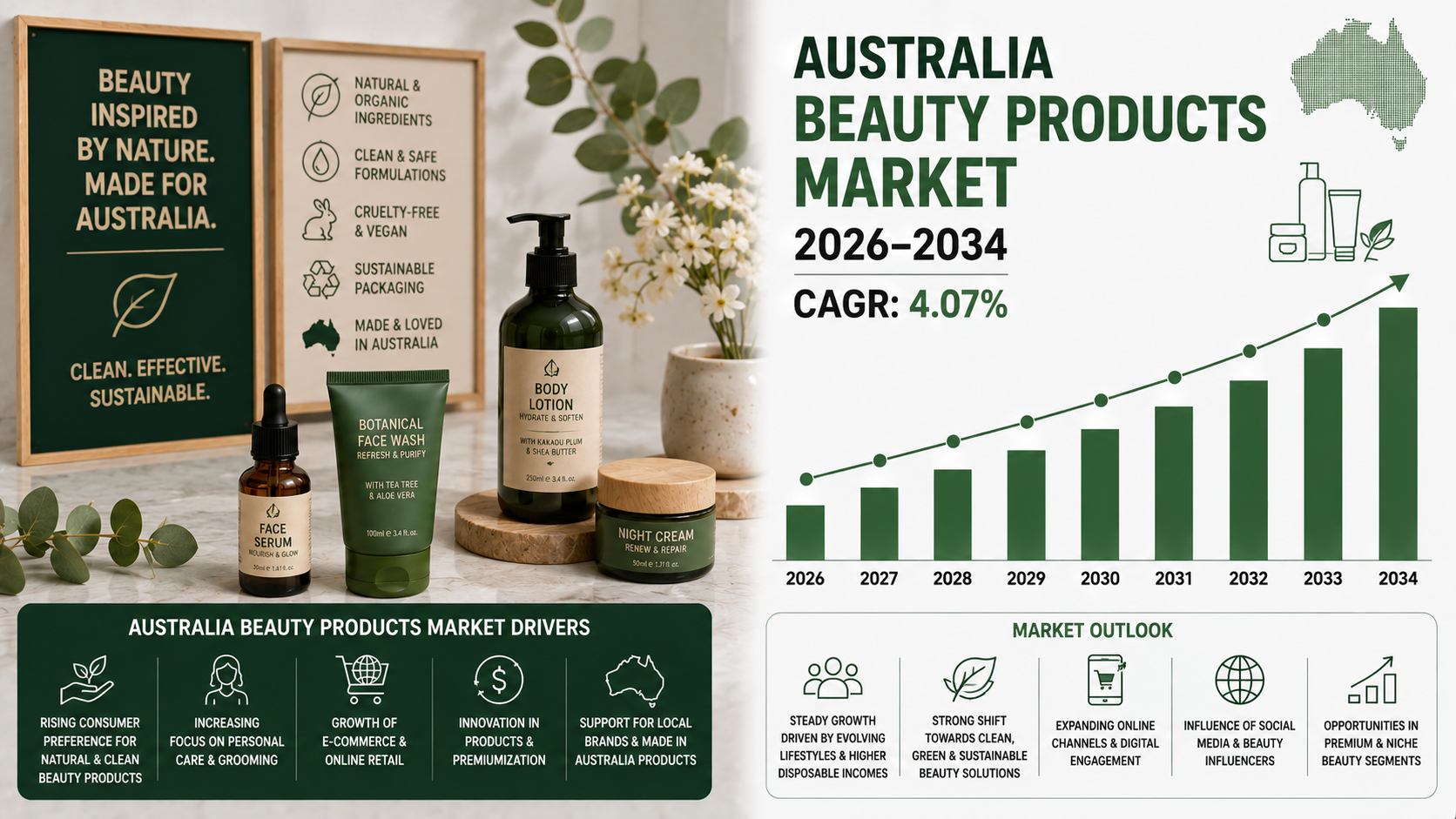
The Australia beauty products market size reached USD 15.5 Billion in 2025 and is projected to reach USD 22.1 Billion by 2034, growing at a compound annual growth rate of 4.07% from 2026–2034. The Australia beauty products market is expanding driven by rising consumer demand for sustainable and eco-friendly packaging, growing preference for personalised and health-integrated beauty formulations, and rapidly expanding online and offline distribution channels. Original & Mineral's 2024 partnership with Green Salon Collective rewarding salons for sustainability efforts, LA MAXIME's launch of the SkinGlow5 anti-aging skincare set featuring Australian botanicals including Kakadu Plum, and Kérastase's 2024 Australian market entry through in-store and online channels are collectively reinforcing the market's strong and sustained growth trajectory throughout the forecast period.
Market Trends
Focus on Sustainable and Eco-Friendly Packaging
Growing consumer awareness of environmental impact is compelling Australian beauty brands to adopt biodegradable, recyclable, and refillable packaging as both a regulatory compliance measure and a brand differentiation strategy. Leading brands are committing to carbon footprint reduction, take-back programmes, and eco-conscious shipping practices. Original & Mineral partnered with Green Salon Collective in 2024 to reward salons recycling metal salon waste, including foil and colour tubes, directly linking professional channel purchasing decisions to measurable sustainability outcomes across the Australian haircare market.
Increased Demand for Anti-Aging and Skin Care Solutions
Australia's ageing population and growing long-term skin health awareness are driving sustained demand for skincare products addressing wrinkles, fine lines, and elasticity loss. Brands are formulating with clinically validated actives including retinol, peptides, hyaluronic acid, and collagen to deliver both immediate and preventive benefits. In 2024, LA MAXIME launched the SkinGlow5 anti-aging set featuring Australian botanicals including Kakadu Plum, offering a five-step system delivering visible results within five days in a TSA-approved carry-on format.
Expansion of Distribution Channels and Accessibility
Growing availability of beauty products across both physical retail and e-commerce platforms is broadening consumer access to domestic and international brands across Australia. Major retailers are expanding store presence while direct-to-consumer brands leverage online marketplaces and social media for seamless purchasing. In 2024, Kérastase launched its luxury haircare range across Australian in-store and online channels, making science-backed formulations accessible to a significantly broader consumer base beyond specialty salon distribution throughout the national market.
Market Growth Drivers
Rising Influence of Social Media and Beauty Influencers
Social media platforms including Instagram, TikTok, and YouTube are powerful purchase decision drivers within Australia's beauty market, enabling influencers and brands to reach mass audiences through product tutorials, reviews, and viral trend campaigns. Younger consumers particularly rely on influencer recommendations when selecting skincare and cosmetic products. Rising digital engagement is sustaining brand awareness and accelerating product trial for both established multinationals and emerging domestic beauty brands, continuously expanding the addressable market across all product categories throughout the forecast period.
Growing Emphasis on Personalised Beauty Solutions
Demand for beauty products tailored to individual skin types, tones, and lifestyle needs is significantly reshaping Australia's market, compelling brands to develop customisable skincare regimens, foundation ranges, and hair care treatments. AI-based skin analysis tools and digital beauty consultations are making personalisation increasingly accessible and commercially scalable. Brands delivering inclusive, personalised product experiences are generating stronger consumer loyalty and premium pricing power, reflecting a decisive market shift away from one-size-fits-all formulations toward genuinely individualised beauty solutions across all distribution channels.
Rising Health and Wellness Integration in Beauty
Australian consumers are increasingly selecting beauty products that simultaneously enhance appearance and support skin and hair health through clean-label formulations enriched with vitamins, botanicals, minerals, and probiotics. Wellness-inspired beauty — including stress-reducing skincare and multifunctional products combining cosmetic and therapeutic benefits — is gaining strong mainstream traction. Brands emphasising science-backed, health-oriented formulations are capturing growing market share as consumers prioritise long-term wellbeing over short-term aesthetic results, reinforcing premiumisation and driving consistent revenue growth across the skincare and functional beauty segments.
Request for Sample Report: https://www.imarcgroup.com/australia-beauty-products-market/requestsample
Porter's Five Forces Analysis of the Australia Beauty Products Market
1. Threat of New Entrants — Moderate to High
E-commerce and direct-to-consumer platforms significantly lower distribution entry barriers, enabling new domestic brands and international labels to reach Australian consumers without the capital investment required for physical retail shelf placement
Growing consumer appetite for niche, clean-label, and Australian botanical-ingredient brands is creating commercially viable entry points for smaller producers competing on ingredient authenticity and sustainability credentials
Established multinationals including L'Oréal, Estée Lauder, and Procter & Gamble hold strong brand equity, retailer relationships, and marketing investment scale that create meaningful competitive barriers against new entrants at mass-market price tiers
2. Bargaining Power of Suppliers — Low to Moderate
Active ingredient suppliers including providers of retinol, hyaluronic acid, and native Australian botanical extracts hold moderate leverage given the specialised sourcing knowledge and certification requirements associated with premium and clean-label formulation ingredients
Packaging material suppliers face increasing scrutiny as brands transition to recycled, biodegradable, and refillable formats, creating moderate dependency on specialised sustainable packaging manufacturers with limited competing supply options
Large multinational beauty companies command global procurement scale that effectively constrains individual ingredient or packaging supplier leverage, while smaller domestic brands face proportionally higher supply-side dependency
3. Bargaining Power of Buyers — Moderate to High
Individual consumers exercise strong purchasing leverage through online price comparison across Priceline, MECCA, Sephora, and major e-commerce platforms, intensifying competitive pricing pressure across standard and premium product tiers
Retail channel buyers including pharmacy chains and beauty specialty retailers hold significant shelf placement leverage, compelling brands to invest in promotional co-funding, exclusivity arrangements, and in-store activation programmes to maintain retail presence
Social media-empowered consumers switch brands readily based on influencer recommendations and peer reviews, reducing brand loyalty and compelling continuous product innovation investment to retain existing customer bases
4. Threat of Substitutes — Low
Beauty products address fundamental personal care and cosmetic needs for which no genuinely functional substitute exists, as consumers cannot consistently replace formulated skincare, haircare, and colour cosmetics with non-commercial alternatives
DIY beauty and natural home remedy approaches represent a marginal substitution option for a small segment of highly ingredient-conscious consumers, but lack the efficacy, stability, and safety assurance of commercially formulated products
The growing integration of wellness and beauty — driving demand for multifunctional products delivering both cosmetic and therapeutic benefits — is further expanding the category's essential positioning and reducing substitution risk across core product segments
5. Competitive Rivalry — High
Multinationals including L'Oréal, Estée Lauder, Beiersdorf, Colgate-Palmolive, Henkel, and Procter & Gamble compete intensely across skincare, haircare, and cosmetics segments through product innovation, influencer marketing, retail network investment, and sustainability credential development
Domestic brands leveraging Australian botanical ingredients and clean-label positioning — including O&M, LA MAXIME, and emerging DTC labels — are creating competitive differentiation that challenges multinational mass-market offerings in the premium and natural product tiers
The rapid expansion of online distribution is intensifying rivalry by enabling international brands to enter the Australian market without local manufacturing investment, progressively broadening the competitive field across all product categories and price segments
Market Segments
By Type:
Facial Care
Makeup Remover
Hand Care
Depilatories
Skin Care Products
Hair Care Products
Makeup and Perfume
By Distribution Channel:
Online
Offline
Supermarket and Hypermarket
Specialty Stores
Drug Stores
By Region:
Australia Capital Territory & New South Wales
Victoria & Tasmania
Queensland
Northern Territory & Southern Australia
Western Australia
Competitive Landscape
The market research report has provided a comprehensive analysis of the competitive landscape in the Australia beauty products market. Competitive analysis covering market structure, key player positioning, top winning strategies, competitive dashboard, and a company evaluation quadrant with detailed profiles of all major companies has been included in the report. Key participants including Beiersdorf AG, Colgate-Palmolive Company, Estée Lauder Inc, Henkel Australia Pty. Ltd., L'Oréal Paris, McPherson's, and Procter & Gamble compete across product innovation, sustainable packaging investment, influencer marketing, e-commerce channel development, and specialty retail partnerships throughout the Australia Capital Territory & New South Wales, Victoria & Tasmania, Queensland, Northern Territory & Southern Australia, and Western Australia regional markets.
Latest News and Developments
May 2026: Kmart expanded its beauty category with the launch of nearly 200 SHEGLAM makeup products across Australian stores, reflecting surging demand for affordable beauty products among Gen Z consumers. Several stores reportedly sold out shortly after launch due to exceptionally strong consumer demand.
April 2026: News Corp Australia launched “Glamour Australia,” a new beauty and lifestyle media platform targeting younger consumers through digital beauty, skincare, and fashion content. The global Glamour brand currently reaches approximately 48 million readers worldwide.
March 2026: Online beauty retail continued expanding rapidly across Australia as retailers increased investment in AI-driven personalization, virtual try-on tools, influencer marketing, and omnichannel beauty shopping experiences.
February 2026: Woolworths expanded its affordable cosmetics offerings after Australian-owned Poni Cosmetics sold approximately 20,000 units within the first week of launch in stores. Products were priced between approximately AUD 12–25, highlighting strong demand for value-focused beauty products.
January 2026: Australia’s skincare segment strengthened further due to rising demand for anti-aging products, clean beauty solutions, and dermatologist-backed skincare routines. Industry data showed skincare remained one of the country’s largest beauty categories.
December 2025: Beauty brands increased focus on multifunctional cosmetics, skincare-infused makeup, and sustainable packaging as Australian consumers increasingly preferred eco-conscious and ingredient-transparent beauty products.
November 2025: Australian beauty retailers accelerated expansion of online fulfillment networks and loyalty programs as social commerce and mobile-driven beauty purchases continued rising nationwide.
September 2025: Industry reports highlighted increasing demand for Korean beauty-inspired products, vegan cosmetics, and natural skincare formulations among Australian consumers, particularly within younger demographics.
August 2025: Major beauty retailers expanded premium fragrance and skincare offerings as luxury beauty spending remained resilient despite broader retail cost pressures.
July 2025: Australian beauty and personal care retailers strengthened investment in influencer collaborations and TikTok-led marketing campaigns to increase engagement with Gen Z and millennial consumers.
2025: Organic and clean-label beauty products gained stronger market traction across Australia as consumers increasingly prioritized cruelty-free, vegan, paraben-free, and sustainably sourced personal care products.
Note: If you require any specific information that is not currently covered within the scope of the report, we will provide the same as a part of the customisation.
Speak to an analyst for a customized sample report: https://www.imarcgroup.com/request?type=report&id=28878&flag=C
About Us
IMARC Group is a global management consulting firm that helps the world's most ambitious changemakers to create a lasting impact. The company provides a comprehensive suite of market entry and expansion services. IMARC offerings include thorough market assessment, feasibility studies, company incorporation assistance, factory setup support, regulatory approvals and licensing navigation, branding, marketing and sales strategies, competitive landscape and benchmarking analyses, pricing and cost research, and procurement research.
Contact Us
IMARC Group
134 N 4th St., Brooklyn, NY 11249, USA
Email: [email protected]
Tel No.: (D) +91 120 433 0800
United States: +1-201-971-6302
Comments
Log in or sign up to join the conversation.