

Fifty-five years ago this month, US President Nixon closed the gold window. It was presented as temporary, but it became permanent and launched the dollar into a half-century of dominance nobody sitting in the room that weekend would have bet on. Now, on the anniversary, the cracks are getting harder to paper over.
Let's go back to the beginning because the origin story explains everything that follows.
How We Got Here
The Bretton Woods agreement was struck between Dexter White for the US and John Keynes, nominally for the UK but really negotiating on behalf of debtor countries everywhere. The deal pegged the dollar to gold at $35 an ounce, and everyone else pegged to the dollar. Simple, elegant, and doomed. It institutionalized power relationships as if the post-war situation was going to be sustained. Although Bretton Woods allowed for adjustments of the pegs, political considerations made them more rigid.
Still, it worked until it didn't. By the late 1960s, the US was running persistent balance-of-payments deficits, and foreign central banks were sitting on more dollar claims than Fort Knox could cover. Europe, in particular, wanted more gold than Nixon was willing to hand over.
What followed Nixon's unilateral announcement, which some argue was a default, was two years of improvisation: The Smithsonian Agreement. The snake in the tunnel. A string of half-measures trying to rebuild some version of fixed rates. All of it fell apart by 1973. Currencies floated, and the interesting part is what didn't happen next: the dollar didn't lose its throne.
Why the Dollar Stayed King
Nothing else was deep enough, liquid enough, or legally robust enough to take the dollar's place. The mark and yen were regional currencies playing a global role they weren't built for. Sterling was already a memory of empire. The dollar's advantage was self-reinforcing then, and it still is now. That's not an accident of history. It's a structural moat.
The early weaponization of the dollar, against the US special ally, the UK, gave birth the offshore dollar, dubbed the Eurodollar market. US banks booking deposits in London to dodge domestic rate ceilings, foreign holders (the Soviets included) parking dollars offshore to keep them out of Washington's reach. In the 1956 Suez Crisis, Washington had already shown it would use the dollar as leverage. It threatened to withhold IMF support that London sought and possibly sell sterling from its reserves unless the UK pulled out of Egypt.
The Eurodollar system underpins global trade finance to this day. The Federal Reserve has supported the market that it does not regulate. The Federal Reserve has standby liquidity swap lines with several major central banks and in past crisis has offered the facility to other central banks on ad hoc basis.
The Federal Reserve launched the Foreign and International Monetary Authorities repo facility in 2022. It allows approved foreign central banks and international monetary authorities to temporarily exchange their Treasury holdings for dollars. Quantitative Easing (QE) and broad dollar liquidity easing during the Great Financial Crisis and again during the pandemic, also support the offshore dollar market.
Weaponization
September 11 changed the calculus. Treasury's Office of Foreign Assets Control turned the dollar's centrality into an actual policy weapon, cutting terrorist financiers off from SWIFT and correspondent banking. That started as counterterrorism. It didn't stay there. Iran, Venezuela, North Korea, Russia, didn't quit the dollar system. They got fired from it. Secondary sanctions made sure other countries fell in line too.
Freezing roughly $300 billion in Russian central bank reserves after 2022 was a different order of escalation entirely. The message landed everywhere, not just in Moscow: Dollar reserves, and euro reserves too, are not sovereign in any absolute sense. They sit at the pleasure of Washington and its allies. When the US then threatened Canada and Denmark, both NATO members, that drove the point home even harder. If treaty allies aren't insulated, nobody is.
You can see the response building in the data. IMF COFER figures show the dollar's share of global reserves sliding from roughly 72% at the turn of the century to under 58% today. A recent Official Monetary and Financial Institution Forum (OMFIF) survey found emerging-market central banks actively planning to trim dollar allocations over the next few years, with the euro and yuan the likely beneficiaries, and real curiosity building around smaller currencies like the Singapore dollar.
Gold is having its own moment in this story. A net 30% of central banks surveyed expect to add to gold holdings over the next one to two years. If you're a reserve manager worried about confiscation risk, bullion is the obvious answer. Nobody can freeze what sits in a vault at home.
The Counterweight Nobody Wants to Talk About
Yet this isn't the whole picture. The US runs a current account deficit near $1 trillion a year. By simple accounting identity, foreigners have to absorb an equivalent volume of US assets: bonds, equities, real estate, direct investment. There's no way around this arithmetic.
And the money keeps showing up. Foreign investors bought $1.43 trillion of US stocks and bonds last year, up from $1.2 trillion in 2024 and $840 billion in 2023. That's not the behavior of capital fleeing the dollar system. That's capital voting with its feet, over and over again, for dollar assets.
So, which is it? Is the dollar being abandoned, or is it still the destination of choice? The honest answer is both, just not in the way headlines suggest.
The real question isn't whether foreign capital keeps showing up. It's which assets it buys and at what price. A rotation out of Treasuries into equities, or out of long-duration debt into bills, would hit the term premium and raise the cost of financing the deficit. That's the mechanism worth watching. Not some cinematic exit from dollar assets that never actually arrives. De-dollarization is a slope, not a cliff, and the slope's angle is what matters here, not the direction.
Where This Leaves Us
Fifty-five years on, the dollar is still the world's number one reserve currency, the transaction currency of choice, and the ubiquitous unit of account. But something intangible, and essential, has slipped away: trust. The weaponization of the dollar crossed a line somewhere along the way, and the broader turn toward economic nationalism and short run transactionalism has alienated exactly the allies who used to provide the system's quiet stability.
Expect the erosion in reserve share to continue even if at glacial speeds. Expect alternative payment systems to keep chipping away at pieces of monetary sovereignty. But a genuinely multipolar currency order, if it ever arrives, is a story measured in years, not months.
And it would be naive to think the midterms this year, or the 2028 election, arrest any of this. The dynamic is bigger than any single election cycle. It's bigger than any single administration.
Bannockburn World Currency Index
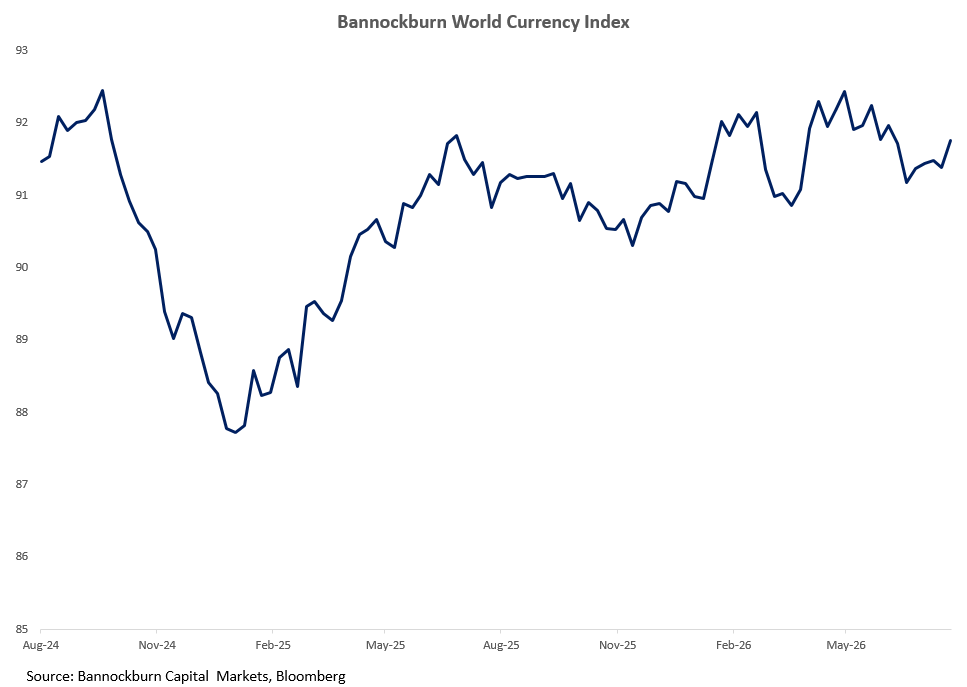
Bannockburn's World Currency Index is composed of the currencies of the dozen largest economies--half of which are from high-income countries and half from emerging markets. In July, it recouped about half of the 1.1% it lost in June. It is up about 0.70% this year after it rose by 3.7% last year, which was the first increase since 2020.
Turning to the components of the index, the greenback itself was unchanged, of course. It accounts for about a third of the index and dampens the volatility of the BWCI. The other five G10 components rose against the dollar. The euro's roughly 0.65% gain was the least. The others rose by at least 1%. The intervention on July 30 helped lift the yen by nearly 2%, which was the strongest of the major currencies.
Turning to the emerging market components, two of the six fell. The Russian ruble fell the most in the index, losing about 1.15%. The Indian rupee fell by about 0.75%. Intervention seemed most effective in South Korea where the won rose by about 7.7%, making it the strongest component. Yet, its weight is slightly less than 2.0%, means marginal impact. . The Chinese yuan, which has about a 21.5% weight rose by 0.25%, while the Brazilian real, with almost a 2.5% weight, rose by about 1.65%.
BWCI rose from late June through the middle of July. It stalled and drifted lower before the combination of the uninspiring Federal Reserve and BOJ intervention weighed on the greenback broadly. BWCI finish July at its best level since mid-June.
U.S. Dollar: The dollar fell against the G10 currencies in July but the Swiss franc. The greenback had been mixed until late in the the month when the market took the dollar down after the FOMC failed to convince the market that is was serious about reaching the 2% inflation target, which it has missed more more than five years. Rhetoric has less heft than action and what was expected to be a hawkish hold turned out saw US short-term rates fall despite the three regional presidents dissents in favor of an immediate hike. The following day, it appears the Bank of Japan intervened. A preliminary review of the changes in the Bank of Japan's balance sheet suggests it sold almost $53 bln, and reports suggest that as was the case earlier this year, the Federal Reserve checked prices and indicated it was doing so on behalf of the US Treasury. The US Q2 26 GDP slowed to 1.5% from 2.1% in Q1. It was dragged down by trade (-1 percentage point) and inventories (-2/3 of a percentage point). Real final sales to private domestic purchasers (excludes trade, inventories, and government) accelerated to 3.9% from 1.7%. Consumer spending rose 3.2% the most in three quarters. The US labor market is proving resilient, with the four-week moving average is below 200k for the first time in almost four years. The Fed funds futures imply about 36 bp tightening, little changed on the month.
Euro: The euro rose by about 0.7% in July, which pared its loss to about 2.1% for the year. The regional economy continues to struggle under three shocks, China's growing market share, especially in autos, the energy shock, emanating from the war in the Middle East, and the ongoing US tariff threats. In addition to the ongoing investigation into "excess capacity" the US has threatened an investigation into the EU's $1 bln (890 mln euros) fine on Google for self-preferencing and app store anti-steering restrictions, with a new levy the expected outcome. The eurozone economy continues to struggle. After stagnating in Q1 26, the eurozone grew by 0.2% in Q2 26, while the year-over-year growth is uninspiring at 0.5%. Inflation remains elevated and the preliminary July estimate was 2.9%. It was at 1.9% before the Middle East war began. August, the month of summer vacations in Europe, will likely be quiet on the political front. However, Le Pen is leading the opinion polls for next spring's presidential election. There are three state elections in Germany in September, and the AfD could win its first state (Saxony-Anhalt). There is speculation at Italy's Meloni will call for national elections next April.
(As of July 31, indicative closing prices, previous in parentheses)
Spot: $1.1527 ($1.1384) Median Bloomberg One-month forecast: $1.1512 ($1.1493) One-month forward: $1.1541 ($1.1398) One-month implied vol: 5.2% (5.6%)
Japanese Yen: The 10-year Japanese government bond yield has risen by slightly more than 70 bp this year, well more than any other G10 country, including the US, where the 10-year Treasury yield has risen by about 56 bp. Yet, the yen has continued to trend lower, reaching new 40-year low in late July. While the yen is sensitive to interest rate developments, many observers are looking in the wrong place. The rolling 60-day correlation between changes in the dollar-yen exchange rate and changes in US two- and 10-year yields is 0.25-0.40, while the correlation with changes in Japanese rates is less than 0.10. Moreover, the correlations with US interest ratees is greater than the correlation with the two- and 10-year interest rate differentials. The core measure of CPI (excludes fresh food) has not been above the 2% target this year. Among the G10, only Switzerland has lower inflation than Japan. Nor will another quarter-point rate hike necessarily make much of a difference, given the external factors, like elevated oil prices, ongoing Middle East tensions, and a hawkish Fed outlook. The Japanese government opened a new front in efforts to support the yen and JGB market. It wants Japanese pension funds and households to boost domestic investment. And that is what appears to be taking place this year. Weekly data shows that Japanese investors have sold about JPY24.3 trillion (almost $153 bln) of foreign bonds this year after purchasing JPY10.1 trillion in the same period last year. Equity flows are considerably less, but Japanese investors have bought about JPY9.6 trillion of foreign equities this year compared with JPY6.2 trillion in the year ago period. Preliminary indications suggest the Bank of Japan intervened on July 30 to sell almost $53 bln to support the yen. The US stepped up its verbal intervention into the month end and the greenback finished July below the 200-day moving average (near JPY158) for the first time since last October.
Spot: JPY157.40 (JPY161.74) Median Bloomberg One-month forecast: JPY158.81 (JPY160.11) One-month forward: JPY157.04 (JPY161.35). One-month implied vol: 9.1% (6.8%)
British Pound: The rally that began from the year's low in late June ($1.3140) continued through mid-July when sterling reached a two-month high, near $1.3560. It stalled amid a broader US dollar recovery and fell back to $1.3300, meeting a technical retracement target. However, it recovered and reached almost $1.3500 at the end of the month. As widely expected, the UK got its seventh prime minister in the decade since the Brexit referendum in 2016. Prime Minister Burnham nearly immediately announced several small measures meant to signal concern about "affordability", including the removal of the value-added tax from electric bills, capping bus fares, and reduction of taxes for pubs, social clubs, and live music venues. The new government inherits a fiscal situation that leaves minimal flexibility. The government borrowed GBP2.7 bln more than the Office for Budget Responsibility forecast in March in the first three months of the new fiscal year (revenue was GBP2.4 bln higher but spending rose by GBP3.6 bln). Higher market interest rates will boost the debt servicing costs. After growing by 0.6% quarter-over-quarter in Q1 26, matching the strongest since Q1 24, the economy likely slowed to a 0.1%-0.2% in Q2 26 and in the second half of the year. The Bank of England stood pat at the July meeting, and the swaps market has about a 30% chance of a hike at the next meeting in September.
Spot: $1.3483 ($1.3200) Median Bloomberg One-month forecast: $1.3378 ($1.3235) One-month forward: $1.3485 ($1.3205) One-month implied vol: 5.6% (6.3%)
Canadian Dollar: The US dollar reached nearly CAD1.4250 at the end of June, its highest level since April 2025. As the US two-year premium over Canada narrowed, the greenback pulled back to slightly below CAD1.4000 in late July. After contracting by 1.0% in Q4 25 and -0.1% in Q1 26 (annualized rates), growth appears to have returned in Q2 26, helped by an increase in government spending. US trade policy is still a headwind, and it may be intensifying if the 50% tariffs threatened on a $20 bln of variety of Canadian products (e.g., electrical equipment, packaging, hockey gear, beer, and dairy) that could be implemented as soon as August 19. Under Prime Minister Carney's leadership, Canada is taking strong measures that will diversify exports away from the United States. Still, his Liberal Party needs to win at least one of three byelection in late August to retain its slim control of the House of Commons. The Bank of Canada cut its overnight lending rate (now 2.25%) last October. It will likely remain on hold in the coming months, but the swaps market is pricing in about a 70% chance of a hike before the end of the year.
Spot: CAD1.4021 (CAD 1.4196) Median Bloomberg One-month forecast: CAD1.4010 (CAD1.4159) One-month forward: CAD1.4005 (CAD1.4192) One-month implied vol: 4.0% (4.5%)
Australian Dollar: The Australian dollar recovered from a three-month low at the end of June ($0.6865) to $0.7045 at the end of July. It has risen in four of the past five weeks, and is up 5.25% this year, which is the second-best in the G10 behind the Norwegian krone (up about 6.25%). The Reserve Bank of Australia hiked rates three times between late February and late May. The economy remains resilient and June employment data and preliminary July PMI suggest that the rate hikes have had minimal impact on the economy, including private sector credit, household spending, and inflation expectations. Meanwhile, Australia's goods trade balance is deteriorating. The May deficit, reported in early July, of A$3.02 bln, the largest monthly gap since 2015. Exports fell 6.9% in May The average monthly trade surplus fell to A$820 mln in the first five months of 2026 compared with an average of nearly A$4.2 bln a month in the January-May 2025 period. Goods exports have fallen by an average of 0.1% this year, while goods imports have soared by an average of 2.8% a month. The disruption from the Middle East war has seen prices for fuel and lubricants rise dramatically, but the softer than expected June and Q2 CPI saw the futures market downgrade the likelihood of another hike this year to about 50%.
Spot: $0.7019 ($0.6896) Median Bloomberg One-month forecast: $0.7009 ($0.6964) One-month forward: $0.7015 ($0.6893) One-month implied vol: 7.3% (7.7%)
Mexican Peso: Within the broad consolidation seen last month, the dollar approached the upper end of our target range (MXN17.58-MXN17.65 in the July monthly) and remained slightly below the June high (near MXN17.6765). At the end of the month, the dollar pushed through the shelf it had forged in the MXN17.35-MXN17.37 area and fell slightly through MXN17.3150. The Mexican economy found better traction in Q2. After contracting by 0.6% (quarter-over-quarter) in Q1 26, the Mexican economy grew by 1.3% in Q2. However, growth is uneven. Consumption slowed as did government spending. The external sector improved. After it recorded trade deficit of a little more than $1 bln in Q1 26, Mexico's trade balance swung back into surplus in Q2 26 to the tune of $10.87 bln. That was the largest quarterly trade surplus since the end of 2020. The June unemployment rate rose to 2.9%, the highest since September 2024. On the other hand, the headline and core inflation rates have slipped back into the 2-4% target range. The central bank meets on August 6 and the swaps market has about a 40% chance of a hike discounted, which seems a bit rich. Lastly, we expect Mexico to acquiesce to US pressure to boost steel tariffs and offer greater protection for domestic truck makers.
Spot: MXN17.3426 (MXN17.5053) Median Bloomberg One-month forecast: MXN17.39 (MXN17.5310) One-month forward: MXN17.4470 (MXN17.5490) One-month implied vol: 7.6 (8.5%)
Chinese Yuan: The JP Morgan Emerging Market Currency Index fell for the second consecutive month in July. It was the first back-to-back monthly decline since the end of 2024. The Chinese yuan rose by about 0.5% on the month. Still, year-to-date the RMB has appreciated by about 3.5%, which leads the region and is the fourth strongest emerging market currency this year behind the high-yielding Colombian peso, Brazilian real. and Mexican peso The PBOC gradually reduced the dollar's fix over the course of the month. It fell from CNY6.8109. at the end of June to a 3.5-year low of CNY6.7892 on July 30. China's Q2 26 growth disappointed at 4.3% year-over-year, its slowest pace since the end of 2022. Many observers anticipate new measures to come after the conclusion of the late July Politburo meeting, but it may opt for implementing previously announced efforts. Meanwhile, given the shifting US tariff regime, the average effective US tariffs on China appears to have fallen to 25.5%-26% from almost 34% at the end of last year, according to Penn Wharton Budget model. Moreover, the pending Section 301 excess-capacity investigation covering 16 economies including China is still outstanding and could raise Chinese electronics rates by another 10 points before year-end. The US and China ae reportedly moving toward establishing investment and trade boards ahead of the likely trip by President Xi to the US in September. Chinese shipments rare-earth magnets to the US remain below pre-trade war levels. Beijing has also weaponized its near monopoly it enjoys on processing critical materials to the detriment of Japan and Europe, as well.
Spot: CNY6.7515 (CNY6.8005) Median Bloomberg One-month forecast: CNY6.7525 (CNY6.7900) One-month forward: CNY6.7525 (CNY6.8121) One-month implied vol: 2.3% (2.3%)



Comments
Log in or sign up to join the conversation.