


Strong Aussie GDP data has AUD/USD testing 0.7200. Can today’s U.S. jobs report keep the pair’s rally alive?
The Australian dollar (AUD/USD) trades above the key 0.7200 level early on Friday, with recent gains in the pair driven by robust domestic economic growth likely to be put to the test later today when the U.S. Labor Department publishes its eagerly awaited August employment report.
AUD/USD Market Positioning Following Domestic GDP Data
The pair’s move higher this week started on Wednesday after data released by the Australian Bureau of Statistics (ABS) showed the economy growing 0.4% in the June quarter, slightly surpassing economist forecasts and further raising the prospect of the Reserve Bank of Australia (RBA) rising interest rates when it meets later this month. On an annual basis, the economy grew at 2.1%, also nudging past consensus estimates.
This latest data combined with sticky domestic inflation continues to support the AUD/USD as expectations of a September rate hike grow. Following this week’s robust gross domestic product (GDP) numbers, the chance of the RBA increasing interest rates this month climbed to around 70%, up from a coinflip before the release.
U.S. Employment Report, AUD/USD’s Next Test
Despite recent bullish momentum, the pair’s next major test comes later today when the Labor Department publishes U.S. employment data for August. Traders will particularly pay close attention to last month’s payroll data, with a stronger-than-expected print potentially pausing the AUD/USD’s recent bullish bias on Greenback strength as traders ramp up expectation that the Federal Reserve will lift its benchmark funds rate later this month, especially following Fed Chair Kevin Warsh’s hawkish remarks at the Jackson Economic Symposium Hole last week.
However, a soft U.S. jobs report would temper expectations of a September rate hike and likely act as a further bullish catalyst for the Australian dollar. Ahead of today’s labor market data, money markets are pricing in a 50% chance that the Federal Reserve will hike rates later this month, helping to create an interest rate expectation differential between the Fed and RBA.
AUD/USD Technical Structure
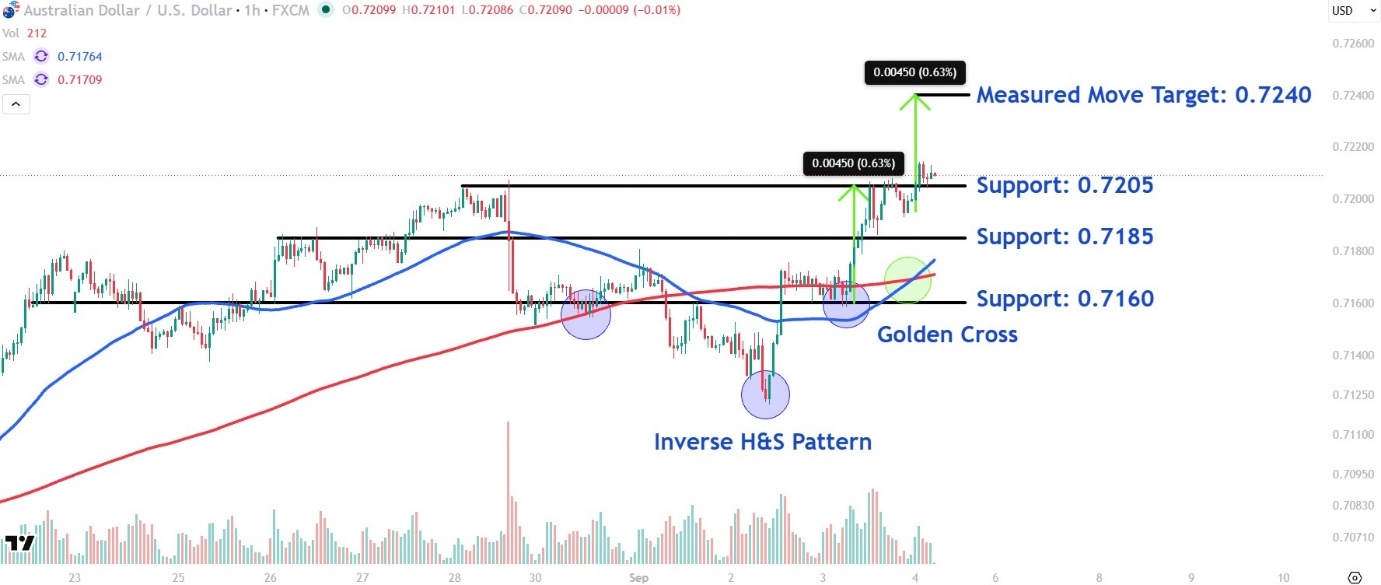
The pair has carved out an inverse head and shoulders pattern this week below the 200 moving average (MA), a chart formation indicating a resumption of the longer-term move higher. It’s also worth pointing out the 50 MA crossed back above the 200 MA in early trade on Friday to form a bullish golden cross, a signal suggesting further upside.
AUD/USD Price Chart
H3 Key AUD/USD Overhead Area to Eye
To project a bullish overhead target, traders can use the measured move technique. When applying this analysis, we calculate the distance of the pair’s most recent leg higher and add that amount from Thursday’s minor retracement low. This forecasts a target of 0.7240 (0.0045 + 0.7195), implying around 30 pips of upside from the pair’s current trading levels.
H3 Important AUD/USD Support Levels Worth Monitoring
The first support level worth watching sits around 0.7205. This location, which previously marked resistance, will likely attract significant attention near recent swing highs on the chart.
Further pullbacks could bring the 0.7185 level into play. Market participants may look to open long positions in this region near a horizontal line that links Thursday’s minor retracement with two prominent peaks that formed on the chart late last month.
A more significant move lower could see the pair test support around 0.7160. Traders may seek to accumulate in this location near a trendline that connects multiple peaks and troughs on the chart between late August and early September.
AUD/USD Hawkish RBA Bets Trump Chances of September Fed Hike
This week’s better-than-expected Australian economic growth numbers continue to increase bets that the RBA will raise interest rates this month, underpinning the AUD/USD’s recent bullish price action. While the chances of a September Federal Reserve rate hike have also increased following last week’s Jackson Hole event, they remain a coinflip but could rise if today’s U.S. jobs report comes in hotter than market participants expect.
Sources:
https://www.abs.gov.au/media-centre/media-releases/australian-economy-grew-04-june-quarter
https://www.abc.net.au/news/2026-09-02/gdp-june-quarter-2026/107106354
https://www.cmegroup.com/markets/interest-rates/cme-fedwatch-tool.html

Comments
Log in or sign up to join the conversation.