


Hopefully it comes across how important I think it is to have small exposures to various types of strategies in case something breaks or just hits a rough patch. The context here is alternatives or niche market segments like catastrophe bonds, not plain vanilla equities or simple fixed income exposures like T-bills.
Lately, we've been looking at closed-end funds a little bit more. They're interesting but have their drawbacks, notably the extent to which they erode because they're not being able to keep up with their distributions.
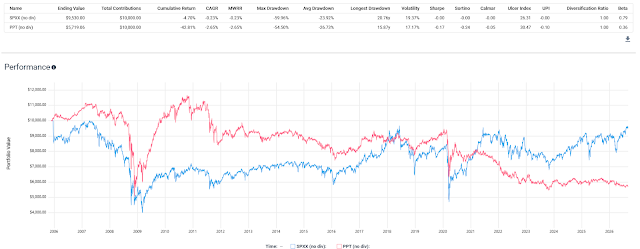
The compounding for both funds- one is equity-oriented, and the other is fixed income- has been negative. It's not so bad with SPXX, but with PPT the value of the position has been cut almost in half. That sort of slow bleed isn't the most difficult part of owning closed-end funds, though.
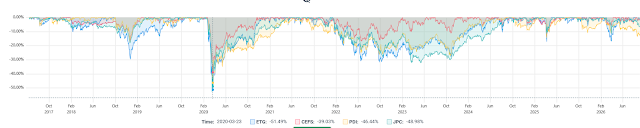
The chart has three longstanding closed-end funds, and CEFS is an ETF that owns closed-end funds. The chart captures the declines for all four of them during the COVID crash. CEFS had the mildest decline at 39%, and ETG clocked in with the biggest decline at 51%. Those declines occurred at VBAIX was down 22%. For a little more context, at that same COVID crash low, the Technology Sector SPDR (XLK) was only down 31%.
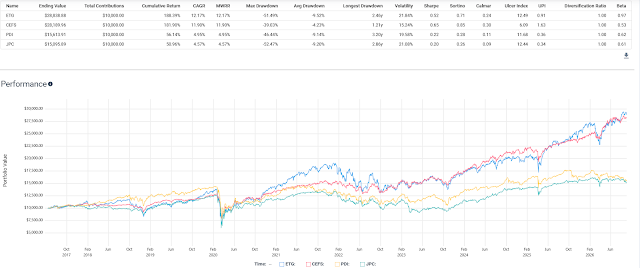
On a total return basis, they compound out just fine. Note that PDI and JPC are fixed income funds. I'm not saying they are great funds or even good funds, just that they function just fine over the long term. The episode in 2020 is typical of how they behave during various types of market declines.
JPC was down 76% during the financial crisis. In the context of a 60/40 portfolio, if someone had 10% of their portfolio in JPC for some extra yield back then, which might seem reasonable, 30% in AGG and 60% in SPY, they would have been down 44% at the GFC low point versus a 36% decline on a price basis for a more straightforward AGG/SPY combo. On a price basis, JPC is far below its 2007 high. On a total return basis, it had recovered by mid-2011.
Occasionally, closed-end funds get absolutely torched. Would you have sold JPC after a 70% decline? Someone did. Would being down 44% in a down 36% world have caused you to sell? JPC's 25% price-only decline in 2022 seems tame by comparison. JPC was down 19% in price only in 2018, and most of that decline occurred before the market crash in December of that year. CEFs can be a very wild and painful ride.
Just eyeballing the declines, they seem faster and sharper than with crazy high-yield funds from YieldMax and the others. Copilot validated that observation.
Since 2000, no closed-end funds have outright failed, meaning none have gone to zero, but having anything beyond a small allocation seems to be inviting anguish when the next panic or semi-serious decline comes. In 2022, there weren't any single-stock covered call funds that were around for the entire year, but there were a few broad-based covered call funds, and they did a little better than the cash index and much better than most closed-end funds.

The above is total return, and below is price only.

Closed-end funds and derivative income funds have different kinds of moving parts, so they take different kinds of risks. It's not that they both couldn't go down in the same manner, but 2022 shows they don't have to. I don't think small allocations to each, like only 5% to get extra yield as part of a bridging strategy, equate to loading up on the same risk. That sentence isn't clear enough; I mean 5% to a closed-end fund and 5% to a crazy high yielder that doesn't take crazy CEO risk (Tesla (TSLA) and Strategy). I think you could go a little heavier into derivative income funds that reference broad indexes and that don't "yield" 30-40%.
I see comments on a lot of Barron's articles where people make it seem like they have heavy allocations to CEFs. That seems like a very difficult way to make a living. Keep allocations small.


Comments
Log in or sign up to join the conversation.