


We would contend that the recent U.S. election shock, combined with the immediately following stock-market shock, has less to do with politics, and more to do with financial fundamentals and market technicalities, and that the two shocks have little to do with one another except in rather oblique ways and connections. That is not to say they are entirely unconnected.
The big mistake for Donald Trump was his campaign promise about ridding the U.S. of “forever wars.” That was a pledge American voters took very seriously, and they took the breaking of that pledge even more seriously.
Trump may be correct (I personally agree) that allowing Iran to have a nuclear weapon is not negotiable. But in light of his campaign pledge he owed the American people a dialog, a “fireside chat.” And the fact that in his campaign he alluded to matters like this being overreaches of presidential constitutional power, a lot of his own constituents believe he owed us permission from the constitution and perhaps even a declaration of war.
One thing this election put in focus is that there are still two basic divisions in America. One is the investor class. The other is everybody else. This in turn has ramifications about how the baby boomers, Trump’s generation, are viewed by everyone else. It is not good public relations, in Donald Trump’s shoes, to be presenting the hard-knocks image of “if you want something in life, go out and earn it like I (err…my dad) did,” if you inherited a huge business from the old man, and then reinforce that image as president by building half-a-billion-dollar ballrooms, gilded everything, and giant arches. This is a big problem for baby boomers in general who, even if they are not part of the investor class, are backed up by social security, while less senior generations watch that institution tremble like a Japanese nuclear power plant during an earthquake and wonder if the lights will still be on by the time they get there to collect.
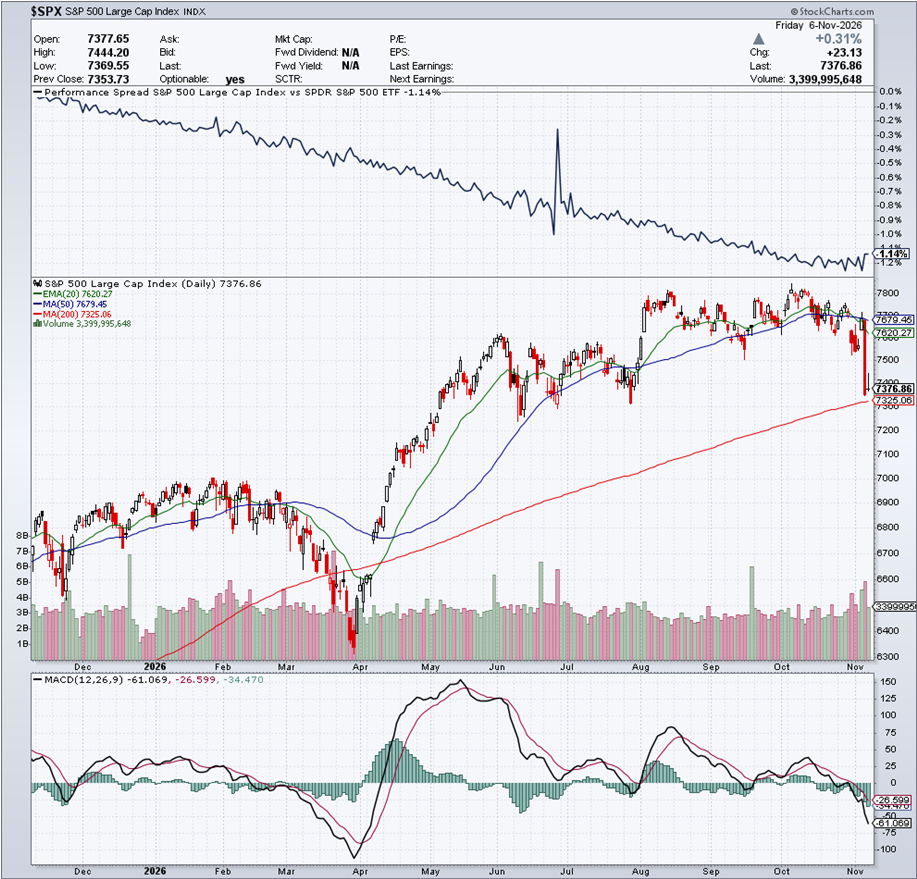
It is said by many technical experts that it is not so much the extent of the decline in a drawdown that matters, but rather the recovery that follows. What was peculiar about this post-election market activity is that the initial reaction was positive, and a lot of the financial media made it seem as though the market was cheering the election results. But it didn’t last. By Thursday, while the Dow was up, the rest of the market was not—then everything sank. On Friday chips recovered, but breadth lagged and the rest of the market was mostly mediocre.
As for the economy, what of the AI bubble? Yes, it is a whole lot of financing measured in trillions of dollars that has come on hugely and swiftly, and there are grave considerations on measuring associated capital expenditures against their expected returns and measuring in a legitimate way, “is this a business in terms of the return being adequate to justify the investment?” There are questions about the debt backing this. But is it logical to think worries about AI debt combined with “election-shock” got us the recent seismic activity in the markets?
Maybe.
But let’s also consider a more prosaic explanation or two. Even before the Iran war came along, there was a lot going on in the energy sector, where rising prices create the same ubiquitous damage as rising interest rates (the price of money). Both leave nothing and no one unaffected. The Iran war, however, provided a pronounced punctuation to the oil shock, however, and now, in some ways, it has permanently altered the cost of energy as new and longer transportation routes to avoid Hormuz have been adopted. Also, the sanctions managed by Secretary Bessent live on and introduce a variety of economic drags internationally beyond Iran.
So yes, we started with a supply shock, effects of which were made worse by the already ongoing war between Russia and Ukraine (such as diesel refining), and that put a dent in what industrial demand and gross margins might have been without that shock, and then—and here’s the point I think has been overlooked—we went on to build a significant part of the economy out of this war in and of itself. Now that that war is potentially winding down (although that could always change in a major way quickly and without notice), its absence could now become a mini-headwind in itself.
So, all this fed into the elections, and now the OUTCOME of the election is forming another shock to reckon with. Hence, rallies one day, craters the next.
There’s not much in the way of progress likely to be made on things as radical as “Medicare for all,” eliminating the Senate and the presidency, packing the court, and so on while Trump is still president, but two years isn’t a long time, and markets discount six months to a year out and even longer. So, these are going to be big factors. “Medicare for all” is an idea that could add two trillion per year to federal spending. How big an impact is that on credit markets, deficits, debt, interest, etc.? Stay tuned, and don’t expect the ride to be smooth.


Comments
Log in or sign up to join the conversation.