

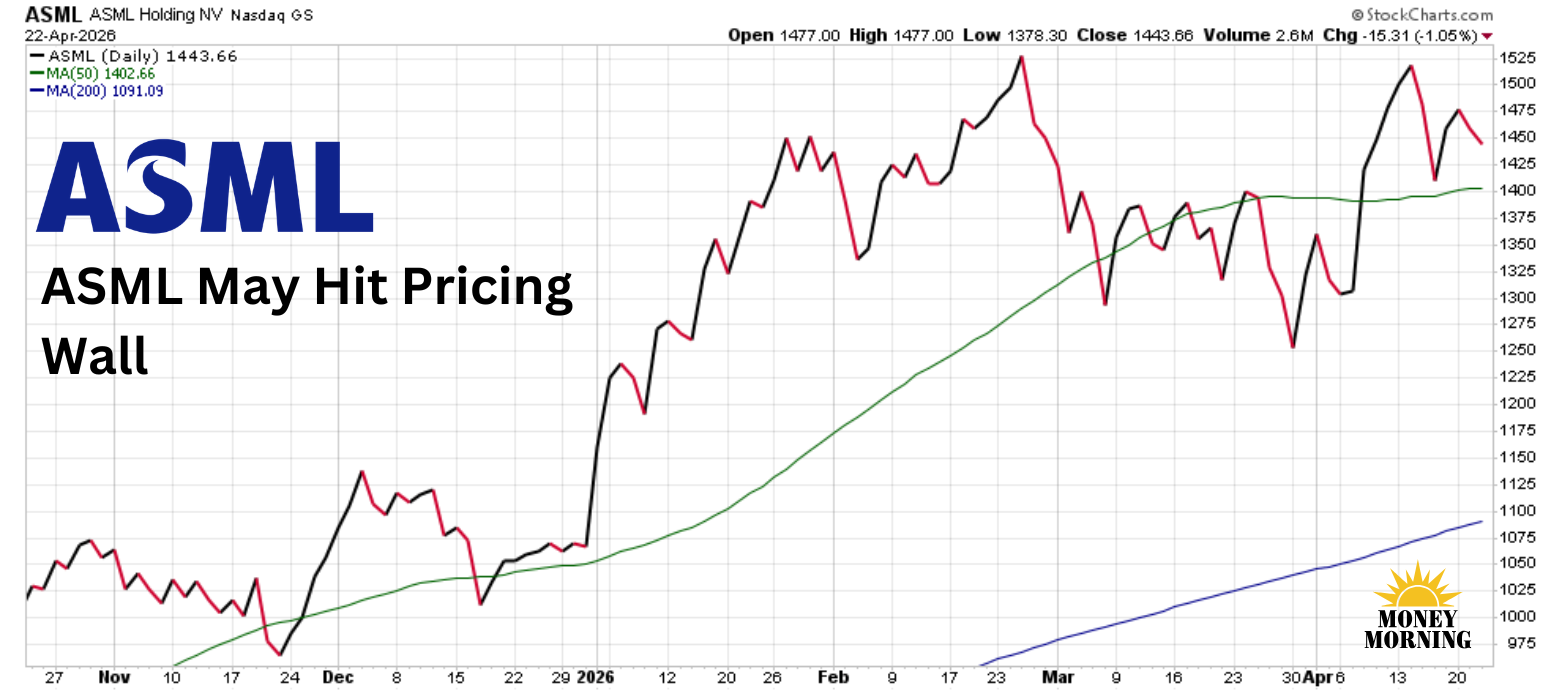
ASML's (ASML) dominance in EUV lithography remains intact, but TSM's efficiency gains introduce a new variable that could influence long-term demand. The balance between manufacturing innovation and equipment necessity is starting to evolve.
The AI boom has turned semiconductor manufacturing into a high-stakes arms race. Every breakthrough in chip design demands tighter tolerances, smaller nodes, and more complex fabrication. That raises a key question for investors: who really controls the future of computing – the companies designing chips, or the ones building the machines that make them possible?
For years, ASML Holding's (ASML) story has been simple: dominate extreme ultraviolet (EUV) lithography, dominate the future. But now Taiwan Semiconductor Manufacturing (TSM) may be testing that assumption.
ASML's $400 Million Advantage
ASML's monopoly in EUV lithography is not theoretical. It remains the only company in the world producing EUV systems capable of manufacturing chips at 5nm and below. And the economics are staggering:
Latest High-NA EUV systems: ~$350 million to $400 million per unit
Prior-generation EUV systems: ~$180 million
ASML gross margin (2025): ~53%
That's a rare combination: monopoly pricing power with expanding margins. Its premium valuation reflects one belief: every next-generation chip requires more ASML machines. More complexity equals more revenue per wafer.
TSM's Curveball: More From Less
Now comes the wrinkle. TSM's latest disclosures show progress with its A13 and N2U technologies – advanced packaging methods that can stitch together 10 large logic chips and 20 memory stacks.
That's a fancy way of saying: instead of shrinking everything further, TSM is building bigger systems by combining smaller pieces. Surprisingly, this approach squeezes more performance out of existing EUV infrastructure.
If chipmakers can extract more output per tool, the math shifts:
Fewer incremental EUV purchases
Slower unit growth for ASML
Potential pressure on pricing over time
Granted, the gains today are limited. TSM's own statements suggest these packaging advances improve performance, but they don't eliminate the need for cutting-edge lithography.
Why ASML Investors Shouldn't Panic
Let's separate signal from noise. Even with TSM's innovations, the physics of semiconductors hasn't changed. To reach 2nm and below, manufacturers still require:
Higher precision lithography
More EUV layers per wafer
Next-gen High-NA systems
ASML's backlog supports this reality. The company reported about $42 billion in backlog – largely booked through 2027 – and continued demand from TSM, Samsung (SSNLF), and Intel (INTC).
That said, TSM's progress introduces a subtle but important shift. If packaging and design improvements continue:
ASML's unit growth could moderate
Its pricing power could face negotiation pressure
Innovation cycles may lengthen
In any case, that's not a collapse – it's a maturation. And it may force ASML to do what it has always done: innovate ahead of demand. Its High-NA EUV rollout is already a response, pushing resolution even further to keep chipmakers dependent on its tools.
The Bottom Line
In short, TSM hasn't broken ASML's story – but it has added nuance.
ASML still controls the most critical chokepoint in advanced chip manufacturing. Its monopoly remains intact, its margins remain high, and its backlog remains strong. That's the foundation investors care about.
That said, TSM's ability to extract more from existing tools is a reminder: no monopoly goes unchallenged forever – not by competitors, but by innovation itself.
For now, ASML remains essential. But smart investors should watch this dynamic closely. If chipmakers can keep bending the curve, ASML's growth may shift from explosive to measured.
Regardless, ASML still sits at the center of the AI economy – and that's not a bad place to be.


Comments
Log in or sign up to join the conversation.