

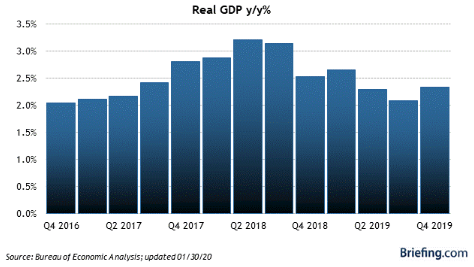
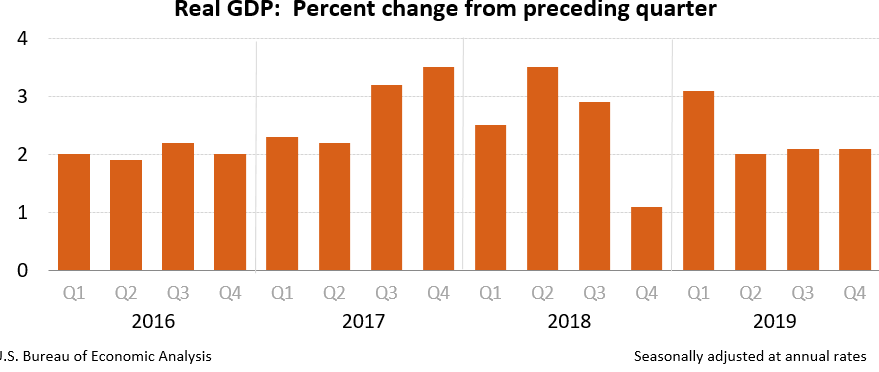
The US economy expanded at a 2.1% annual rate in the fourth quarter of 2019 according to the “advance” estimate, identical to the rate of growth in the previous quarter. The Q3 and Q4 annual growth rates from last year are reflective of a broader trend toward steady, but slower US economic growth.
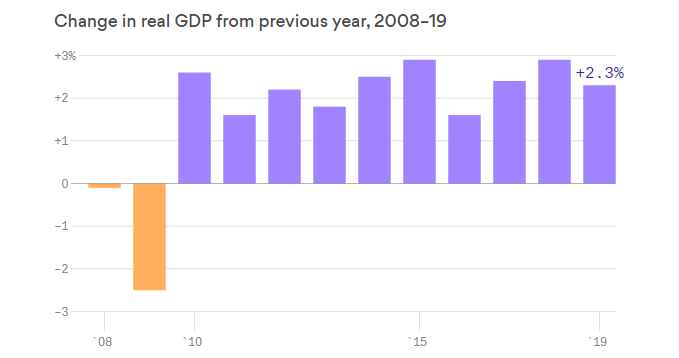
In all of 2019 American GDP increased 2.3%, significantly slower than the 2.9% increase in 2018. GDP growth was 2.4% in 2017 and 2.9% in 2018. The 2019 growth rate was the slowest of Trump’s three years of Presidency.
Bear in mind that the Trump Administration promised that its generous 2017 tax bill, which cut corporate and individual rates, would trigger at least 3% annual growth into the future.
In other words, the US economy is growing in a much slower 2% equilibrium track, as productivity growth continues at a slow 1% annual rate, and the labor force is also growing at about a 1% pace. The natural question we should ask is what might be the shock to the system and end the near eleven-year economic expansion?
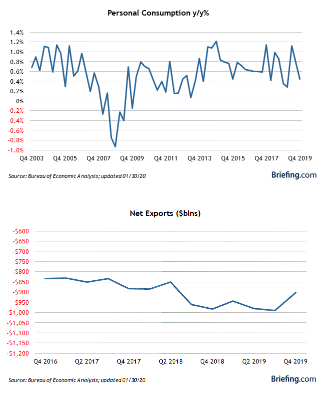
Looking at the components of GDP growth, it is somewhat surprising that the foreign trade sector (net exports) provided a large boost to the economy in the fourth quarter.
Exports rose 1.4% at annual rates in Q4 while imports contracted by 8.7%. Thus, net exports contributed 1.48 percentage points to fourth-quarter GDP growth of 2.1%, while consumer spending rose only 1.8% in the quarter and contributed 1.2 percentage points to total growth.
Once again, the US real investment was quite disappointing, as domestic investment declined 6.1% in the fourth quarter.
In other words, the principal sources of growth in Q4 was a narrower trade deficit, driven almost entirely by a drop in imports, and stronger residential investment – which helped offset a pullback in personal consumption.
It is anticipated that the healthy labor market -- characterized by the lowest unemployment rate in a half-century and increasing labor force participation -- and elevated consumer sentiment will continue to support spending in the months ahead. Nonetheless, the waning effects of tax cuts along with moderate wage gains may limit consumption as well.
Finally, the Trump Administration has continued to pressure the Federal Reserve to cut its interest rates to boost economic growth, but the as recently as Jan. 29, the Fed kept its benchmark rate unchanged in the range between 1.5%-1.75%.
The central bank has said that it would remain patient this year after cutting interest rates three times in 2019. The Fed also indicated it would hold rates stable unless economic conditions change significantly.
(Click on image to enlarge)
(Click on image to enlarge)
(Click on image to enlarge)
(Click on image to enlarge)


Comments
Log in or sign up to join the conversation.