

Most senior gold miners have seen production decrease in recent years, suggesting that finding and digging up new metal is harder than it used to be. Here, for instance, are the most recent year-over-year and sequential quarterly production declines for Newmont (NEM), the world’s biggest gold miner.
Quick answer: New gold discoveries are getting scarcer, but the author argues that does not mean the world is running out of gold in any way that matters for its price. S&P Global counts only six major discoveries since 2020, yet about 233,000 tons have been mined in history and nearly all of it still exists.

Echoing that point is the following (slightly dated but still shocking) chart showing a dramatic decline in major new gold discoveries.
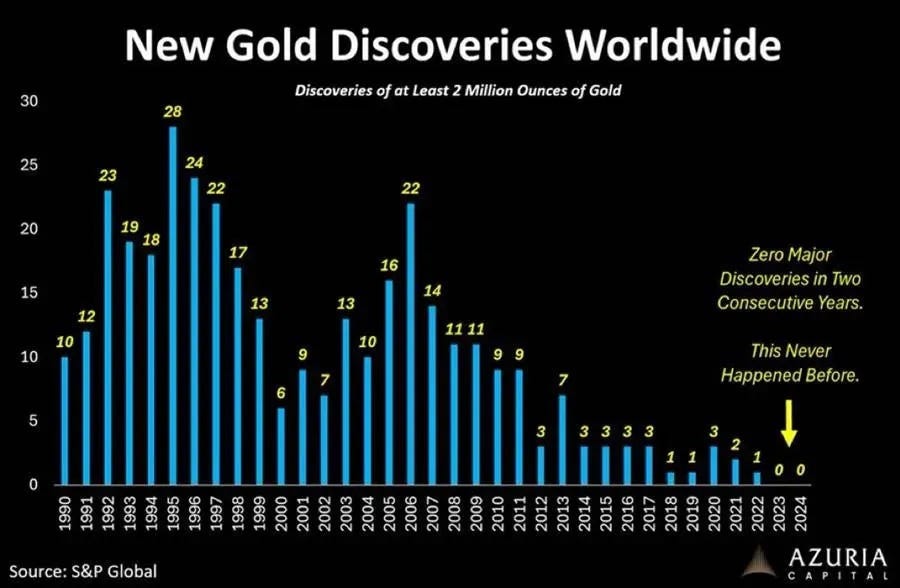
The apparent takeaway is that in our 5,000 years of exploring, we’ve found the low-hanging fruit, and henceforth, goldbugs shouldn’t worry about being swamped by a flood of newly mined metal. A 2025 article from Mining.com fleshed out this thesis:
Gold exploration spend trending down despite higher prices – S&P Global
The gold mining sector continues to rely on older discoveries for reserve growth despite a sustained gold price rally in recent years, an annual analysis by S&P Global finds.
The S&P analysis points out that — consistent with its previous reports — almost all of the new additions to [the list of major deposits] were discovered decades ago and have only recently met its 2-million-oz. criteria for a “major gold discovery”.
Notably, no major discoveries occurred during the 2023–24 period, and since 2020, only six major discoveries have been made, contributing a total of 27 million oz. in reserves and resources, it said.
Declining budget
The absence of new major discoveries in the past two years can be linked to reduced exploration budgets. According to S&P estimates, global exploration spending fell 15% in 2023 and 7% in 2024, ending an uptrend that began in 2017.
The decline, S&P says, was driven by reduced allocations by junior companies, which faced tighter financing conditions as interest rates rose, and the higher gold prices did little to encourage more spending.
The overall quality of recent discoveries is also on the decline. The average size of new deposits over the five-year period was 4.4 million oz., down from the average of 7.7 million oz. in the decade prior. Moreover, none of the discoveries made in the past 10 years have ranked among the largest 30 gold discoveries, S&P adds.
But Then China…
In the past couple of years, China has seen a discovery boom that could affect this story.
Geologists Might Have Stumbled Upon the Largest Gold Mine in the World
(Popular Mechanics) - A deposit of gold ore discovered in China isn’t just giant. It’s supergiant. So much so, in fact, that Chinese experts claim it could be the largest deposit of any precious metal—not just gold ore—in existence today.
How big is the “supergiant” deposit located under the Wangu gold field in the Hunan province? Experts estimate it at 1,100 tons.
According to Chinese state media in 2024, a team of geologists detected over 40 gold veins of roughly 330 tons of gold ore dipping 6,600 feet deep under Pingjiang County’s Wangu gold field. But 3D modeling blows that number out of the water, showing there could be as much as 1,100 tons as deep as 9,800 feet. If the models are accurate, the deposit in its entirely could be worth roughly $83 billion.
Adding some more heft to the already weighty (literally) find was the report that the discovery features 138 grams of gold per metric ton of ore, a valuable rate not often found in gold mining. “Many drilled rock cores showed visible gold,” said Chen Rulin, an ore-prospecting expert at China’s Hunan Province’s Geological Bureau, according to Chinese state media.
If the 1,100-ton figure holds up, that makes this new find the largest gold mine in the world, even outpacing South Africa’s South Deep gold mine with its 1,025 tons of gold, according to Mining Technology. Mines in Indonesia, Russia, New Guinea, and Chile round out the top-five gold mines in the world. The Carlin Trend and Cortez gold mines, both in Nevada, are ranked sixth and 10th worldwide.
Historically, the world has mined 233,000 tons of gold, all of it still around in some form, and two-thirds of that mining has occurred since 1950.
Conclusion: Ignore This Debate
So are we running out of newly-mined gold, or not?
As it turns out, that’s a pointless question, because marginal production fluctuations mean nothing to the price of gold. Consider the final sentence in the above article: “Historically, the world has mined 233,000 tons of gold, all of it still around in some form…”
233,000 tons equals 7.5 billion ounces. And gold, unlike virtually any other commodity, isn’t used up in cars or microchips. It is saved as money. That means any given year’s production — including whatever China gets from its new 1,100-ton mine — is just a drop in the ocean, and as such is virtually meaningless to gold’s price.
Where production does matter is at the miner level. Rising production in a bull market is the perfect profile, and we should seek out those stocks, along with the smaller players they’re acquiring.
Comments
Log in or sign up to join the conversation.