

“According to IMF staff, as reported in their World Economic Outlook, real GDP should expand by about 2% in advanced economies this year and next. This will pull the unemployment rate below 6%, not much different from its level before the 2008 financial crisis. Not to rain on officials’ parade, but we fear that they are taking too much comfort in the stabilization of economic conditions. Beneath the headline numbers, there is little evidence that underlying problems have been resolved.” (Carman Reinhart and Vincent Reinhart, A False Spring at the Spring Meetings? Project Syndicate, May 2017)
In a recent article, Carman and Vincent Reinhart caution economists that the consensus outlook for improved economic growth for the advanced economies may be too optimistic.
Their argument is based on extensive research that suggests that recoveries from major financial crises are often painfully long. They correctly point out that since WW2 there have been at least two major episodes where some economies have endured decade or longer periods of economic stagnation. They cite the example of a dozen countries in Latin America from 1982 to 1992 and of Japan from 1992 to 2007. In Japan’s case, despite the lengthy deflationary slump, the standard of living increased.
Turning to the present, they highlight how slow the recovery has been since the Global Recession ended. Indeed, there is still a desperate crisis in Greece. Even though Italy has been able to avoid a major economic downturn, nonetheless the country still faces significant financial and economic problems. They point out that both countries are not expected to regain their pre-crisis level of real GDP per capita within the World Economic Outlook’s forecast period, which stretches to 2022.
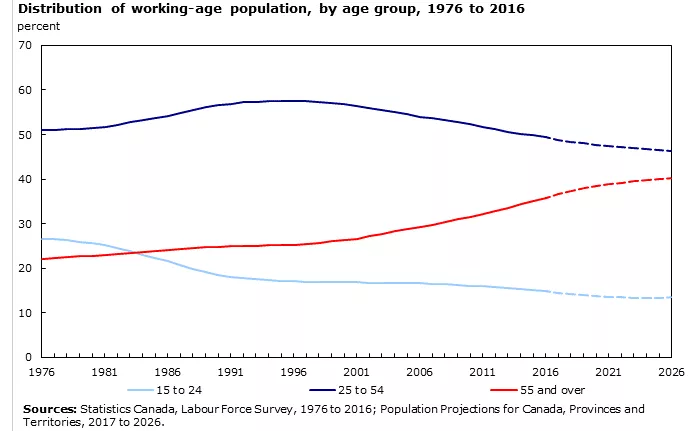
But there is another reality which is a constraint on economic growth, and there are very few fresh ideas for providing a solution for this problem. The concern relates to the longer-term decline in potential GDP growth due to the aging of the population and as well as to declining productivity growth. The deceleration in potential GDP growth makes per capita income increases in the advanced economies difficult to achieve.
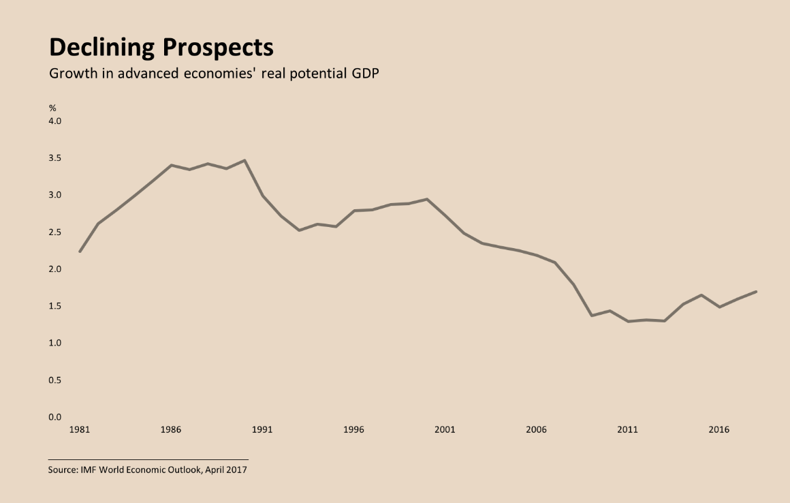
The latest IMF report indicates that in the advanced economies potential GDP growth has shrunk by about 50% over the past half century.
“According to the IMF, growth in the advanced economies’ real potential GDP – think of this as the underlying trend for aggregate supply – has fallen by half this century, from 2.71% in 2001 to as low as 1.28% just a few years ago. The picture is bleaker in the US, where, according to the Congressional Budget Office the amplitude of the swing is double, from about 4% to 1.5%.” (Reinhart and Reinhart)
Finally, budget deficits and debts are also a major concern to these economists. They note that for the advanced economies gross general government debt is hovering around 106% of nominal GDP and fiscal deficits are projected far into the forecast horizon. They are correct that the budget math is quite troubling.
While not denying the importance of these constraints or challenges to continued expansion (the aftermath of a financial crisis, low productivity growth, and financial problems of governments) this writer still believes that with a bit of luck the advanced economies should be able to sustain the recovery.
However, there is little doubt that the aging of populations and productivity growth slowing makes it more difficult for economies to grow and create wealth.
(Click on image to enlarge)


Comments
Log in or sign up to join the conversation.