

You might associate solar energy with bright, cloudless skies and warmer countries. Ireland’s changeable weather may not seem ideal, yet solar hot water panels Ireland homeowners install can still collect useful heat and reduce boiler or immersion use.
The question is whether the savings justify the installation cost. The answer depends on hot-water demand, your current fuel, roof, cylinder and how long you plan to stay. For some Irish homes, solar thermal is a sensible upgrade. For others, solar PV with a diverter may offer greater flexibility.
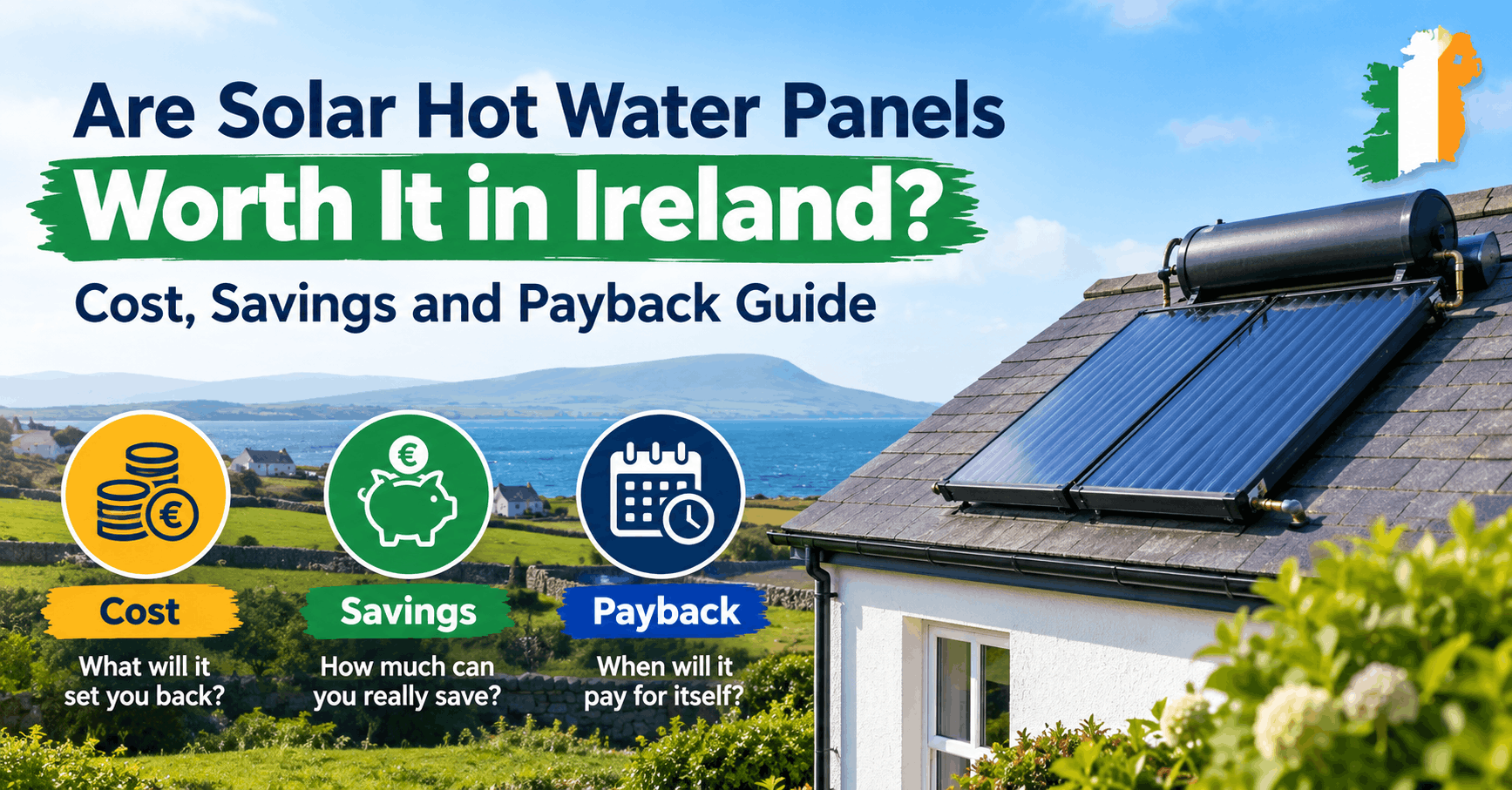
What you’ll discover in this guide
This guide explains how solar thermal works in Ireland, what an installation may cost, how much hot water it can provide, how the SEAI grant affects the figures and why payback can vary considerably from one home to another.
How do solar hot water panels work in Ireland?
Solar hot water panels, also called solar thermal panels, capture sunlight and use it to heat a fluid inside the system. That heat is transferred to water stored in a hot-water cylinder, ready for showers, baths, washing-up and other everyday uses.
This is different from solar PV. PV panels generate electricity, while solar thermal panels generate heat directly. A solar thermal system is therefore focused on one job: reducing the energy needed to produce domestic hot water.
Ireland does not need tropical sunshine for the system to work. It can still collect heat on bright, cool and partly cloudy days, although output changes with the season. Summer is usually the strongest period, while winter production is much lower and a boiler, heat pump or immersion will still be needed as backup.
A well-designed system may provide up to 60% of annual hot-water demand, although savings vary with household size and usage.
How much do solar hot water panels cost in Ireland?
Published Irish market guides commonly place a complete solar thermal installation in the region of €3,000–€5,500 before grants. The final quotation can sit outside that range depending on the system size, roof access, cylinder work and plumbing required.
Cost factor | Indicative effect on the price |
Flat-plate collectors | Usually the lower-cost collector option |
Evacuated-tube collectors | Often cost more but can perform well in lower light |
New twin-coil cylinder | May add substantially if the existing cylinder is unsuitable |
Roof access and mounting | More complex roofs can increase labour time |
Plumbing and controls | Depends on the distance between panels and cylinder |
System size | Larger households may need additional collector area |
The cylinder is easy to overlook. Solar thermal systems generally need a dedicated coil, so replacing an incompatible cylinder can add substantially to the project cost.
What is the solar thermal grant in Ireland?
Qualifying homeowners may be able to claim an SEAI solar thermal grant of €1,200. That could bring an installation priced at €3,000–€5,500 down to an indicative net cost of roughly €1,800–€4,300.
The grant is not automatic. The property, contractor and installation must meet the relevant requirements, and grant approval should be obtained before work begins. A registered contractor is required, and a post-works BER assessment forms part of the process.
Treat the grant as part of the calculation, not a reason to rush. Ask for a written quotation showing the full price, grant assumption, cylinder specification, warranties and servicing.
How much can solar thermal save each year?
The key question is what type of energy the system is replacing, not simply how much sunlight reaches the roof.
A household relying on an electric immersion may save more because electricity is relatively expensive. Homes using gas or oil boilers may save less, depending on fuel prices and boiler efficiency.
Independent Irish guidance often places potential annual savings in the broad region of €150–€350, although higher-use homes can sometimes save more. This should be treated as an estimate rather than a promise. Your actual result will depend on how much hot water you use, when you use it, how well the system is sized and how often the backup heating is required.
Is the payback period attractive?
For many Irish households, a realistic solar thermal payback estimate may fall somewhere around eight to fifteen years after the grant. That is a wide range, but it reflects the number of variables involved.
For example, imagine a system costing €4,200 after the grant and saving €300 per year. The simple payback would be approximately fourteen years. If the same household saved €450 annually because it relied heavily on an electric immersion, the payback would be closer to nine years.
This simple calculation excludes finance, maintenance, future energy prices and component replacement. Payback is useful, but it should not be the only test.
Flat plate or evacuated tube collectors?
Flat-plate collectors are robust, widely used and generally lower in capital cost. They can be suitable for many Irish homes with enough roof area and a practical installation route.
Evacuated-tube collectors often cost more, but their design can perform well in lower-light conditions and where roof space is limited. They may be worth considering when the available roof area is small or when the household has higher-than-average hot-water demand.
The best option is not automatically the one with the highest efficiency figure. It should suit the roof, cylinder, household size and budget.
When are solar hot water panels worth it?
Solar hot water panels Ireland homeowners should consider are most likely to make financial sense when several conditions come together:
1. The home has a steady and relatively high hot-water demand.
2. The existing cylinder can be adapted or replaced without excessive additional work.
3. The roof has suitable orientation, pitch and access.
4. The current hot-water fuel is expensive, particularly heavy immersion use.
5. The household expects to remain in the property long enough to benefit from the savings.
They may be less attractive for a low-occupancy home, a property with serious roof shading or a household planning to move shortly after installation.
Solar thermal or solar PV with a diverter?
Solar thermal heats water directly, while solar PV generates electricity for appliances, electric vehicles or an immersion through a diverter.
PV offers more flexibility, but solar thermal may suit homes with high hot-water demand, limited roof space or a clear preference for direct water heating.
Compare useful energy produced, the grant, expected lifespan, future plans and the amount of hot water you actually use.
The bottom line
So, are solar hot water panels worth it in Ireland? They can be, particularly for households with high hot-water demand, suitable roof space and a costly existing heating method. A qualifying grant can reduce the upfront cost, while annual savings may gradually repay the investment over roughly eight to fifteen years in many cases.
They are not a universal shortcut to free hot water. Design quality, the cylinder, installation and daily usage matter as much as the panels. A careful quotation and realistic savings estimate are more useful than a guaranteed payback promise.
Comments
Log in or sign up to join the conversation.