

Numerous traders keep telling me their market breadth indicators keep failing.
The advance-decline line points one way, yet the indices go the other.
You’re not losing your mind. The tool is broken.
Let me back up for the people who don’t live in this stuff every day.
Market breadth measures how many stocks are participating in a move. Broad participation means a healthy rally. Narrow participation means a fragile one.
The most popular gauge for this is the McClellan oscillator. It tracks advancing stocks minus declining stocks and smooths the result.
When breadth is wide, the oscillator confirms the trend. When breadth narrows, it warns you before the index rolls over.
That tool worked for decades. It does not work now.
The reason is simple. The market changed underneath it, and the indicator never adjusted.
I’m going to show you exactly what changed. Then I’ll hand you what I track instead.
It takes about thirty seconds each morning.
Here’s how it works.
How The Market Lost Its Balance
Eighteen years ago, the S&P 500 was a balanced index.
Technology was 16.6% of it. Energy sat right beside it at 16%.
Financials were 14%. Industrials were 11%. Consumer staples were 10%.
When people worried about tech hitting a wall, it barely mattered. Only about 20% of the index lived in tech.
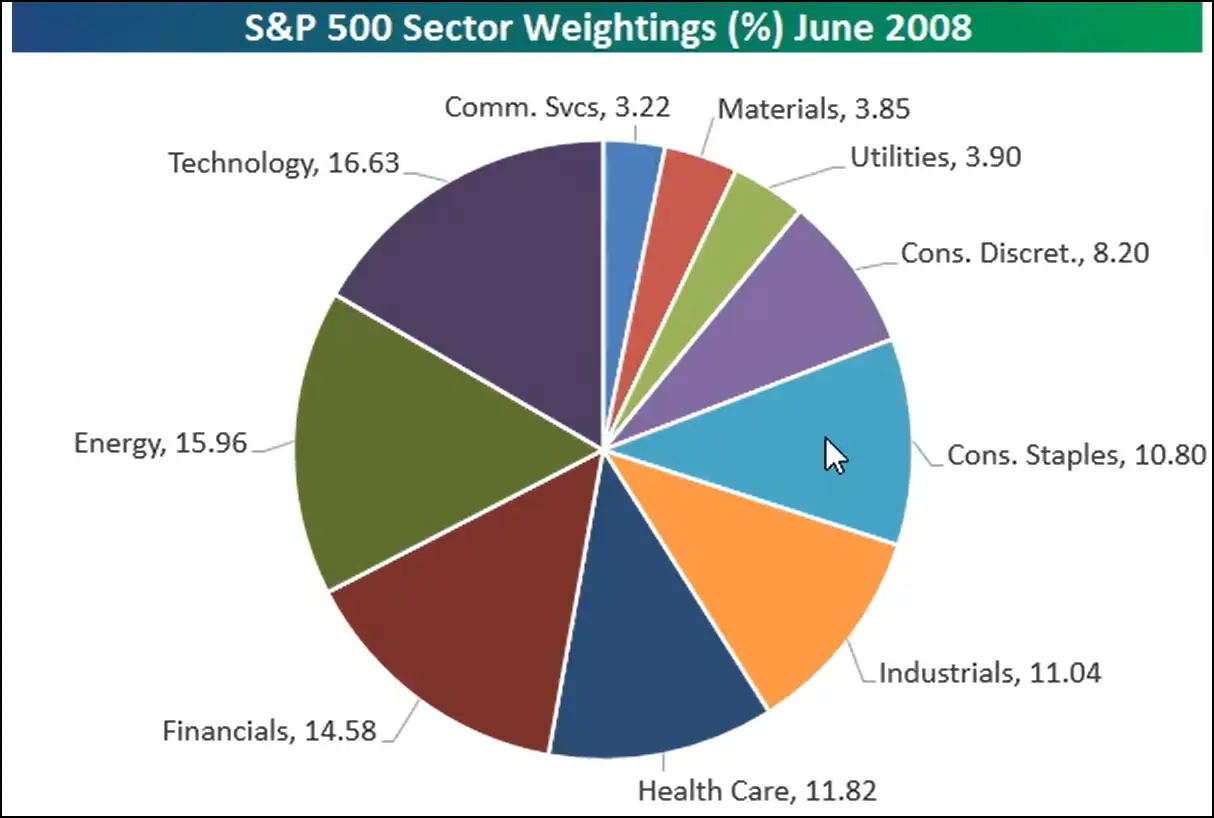
The market could absorb the hit. There was no concentration risk.
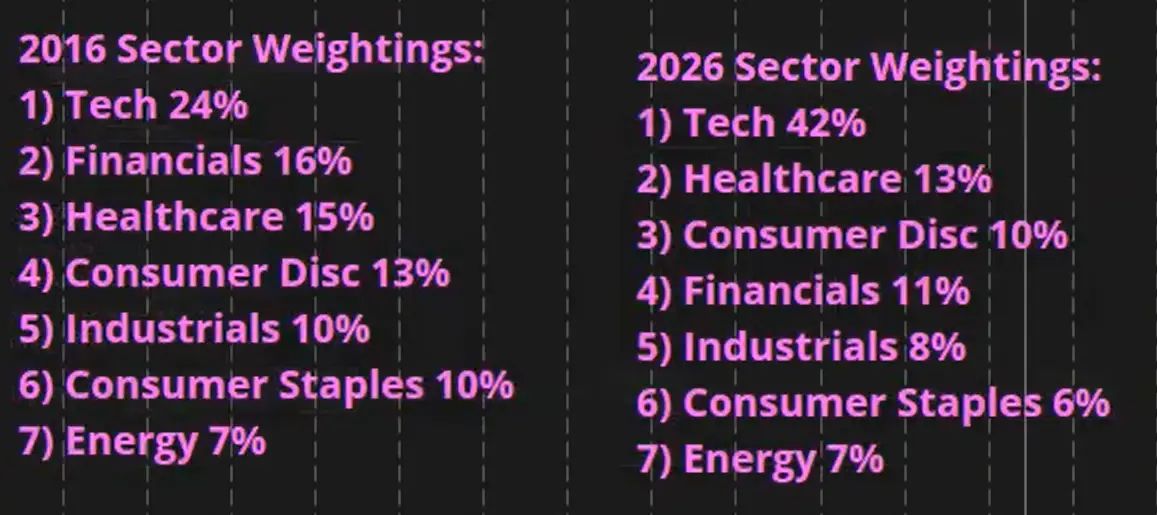
Move ahead to 2016. Technology climbed to 21%.
Add telecommunication services and the real tech weighting reached roughly 24%. Even then the risk stayed contained.
Twenty tech names could break and the index would hold.
[CHART at 30:42 — 2016 S&P 500 sector weightings, tech near 24%]
Now look at today. Technology alone is 32% of the S&P 500.
Add communication services and the real tech weighting hits 42%.
Healthcare is 13%. Financials are 11%. Consumer discretionary is 10%.
Financials made up 16% a decade ago. They make up 11% now.
Everything that drained out of those other sectors funneled into one place. It all went to tech.
Why Your Breadth Tools Stopped Working
The McClellan oscillator was built for the balanced market you just saw.
It assumes leadership spread across 10, 15, 20 sectors. That market is gone.
Today one sector is 42% of the index. It’s heading for 50%.
The advance-decline math fails as a result. You can have Google (GOOGL) down seven and Microsoft (MSFT) down seven on the same day.
The index gets bought anyway. Apple (AAPL) rises and offsets the whole thing.
That’s why your breadth indicator keeps misleading you. It’s measuring a market that no longer exists.
So stop using it here. It won’t help you at all.
The Eight Stocks That Are Your New Breadth
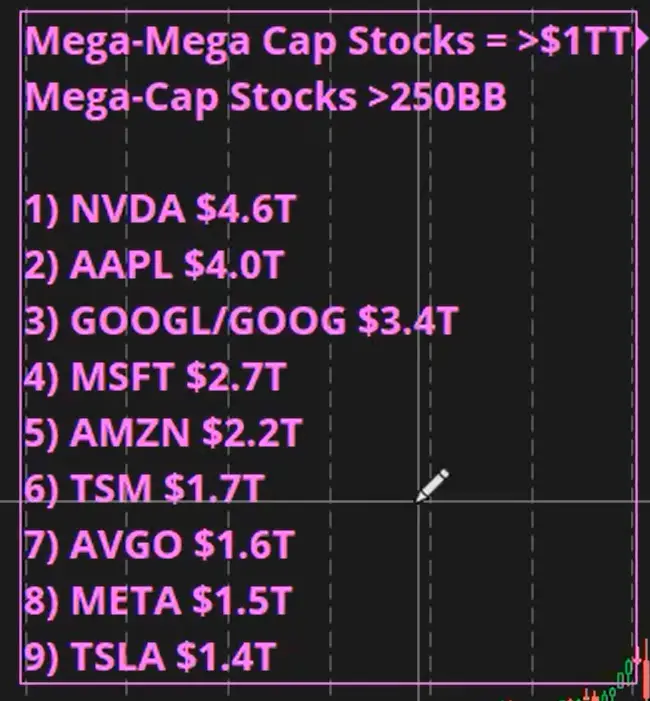
Here’s the fix. Build a watchlist of the mega-mega-cap stocks.
These are companies worth more than a trillion dollars each.
Nvidia (NVDA) sits at $4.6 trillion. Apple is $4 trillion. Google is $3.4 trillion.
Microsoft is $2.7 trillion. Amazon (AMZN) is $2.2 trillion. Avago Broadcom (AVGO) is $1.6 trillion.
Meta (META) is $1.5 trillion. Tesla (TSLA) is $1.4 trillion.
Set Taiwan Semiconductor (TSM) aside because it trades as an ADR. Follow those eight names. That’s your new breadth.
These eight stocks make up 25% to 30% of the entire index.
If they get sold off, the market gets sold off. If they hold, the market holds.
You cannot break this market with five of the eight down. You need all of them down together.
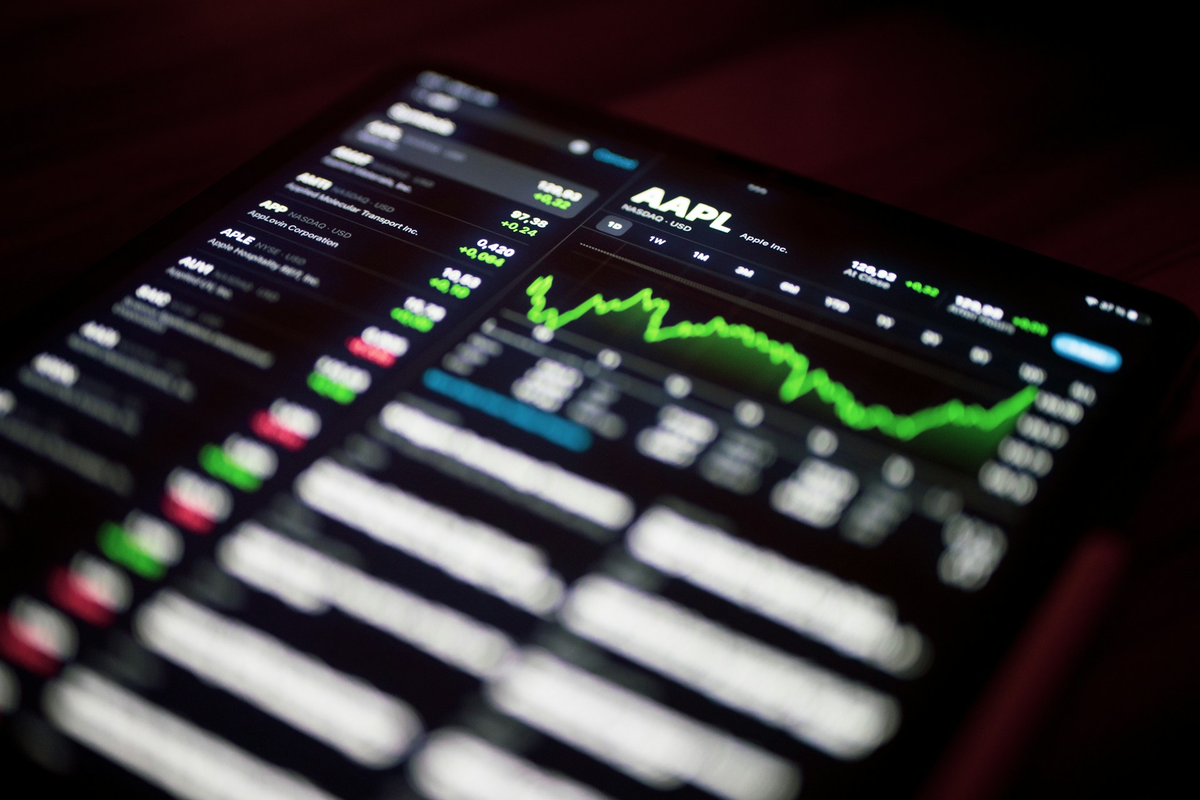
So each morning, pull up your quotes. Run the eight. Count how many are red.
If most of them are green, the index isn’t falling far. That’s the whole exercise.
The Day This Matters Most
The traditional breadth model is dead. I’m telling you that plainly.
This market won’t rebalance until the mega-mega caps come down hard.
When the crowd finally wakes up to 10 times sales and starts selling tech, the skew to the downside will be brutal.
Until that day, watch the eight. Nothing else moves this market.
Build the watchlist today. Walk into tomorrow knowing exactly what to track.

Comments
Log in or sign up to join the conversation.