

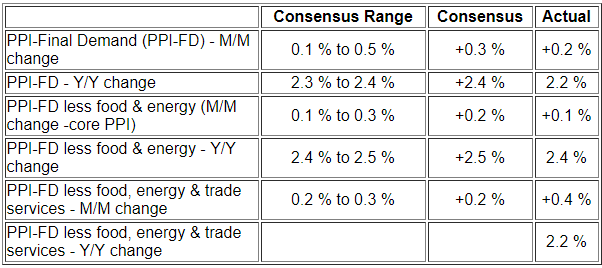
The Producer Price Index year-over-year inflation was unchanged at 2.2 %.

Analyst Opinion of Producer Prices
The Producer Price Index was unchanged. Here is what the BLS said in part:
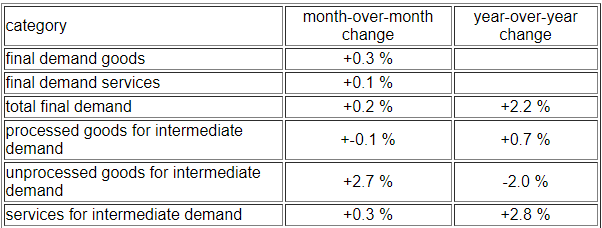
Final demand goods: The index for final demand goods moved up 0.3 percent in April, the third consecutive increase. The April advance can be traced to prices for final demand energy, which rose 1.8 percent. In contrast, the index for final demand foods fell 0.2 percent. Prices for final demand goods less foods and energy were unchanged.
Product detail: Most of the April rise in the index for final demand goods is attributable to prices for gasoline, which increased 5.9 percent. The indexes for meats; search, detection, navigation, guidance systems, and related equipment; electric power; pharmaceutical preparations; and processed young chickens also moved higher. Conversely, prices for fresh and dry vegetables decreased 11.6 percent. The indexes for thermoplastic resins and materials and for liquefied petroleum gas also declined.
Final demand services: Prices for final demand services inched up 0.1 percent in April following a 0.3- percent advance in March. Leading the increase in April, the index for final demand services less trade, transportation, and warehousing rose 0.3 percent. Prices for final demand transportation and warehousing services climbed 1.0 percent. In contrast, margins for final demand trade services fell 0.5 percent. (Trade indexes measure changes in margins received by wholesalers and retailers.)
Product detail: Most of the April advance in the index for final demand services can be traced to prices for portfolio management, which jumped 5.3 percent. The indexes for hospital outpatient care; transportation of passengers (partial); machinery, equipment, parts, and supplies wholesaling; and fuels and lubricants retailing also moved higher. Conversely, margins for food and alcohol retailing decreased 3.1 percent. The indexes for traveler accommodation services; health, beauty, and optical goods retailing; and long-distance motor carrying also declined.
The PPI represents inflation pressure (or lack thereof) that migrates into consumer price.
The market had been expecting (from Econoday):
(Click on image to enlarge)
The producer price inflation breakdown:
(Click on image to enlarge)
(Click on image to enlarge)

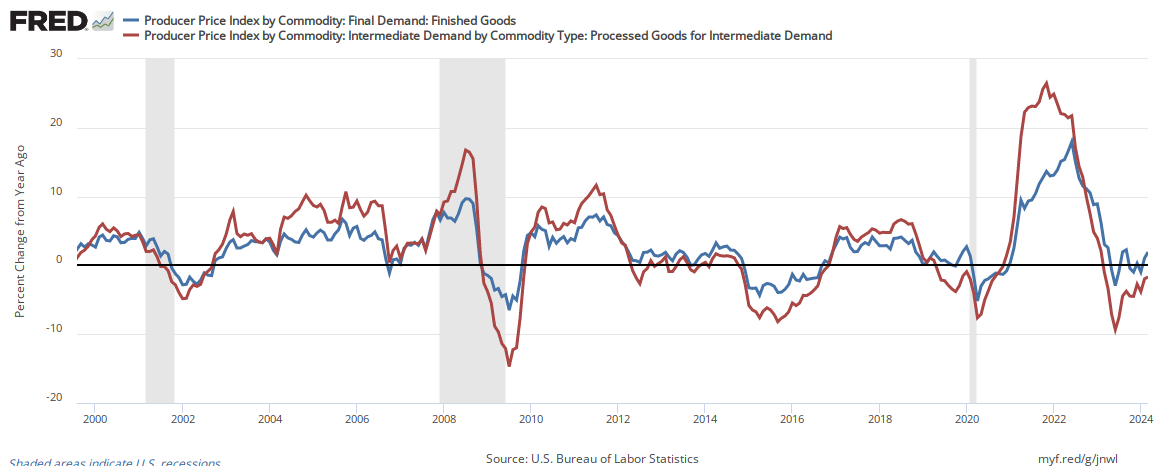
In the following graph, one can see the relationship between the year-over-year change in the intermediate goods index and finished goods index. When the crude goods growth falls under finish goods - it usually drags finished goods lower.
Percent Change Year-over-Year - Comparing PPI Finished Goods (blue line) to PPI Intermediate Goods (red line)
(Click on image to enlarge)
Econintersect has shown how pricing change moves from the PPI to the Consumer Price Index (CPI).
Comparing Year-over-Year Change Between the PPI Finished Goods Index (blue line) and the CPI-U (red line)
(Click on image to enlarge)

The price moderation of the PPI began in September 2011 when the year-over-year inflation was 7.0%. Currently, inflation is on an increasing trend line.
Caveats on the Use of Producer Price Index
Econintersect has performed several tests on this series and finds it fairly representative of price changes (inflation). However, the headline rate is an average - and for an individual good or commodity, this series provides many sub-indices for a specific application.
A very good primer on the Producer Price Index nuances can be found here.
Because of the nuances in determining the month-over-month index values, the year-over-year or annual change in the PPI index is preferred for comparisons.
There is a moderate correlation between crude goods and finished goods. Higher crude material prices push the finished goods prices up.


Comments
Log in or sign up to join the conversation.