

The headline seasonally adjusted BLS job growth was again significantly below expectations. This month's data is so chaotic - I would not look too deeply at the internals.

Analyst Opinion of the BLS Employment Situation
The household and establishment surveys were not in sync - which means if you believe the establishment's survey's employment growth, then it is hard to believe the unemployment rate. The year-to-date employment is running slightly below the pace of last year.
- The year-over-year rate of growth for employment marginally decelerated this month (blue bars on graph below). This is a year-over-year analysis which has no seasonality issues.
(Click on image to enlarge)

- Economic intuitive sectors of employment were mixed with truck transport contracting.
- This month's report internals (comparing household to establishment data sets) was inconsistent with the household survey showing seasonally adjusted employment expanding only 3,000 vs the headline establishment number expanding 164,000. The point here is that part of the headlines are from the household survey (such as the unemployment rate) and part is from the establishment survey (job growth). From a survey control point of view - the common element is jobs growth - and if they do not match, your confidence in either survey is diminished. [note that the household survey includes ALL jobs growth, not just non-farm).
- The household survey removed 236,000 people to the labor force.
- The National Federation of Independent Business (NFIB)'s monthly Jobs Report is at the end of this post.
A summary of the employment situation:
- BLS reported: 164K (non-farm) and 168K (non-farm private). Unemployment rate fell from 4.1 % to 3.9 % (removing 236,000 people from the workforce was a big number).
- ADP reported: 204K (non-farm private)
- In Econintersect's April 2018 economic forecast released in late March, we estimated non-farm private payroll growth at 170,000 (based on economic potential) and 205,000 (fudged based on current overrun / under-run of economic potential).
- The market expected (from Bloomberg / Econoday):
| Seasonally Adjusted Data | Consensus Range | Consensus | Actual | |
| Nonfarm Payrolls - M/M change | 152,000 to 255,000 | 190,000 | 164,000 | |
| Unemployment Rate - Level | 3.9 % to 4.1 % | 4.0 % | 3.9 % | |
| Private Payrolls - M/M change | 150,000 to 250,000 | 190,000 | 168,000 | |
| Manufacturing Payrolls - M/M change | 11,000 to 25,000 | 19,000 | 24,000 | |
| Participation Rate - level | 62.8 % to 63.0 % | 62.9 % | 62.8 % | |
| Average Hourly Earnings - M/M change | 0.2 % to 0.3 % | 0.2 % | +0.1 % | |
| Average Hourly Earnings - Y/Y change | 2.6 % to 2.8 % | 2.7 % | +2.6 % | |
| Av Workweek - All Employees |
|
34.5 hrs | 34.5 hrs |
The BLS reports seasonally adjusted data - manipulated with multiple seasonal adjustment factors, and Econintersect believes the unadjusted data gives a clearer picture of the jobs situation.
Non-seasonally adjusted non-farm payrolls expanded 998,000 - worse than last year. The following chart compares the jobs gains this month with the same month historically:
(Click on image to enlarge)

Year-to-date unadjusted employment growth is 21,000 people below the pace of last year.
(Click on image to enlarge)

Last month's headline employment gains were revised upward. Generally speaking, employment is overstated when the economy is slowing and understated when the economy is accelerating.
(Click on image to enlarge)

Most of the analysis below uses unadjusted data, and presents an alternative view to the headline data.
Unemployment
The BLS reported U-3 (headline) unemployment was 3.9 % with the U-6 "all in" unemployment rate (including those working part time who want a full time job) was revised from 8.0 % to 7.8 %. These numbers are volatile as they are created from the household survey.
BLS U-3 Headline Unemployment (red line, left axis), U-6 All In Unemployment (blue line, left axis), and Median Duration of Unemployment (green line, right axis)
(Click on image to enlarge)

Econintersect has an interpretation of employment supply slack using the BLS employment-population ratio, demonstrated by the graph below. The employment-population ratio declined from 60.4 to 60.3.
Employment-Population Ratio
(Click on image to enlarge)
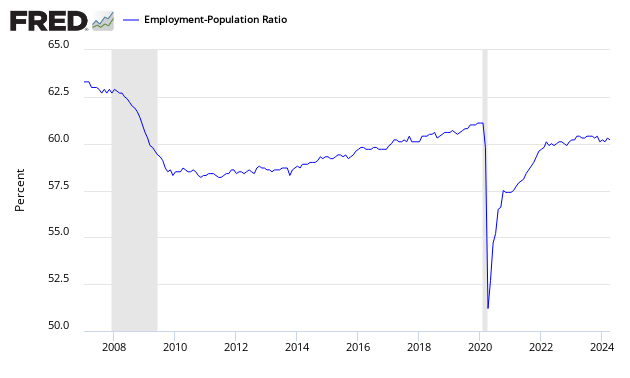
The jobs picture - when the employment / population as a whole - has been on an uptrend since mid-2011. This ratio is determined by household survey.
- Econintersect uses employment-populations ratios to monitor the jobless situation. The headline unemployment number requires the BLS to guess at the size of the workforce, then guess again who is employed or not employed. In employment - population ratios, the population is a given and the guess is who is employed.
- This ratio has been in a general uptrend since the beginning of 2014. The employment-population ratio tells you the percent of the population with a job. Each 0.1 % increment represents approximately 300,000 jobs. [Note: these are seasonally adjusted numbers - and we are relying on the BLS to get this seasonal adjustment factor correct]. An unchanged ratio would be telling you that jobs growth was around 150,000 - as this is approximately the new entries to the labor market caused by population growth.
- The growth in employment since the Great Recession has been in full-time jobs.
(Click on image to enlarge)

Employment Metrics
The growth trend in the establishment survey's non-farm payroll year-over-year growth rate was trending up beginning of 2014 but has been trending down beginning in 2015. Year-over-year growth rate marginally declined this month.
Unadjusted Non-Farm Payrolls Year-over-Year Growth
(Click on image to enlarge)
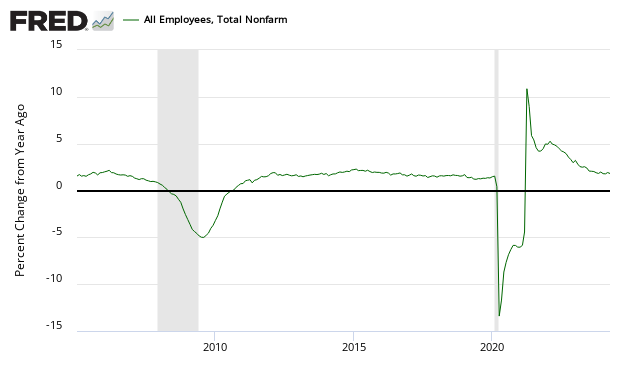
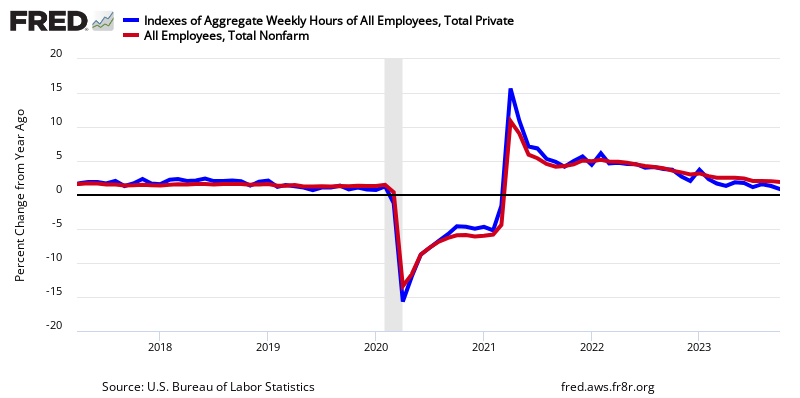
Another way to view employment is to watch the total hours worked which no clear trend is obvious.
Percent Change Year-over-Year Non-Farm Private Weekly Hours Worked
(Click on image to enlarge)
The bullets below use seasonally adjusted data from the establishment survey except where indicated:
- Average hours worked (table B-2) was unchanged at 34.5. A rising number normally indicates an expanding economy .
- Government employment declined 4,000 (4K) with the Federal Government up 1K, state governments down 7K and local governments up 2K.
- The big contributors to employment growth this month was health care (24.4K), office and admin services (25.6K), professional/tech services (25.8K) and manufacturing (24k)
- Manufacturing was up 24K, and construction was up 17K.
- The unemployment rate (from household survey) for people between 20 and 24 (Table A-10) degraded 0.1 to 6.7 %. This number is produced by survey and is very volatile.
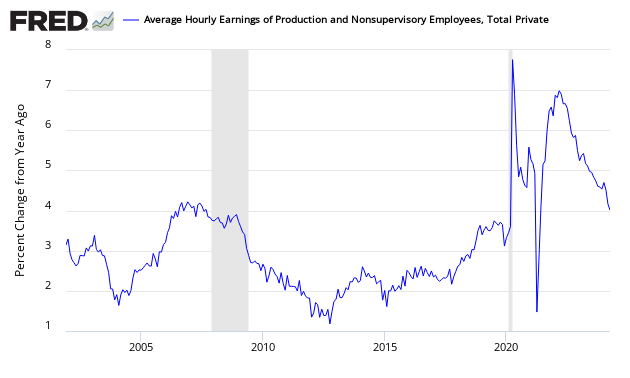
- Average hourly earnings (Table B-3) was up $0.04 to $26.84.
Private Employment: Average Hourly Earnings
(Click on image to enlarge)
Economic Metrics
Economic markers used to benchmark economic growth (all from the establishment survey).
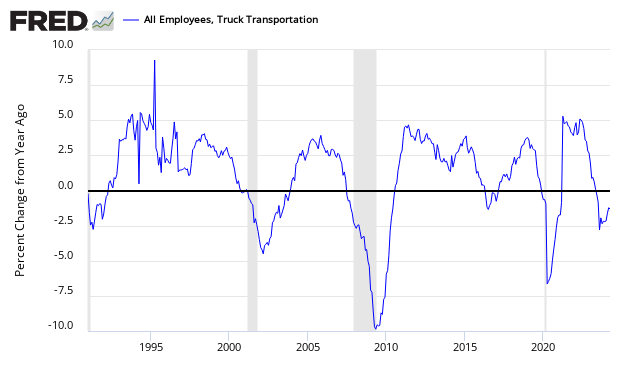
The truck employment was down 5.5K.
Truck Transport Employment - Year-over-Year Change
(Click on image to enlarge)
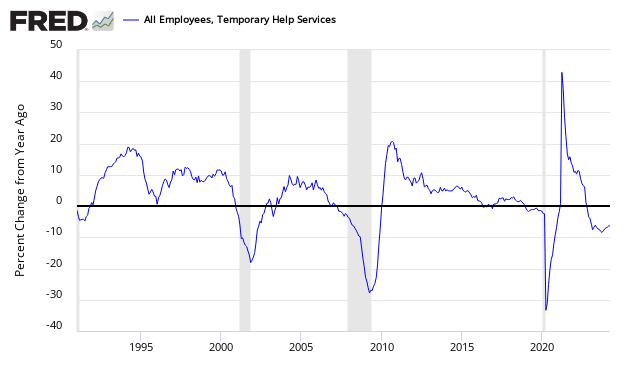
Temporary help was up 10.3K.
Temporary Help Employment - Year-over-Year Change
(Click on image to enlarge)
Econintersect believes the transport sector is a forward indicator. Others look at temporary help as a forward indicator.
Food for Thought
Who are the victims in this employment situation. It is not people over 55.
Index of Employment Levels - 55 and up (blue line), 45 to 54 (red line), 35 to 44 (green line), 25 to 34 (purple line), 20 to 24 (light blue line), and 16 to 19 (orange line)
(Click on image to enlarge)

Women are doing better than men.
Index of Employment Levels - Men (blue line) vs Women (red line)
(Click on image to enlarge)

Mom and Pop employment remains below recessionary levels.
(Click on image to enlarge)

The less education one has, the less chance of finding a job.
Index of Employment Levels - University graduate (blue line), Some college or AA degree (orange line), high school graduates (green line), and high school dropouts (red line)
(Click on image to enlarge)

Here is an indexed view of employment levels.
Index of Employment Levels (from the BLS Establishment Survey) - Hispanic (blue line), African American (red line), and White (green line)
(Click on image to enlarge)

However, keep in mind that population growth is different for each group. Here is a look at employment to population ratios which clearly shows NO group has recovered from the Great Recession:
Employment / Population Ratios (from the BLS Household Survey) - Hispanic (blue line), African American (red line), and White (green line)

National Federation of Independent Business (NFIB)'s monthly Jobs Report Statement:
Small businesses continue to demonstrate strong economic growth, according to the National Federation of Independent Business (NFIB)'s monthly Jobs Report, released today. Fifty-seven percent of small business respondents indicated they are hiring or planning to hire, up four points from March. A net 33 percent of small business owners also report higher worker compensation, on par with the previous month and the highest reading since 2000.
"This month's jobs report reinforces small business owners' optimism about the economy. They are hiring, and compensation is up," said NFIB President and CEO Juanita Duggan. "In previous years, small businesses were most concerned about taxes and regulations on their businesses, now they are setting plans to grow, and they want to find workers to fill these jobs."
While 57 percent of small businesses are hiring or planning to hire, a large majority (88 percent) of them reported difficulties finding qualified candidates. Twenty-two percent of all small business owners cited the difficulty of finding qualified workers as their Single Most Important Business Problem (up one point from March), exceeding the percentages citing taxes and regulations.
Owners reporting job openings they could not fill in the current period remained at 35 percent. Twelve percent reported using temporary workers, up two points from the previous month. Job openings were the most frequent in construction and manufacturing, both at 48 percent.
"The shortage of qualified workers is clearly holding back even stronger economic growth," saidNFIB Chief Economist Bill Dunkelberg. "The high demand has real impacts. In some industries, nearly half of the firms have unfilled openings. It's especially severe in construction and manufacturing."
Click here to view the entire NFIB Jobs Report. For more information about NFIB, please visitwww.nfib.com.
Caveat on the use of BLS Jobs Data
The monthly headline data ends up being significantly revised for months after the initial release - and is subject also to annual revisions. The question remains how seriously can you take the data when first released.
Econintersect Contributor Jeff Miller has the following description of BLS methodology:
- An initial report of a survey of establishments. Even if the survey sample was perfect (and we all know that it is not) and the response rate was 100% (which it is not) the sampling error alone for a 90% confidence interval is +/- 100K jobs.
- The report is revised to reflect additional responses over the next two months.
- There is an adjustment to account for job creation — much maligned and misunderstood by nearly everyone.
- The final data are benchmarked against the state employment data every year. This usually shows that the overall process was very good, but it led to major downward adjustments at the time of the recession. More recently, the BLS estimates have been too low.
ADP (blue line) versus BLS (red line) - Monthly Jobs Growth Comparison
(Click on image to enlarge)

However, there is some discussion that neither the ADP nor BLS numbers are correct - as both are derived by a sampling methodology. The answer could be that there is no correct answer in real time - and that it is best to look at the trends. As has been noted, all eventually end up correlating.
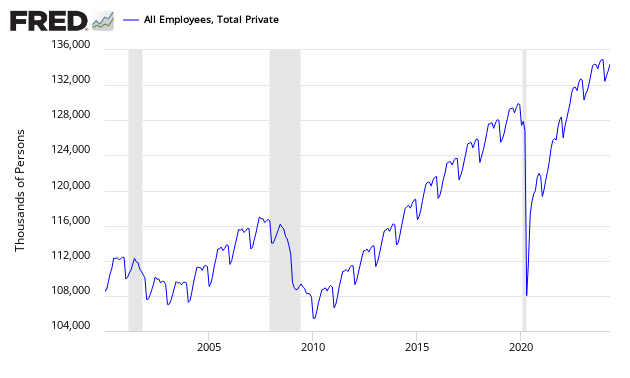
The BLS uses seasonal adjusted data for its headline numbers. The seasonally adjusted employment data is produced by an algorithm. The following graph which shows unadjusted job growth - seasonal adjustments spread employment growth over the entire year. Employment does not really grow in the second half of the year and always falls significantly in January.
Non-Seasonally Adjusted Employment - Private Sector
(Click on image to enlarge)
There is the proverbial question on what is minimal jobs growth each month required to allow for new entrants to the market. Depending on mindset, this answer varies. According to Investopdia, the number is between 100,000 and 150,000. The Wall Street Journal is citing 125K. Mark Zandi said 150K. Econintersect is going with Mark Zandi's number:
- In Econintersect's June 2014 economic forecast released in late May, we estimated non-farm payroll growth at 160,000 (unadjusted based on economic potential) and 229,000 (fudged based on current overrun of economic potential).
- If Econintersect uses employment - population ratios, the correct number would be the number where this ratio improved. Using the graph below, the ratio began to improve starting a little after mid-year. This corresponds to the period where the 12 month rolling average of job gains hit 150,000.
Employment to Population Ratio
(Click on image to enlarge)
Note: The ratio could be fine tuned by adjusting to the ratio of employment to working age population rather than the total population. However, this would not change the big picture that an increase of somewhere around 150,000 (+/-) is needed for the growing population numbers. We have estimated 140k - 160k. The number might possibly be within the range 125k - 175k. Econintersect cannot find reason to support the estimates below 125k.
The question of how changing demographics impact the employment numbers is at the margins of analysis. Econintersect will publish more on this fine tuning going forward, both in-house research and the work of others.


Comments
Log in or sign up to join the conversation.