

I was always fascinated with the concept of autonomous or self-driving vehicles. This fascination began when I was a child after reading L. Frank Baum and John R. Neill’s Scalawagons of Oz book. The book features cars created by the Wizard of Oz. The Scalawagon vehicles have the ability to transport its passengers to their destinations safely and autonomously (sensing and navigating without driver control).
The Scalawagon concept is similar to Apple (AAPL), Alphabet’s (GOOG) (GOOGL), and the auto maker’s efforts to get autonomous vehicles on the road. Alphabet’s (Google’s) self-driving car efforts are being carried out through the company’s Waymo business, while Apple operates through Project Titan.
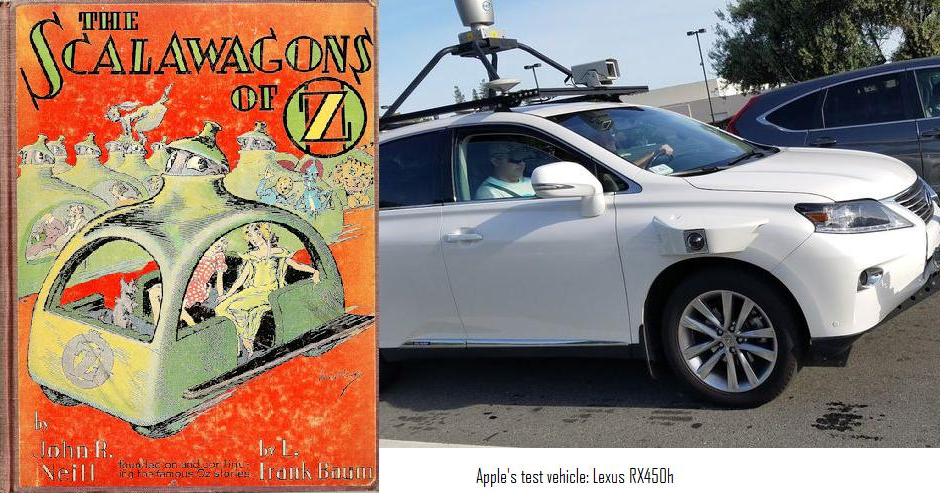
Image sources: pbase.com & Bloomberg
What is now known is that Apple obtained a permit to test autonomous vehicles on public roads in California. It is also known that a white Lexus RX450h SUV equipped with radar, cameras, and sensors, was seen leaving an Apple building. The use of the Lexus RX450h is consistent with a California DMV spokesperson who stated that three of these Lexus SUV’s and six drivers were covered under a permit to test the cars on public roads. Bloomberg first shared the picture of the Lexus on April 27, 2017.
This shows that Apple’s current focus is on developing an autonomous driving system rather than its own branded vehicle. Although it is not clear how profitable the production of an autonomous vehicle system will be, it is easy to see the value of experiencing one to free up time for passengers on long trips and commutes. Businesses such as trucking companies will also benefit from self-driving vehicles as they’ll save on labor costs.
Self-driving vehicles are also important for improving safety. Currently, about 90% of road accidents are caused by human errors. The National Highway Traffic Safety Association [NHTSA] estimates that the use of autonomous vehicles could save 69 lives every year in the United States. The significant savings in lives and the health of drivers adds to the value of autonomous vehicles.
It could be argued that Apple’s efforts to offer its own money-transfer service could eventually evolve into a financing arm that would help customers buy or lease autonomous vehicles. Since automakers make a lot of money through their financing businesses, Apple could also find a way to offer attractive financing deals for its autonomous vehicle system.
Apple could also negotiate licensing deals with auto makers for its autonomous driving system. That would probably be the most practical scenario, assuming that Apple never produces its own vehicles. Licensing would allow Apple to focus on producing an autonomous driving system, while auto makers focus on building the vehicles.
Since the use of autonomous vehicles would be a benefit to consumers to gain valuable extra time and for businesses to cut labor costs, I think Apple and others will find a way to make autonomous driving systems profitable. I think this is likely to be a viable source of revenue for the future.
Many sources are predicting autonomous vehicles to be available to consumers around 2020. However, wide spread use of autonomous vehicles may not happen until 2025 or 2030. There is plenty of work to be done regarding reliability & safety and obtaining approval from governments for widespread consumer and business use on public roads. So, consumers and businesses will have to be patient.
Conclusion
It may take many years before autonomous driving produces significant profit for Apple. However, given the value to consumers & businesses, and for saving lives, an autonomous driving system is likely to turn out to be a profitable business for Apple in my opinion.
With 17.6 million vehicles sold in the U.S. in 2016, I think Apple’s autonomous driving system has a strong market to get a piece of the pie for a new revenue stream. Of course, we’ll probably have to wait about 10 years for sales to materialize on a wide scale. For now, I’m comfortable owning the stock as a result of continued strong iPhone sales that Apple has achieved with each new model, the strong cash flow, the stock appreciation, and the dividend payments.

Comments
Log in or sign up to join the conversation.