

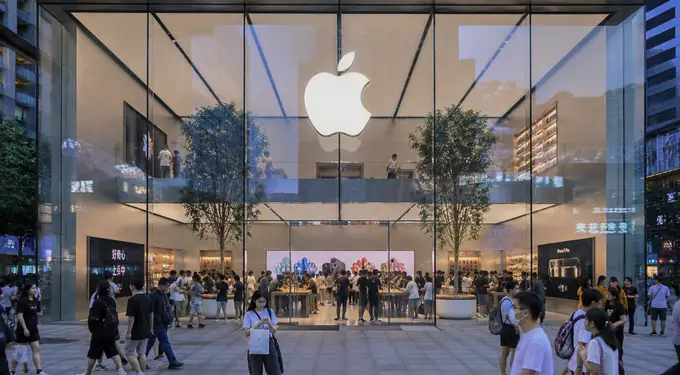
Apple stock AAPL rose about 3% on Tuesday as John Ternus formally took over as chief executive, marking the company’s first CEO transition since 2011 and opening a new chapter for the world’s most valuable technology company.
The leadership change comes at a pivotal moment for Apple.
Ternus, a 25-year Apple veteran who has led the hardware engineering teams responsible for products including the iPhone, Mac and iPad, takes charge as the company confronts a rapidly changing technology landscape, intensifying competition in artificial intelligence and questions over whether its valuation leaves enough room for further growth.
Tim Cook, who succeeded Apple co-founder Steve Jobs in August 2011, becomes executive chairman after transforming the company from a roughly $350 billion business into one valued at more than $4.5 trillion.
Investors appeared to view the transition as an orderly succession rather than a disruptive change.
Ternus’ long experience inside Apple and his product and engineering background could also prove useful as the company prepares for a potentially important new hardware cycle.
Ternus inherits a strong but demanding Apple
Ternus is taking over a company with considerable financial strength and an enormous installed user base, but also one facing expectations that are difficult to meet.
Apple shares have gained about 21% this year, adding to the enormous wealth creation seen during Cook’s tenure.
The stock has risen 2,258% since Cook became CEO, while its total return including dividends has climbed 2,716%, according to Bloomberg data.
Over the same period, the S&P 500 gained 757% on a total-return basis, while the Nasdaq 100 rose 1,499%.
“Under Tim Cook, Apple has created market cap growth at a rate of roughly $32 million an hour, every hour, for nearly 15 years,” Bank of America (BAC) analyst Wamsi Mohan wrote in an Aug. 20 report.
Cook’s tenure also saw Apple’s market value repeatedly surpass that of its technology peers.
The company’s weighting in the S&P 500 has risen to about 7%, from less than 3.3% in 2011, and recently approached 7.9%.
foldable iPhone.
The launch could provide an early indication of how aggressively Apple intends to refresh its hardware portfolio under the new leadership.
The company has already shown signs of product momentum.
In late August, Apple unveiled new Mac mini models powered by its first 2-nanometer M6 chip.
A successful premium foldable could provide another growth opportunity for Apple while helping it compete more directly in a category where rivals have already established products.
Rothschild & Co. Redburn has become particularly optimistic about that opportunity.
The firm upgraded Apple from “Neutral” to “Buy” on Aug. 17 and raised its price target to $400 from $260, citing confidence in the next product cycle and a revamped AI strategy.
This reflects a 23% upside from Apple's current trading levels.
The firm views Apple’s expected entry into the premium foldable smartphone market with the iPhone Ultra as one of the company’s biggest potential catalysts.
Valuation leaves little room for disappointment
The bullish outlook, however, is already reflected to some degree in Apple’s share price.
Rosenblatt raised its price target to $303 from $300 while retaining a Neutral rating.
The firm’s target implies downside from current levels and highlights the valuation challenge facing Apple.
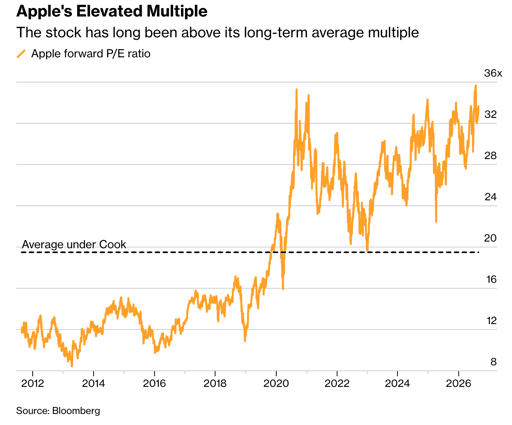
The company trades at a price-to-earnings ratio in the 30s, compared with a 10-year average of about 23.
Rosenblatt’s $303 target is based on a multiple of 31 times estimated fiscal 2027 earnings, which it considers a healthy premium to Apple’s low double-digit EPS growth rate.
Apple’s valuation is therefore substantially higher than it was when Cook took over.
Source: Bloomberg
The stock traded at about 12 times earnings in 2011.
The stock traded at about 12 times earnings in 2011.
That has created a growing divide on Wall Street.
Of the 58 analysts tracked by Bloomberg who cover Apple, 34 have buy ratings.
That is considerably less bullish than sentiment toward other megacap technology companies, including Microsoft (MSFT), Nvidia (NVDA) and Amazon (AMZN).
For Apple, the concern is not necessarily that its business is weakening, but that its stock price may already assume a considerable amount of future success.
Ternus could change Apple’s investment strategy
The transition could also bring a change in Apple’s willingness to invest.
Bank of America’s Mohan has suggested that Apple’s move away from its previous net-cash-neutral objective could indicate a period of higher spending on research and development, capital expenditure and potentially larger acquisitions.
That could become particularly important as Apple tries to accelerate its AI capabilities.
A greater willingness to spend would represent a notable shift from the financial discipline that characterized much of Cook’s tenure.
“The latter two have not been emphasized in the Tim Cook era but AI could require Apple to move with a higher rate of change,” Mohan wrote.
That does not necessarily mean Apple will abandon the capital-return model that has rewarded shareholders.
Rather, Ternus could face a balancing act between funding new technologies and maintaining the financial discipline that helped drive Apple’s extraordinary stock-market performance.
The Cook era sets a difficult benchmark
Cook leaves behind an unusually high standard.
Apple’s transformation under his leadership was not driven by a single revolutionary product comparable to the original iPhone.
Instead, he expanded the existing ecosystem, improved supply-chain efficiency, built out services, and used enormous cash flows to return money to shareholders.
“While he isn’t the visionary showman that Jobs was, or as product-focused, everything he did was to bolster Apple’s ecosystem and operations, which was a very effective way of increasing the company’s value,” Bond said.
“The stock performance reflects that success.”
Now Ternus must demonstrate that Apple can generate another phase of growth without relying solely on the existing iPhone franchise.
AI, foldable devices, services, manufacturing diversification and potentially higher investment will define the early years of his tenure.
The September iPhone event will offer the first major glimpse of that strategy.
For investors, however, the bigger question is whether Ternus can create enough new growth to justify a stock valuation that is already well above Apple’s historical norms.
The transition may be orderly. The expectations surrounding it are anything but.

Comments
Log in or sign up to join the conversation.