

The 25-day quiet period on Appian Corporation (Nasdaq:APPN) will end on June 19, allowing the firm's IPO underwriters to publish detailed positive reports and recommendations on Appian for the first time since the IPO.
Appian provides a low-code software development platform that enables various organizations around the world to develop applications. We expect underwriters will be eager to release positive reports once restrictions are lifted, leading to a boost in stock price as more investors become aware of the company and its fundamentals.
Underwriters include: Barclays Capital, Goldman Sachs, Morgan Stanley, Cannacord Genuity, Cowen & Company, and Pacific Crest Securities.
We first covered Appian ahead of its IPO. At the time, we were optimistic about the company's fundamentals and recommended investors consider purchasing shares. Shares are up 59.9% since then, and we view the upcoming quiet period expiration as a second buying opportunity.
Early Market Performance
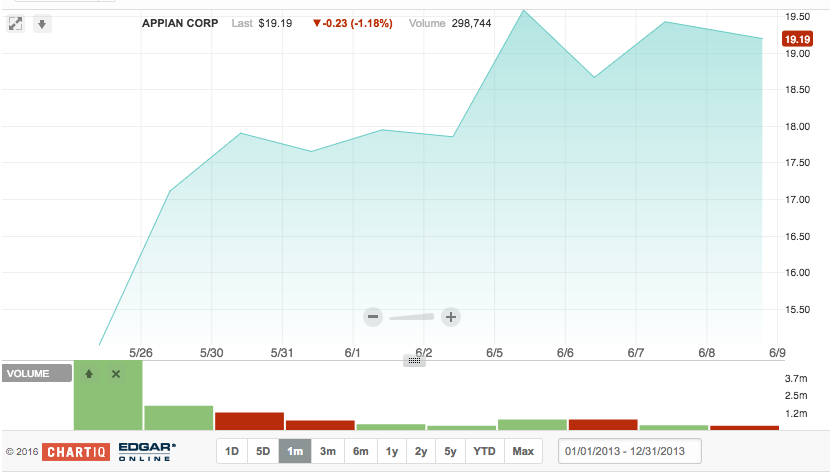
Appian Corporation went public on 5/24, raising $75M through the offer of 6.3M shares at $12, the midpoint of the expected price range of $11 to $13. The stock jumped 25.1% on the first day of trading and then has continued to rise. Currently shares are trading at $18.37 (market close 6.12).
We expect these shares have further room to climb as more investors become aware of this newly public tech business.
(Click on image to enlarge)
Business Overview: Provider of Low-code Software Development Platform
Appian Corporation provides a low-code software development platform that enables companies to develop applications. Appian's platform automates the creation of data flows, reports, records, and forms, as well as other software elements that typically require coding. Companies are able to easily design, build and implement enterprise-level applications through the platform. The company provides customer and professional support services.
Its clients include transportation, manufacturing, energy, media, telecommunications, government, healthcare, and financial services organizations. The company was founded in 1999 and is headquartered in Reston, Virginia.
Appian launched its cloud platform in 2007, and it continued to improve the Appian platform with its records data management technology in 2012 and its patented Self-Assembling Interface Layer, also called SAIL, in 2013. The SAIL technology enables customers to develop application immediately for deployment across a full range of desktop and mobile devices. The company introduced Quick Apps in 2016, and this product enables non-professional developers to develop web and mobile application with no coding.
In 2016, Appian generated the majority of its revenue through sales of software, subscriptions, and support. To a lesser extent, the company derived revenue from the sale of perpetual software license agreements and related maintenance and support agreements. Subscriptions vary in length from one to five years, with the average being three years.
Since its inception, Appian has invested in its professional services organization to help customers build and deploy applications on their platform. Appian has several strategic partnerships with companies, including Deloitte, PricewaterhouseCoopers (NYSEARCA:PWC), and KPMG, that refers clients to Appian for professional services using the Appian platform.
Financial Highlights
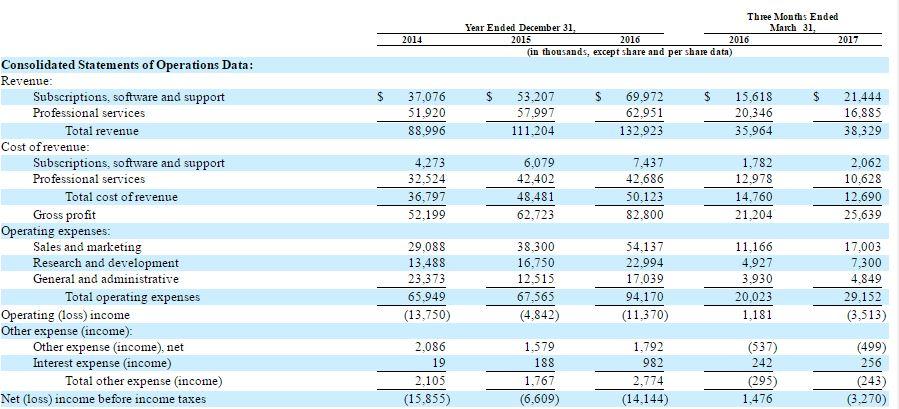
Appian generates the majority of revenue through subscription as well as professional services. Both revenue streams have been growing, with subscription services growing at a faster rate and accounting for a larger percentage of the total revenue (see table below). Subscription services generates a significantly higher margin, and so it is encouraging to see this growth. The company has been spending heavily on sales and marketing and has not yet generated profits.
(Click on image to enlarge)
(S-1/A)
Management Team
Matthew Calkins co-founded the company and serves as CEO, President, and Chair of the board, positions he has held since inception in 1999. His previous experience comes from senior positions at MicroStrategy. He was awarded the 2004 Ernst & Young "Entrepreneur of the Year" award in the Emerging Technology & Communications category. Calkins received a B.A. in Economics from Dartmouth College in 1994 where he won Dartmouth College's Rockefeller Prize for outstanding Economics Graduate.
Mark Lynch serves as Chief Financial Officer, position he has held since October 2008. Previously, Lynch served as the Chief Financial Officer of MicroStrategy Inc. He holds a B.S. in Accounting from Pennsylvania State University and an M.B.A. in Finance from George Washington University
Conclusion: Consider Purchasing Shares Ahead of 6.19 Event
We were bullish on this company ahead of the IPO and we now view the company as a second buying opportunity for investors.
We expect the stock has further room to climb, and the expiration on the quiet period will enable underwriters to spread word on the company, most likely speeding up the stock boost.
We recommend investors consider purchasing shares ahead of the June 19 expiration date to benefit from this expect boost.


Comments
Log in or sign up to join the conversation.