
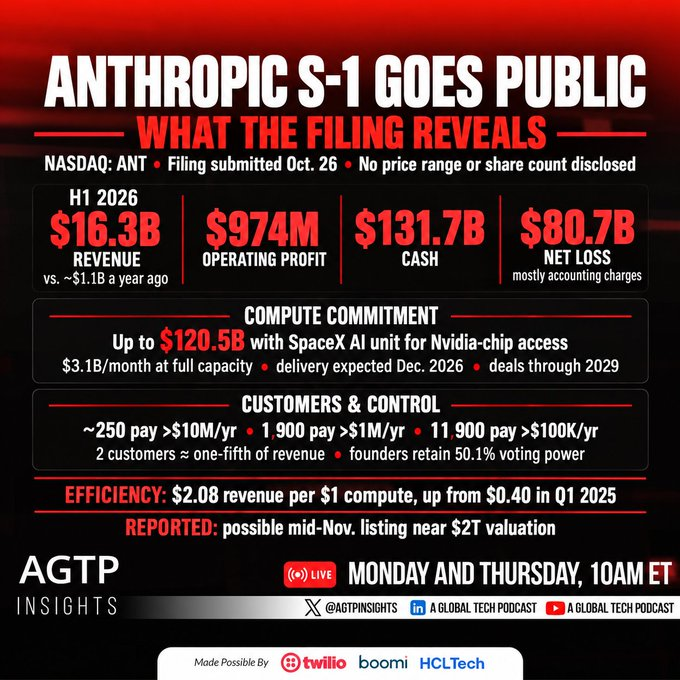
On Monday morning, Anthropic filed an SEC S1 form to begin the listing process on the Nasdaq under the symbol ANT. Three topics within the filing caught our attention.
Let’s start with the financials, which are better than the headlines. Revenue for the first half of 2026 reached $16.3 billion, up sharply from $1.2 billion a year earlier. The headlines report an $80.7 billion net loss, which sounds horrendous, but, as we show below, $72.4 billion of it is a non-cash charge for revaluing convertible notes and similar instruments. That primarily reflects the company’s valuation rising. The company actually had an operating profit of $974 million. Cash and short-term investments stood at $131.7 billion at June 30.
The future funding needs are timely, given Meta’s stock split, which essentially opens up an equity funding line. Anthropic spent $8.9 billion on compute and infrastructure in the first half alone, exceeding the $7.3 billion spent in all of 2025. The filing discloses purchase commitments and leases running through 2045, with a portion due before 2030 and the remainder between 2031 and 2045. We have seen credible estimates putting that number above $500 billion. Anthropic states it intends to secure further compute beyond those commitments and build its own data centers. To wit, a company sitting on $131.7 billion is telling investors it will need significant financing going forward.
Finally, the voting structure. The seven co-founders will hold a single share of Class F common stock entitling them to 50.1% of total voting power, with no economic rights. A separate trust elects a majority of the board through another nonvoting class. The filing warns the structure “may effectively eliminate the ability of holders of our Class A common stock to influence important decisions, including a change in control.” This structure takes a page from the Meta playbook, separating control of the company via voting rights from capital financing.
There is actually a fourth topic that we share in the Tweet of the Day below.
What To Watch Today
Earnings
Wednesday, October 28, 2026. Q3 reports from market-moving names.
Company (Ticker) | Timing | EPS Est. | Rev. Est. |
|---|---|---|---|
GE Vernova (GEV) | Before open | $4.01 | $12.00B |
Amphenol (APH) | Before open | $0.73 | $9.49B |
Automatic Data Processing (ADP) | Before open | $2.77 | $5.47B |
Phillips 66 (PSX) | Before open | $11.79 | $43.23B |
Vertiv Holdings (VRT) | Before open | $1.82 | $3.76B |
Microsoft (MSFT) | After close | $4.72 | $90.74B |
Alphabet (GOOGL) | After close | $3.00 | $127.83B |
ServiceNow (NOW) | After close | $1.02 | $4.09B |
KLA Corp. (KLAC) | After close | $1.18 | $4.04B |
Source: Yahoo Finance consensus estimates, with dates and timing confirmed against the Nasdaq earnings calendar. As of October 27, 2026.
Economy
Wednesday, October 28, 2026. Day two of the FOMC meeting. All times ET.
Time (ET) | Release (Period) | Prior | Consensus | Forecast |
|---|---|---|---|---|
8:30 AM | Goods Trade Balance, Advance (Sep) | -$132.1B | -$130.0B | -$108.0B |
8:30 AM | Wholesale Inventories MoM, Advance (Sep) | 0.5% | 0.5% | 0.3% |
10:30 AM | EIA Crude Oil Stocks Change (wk Oct 23) | -3.061M | n/a | 0.8M |
2:00 PM | FOMC Rate Decision (upper bound) + Statement | 4.00% | 4.00% | 4.00% |
2:30 PM | Fed Chair Press Conference |
Fed speakers: None outside the decision. The Fed is in its meeting blackout until the press conference. The target range is 3.75% to 4.00% after September’s hike, and futures price less than a 10% chance of another hike today.
Source: Trading Economics (primary), confirmed against the Census Bureau advance economic indicators schedule, the EIA weekly schedule and CME FedWatch. As of October 27, 2026.
Market Trading Update
Yesterday, we discussed how hedge funds sold technology at the fastest pace since 2016 while retail investors stepped in to buy semiconductors. Today, let’s look at what that tug-of-war means for the index, because AI concentration risk now sets the margin of error for the entire portfolio.
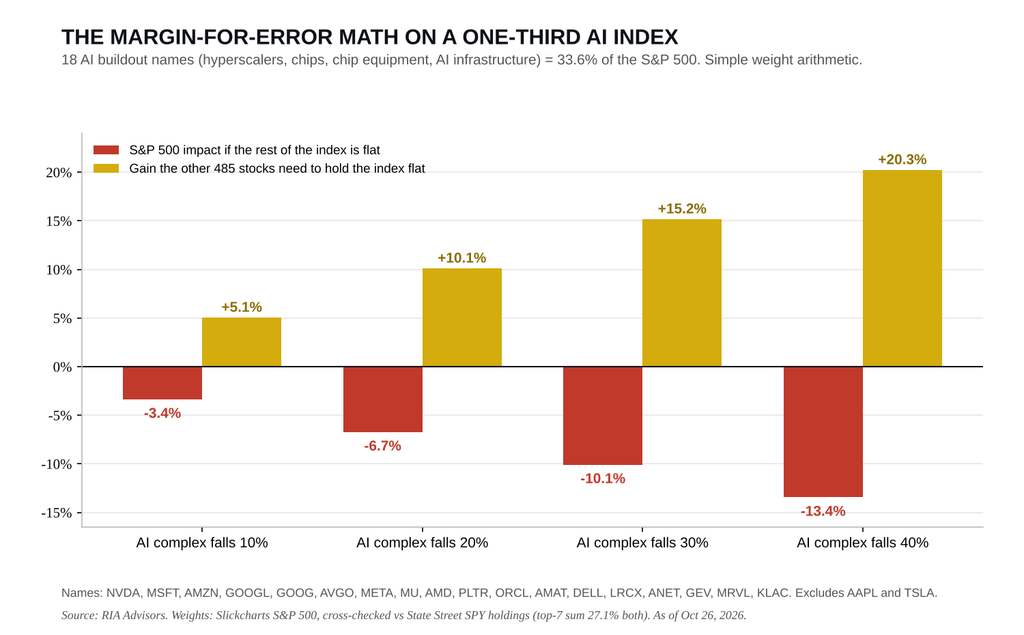
Nohshad Shah at Citadel Securities made the point well in a note on Friday. With so much of the market levered to the AI trade, he wrote, there is “precious little margin for error.” The weights back him up. As of Monday’s close, 18 AI buildout names, from Nvidia and the hyperscalers to the chip equipment and power suppliers, make up 33.6% of the S&P 500. Nvidia, Microsoft, Amazon, Alphabet, Broadcom and Meta alone account for 27.1%.
That math cuts both ways. If the AI complex drops 20% and nothing else moves, the S&P 500 loses 6.7%. To hold the index flat, the other 485 stocks would need to rally 10.1%. Notice in the chart below how quickly the required “support” from the rest of the market escalates.
Here’s where it gets interesting. The rest of the market has been doing the lifting this month. Through Monday, the equal-weight S&P 500 (RSP) is up 4.5% in October, while the cap-weighted SPY is up just 0.4%. The RSP/SPY ratio bounced from 27.10 on October 7th, its lowest reading in 15 months, to 28.39. It’s back above its 50-day average and pressing against its 200-day at 28.54.
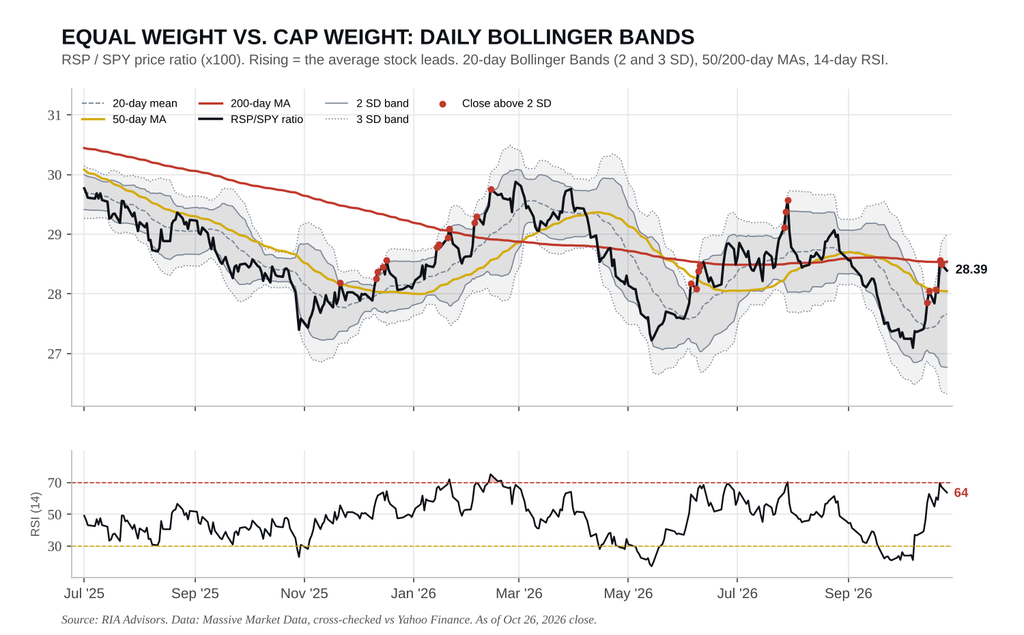
The optimist calls that healthy rotation, and that may indeed be the case. However, it has only been a few weeks since a broadening market and a market losing its leaders look exactly alike. That doesn’t necessarily equate to a massive change in leadership. The difference shows up in the index level. The S&P 500 closed Monday at 7,676.77, still just under its 50-day average near 7,700, even with the average stock rallying. That’s what one-third concentration does. The other two-thirds can run hard and still only tread water.
Today is the test. The Fed announces at 2:00 p.m. ET, and Microsoft and Alphabet, together accounting for roughly 11% of the index, report after the close. Shah’s capex warning is the lens to use. Meta spent $34.9 billion in the third quarter against $32.8 billion of operating cash flow. If two more hyperscalers show the same squeeze, the “sell the capex” trade gets another leg.
Such is the problem with a market built on one narrative. It doesn’t need to be wrong to hurt you. It only needs to be less certain.
In our Equity Growth model, AI exposure stays at target weight, NOT above it, heading into Wednesday. If you’re overweight the AI complex, trim back to target now while the equal-weight rally provides the liquidity. Put the proceeds to work in the sectors doing the lifting, and keep stops below the 200-day average near 7,295.
A thin margin for error is not the place to add leverage.
Who Will Survive The “AI Bubble”
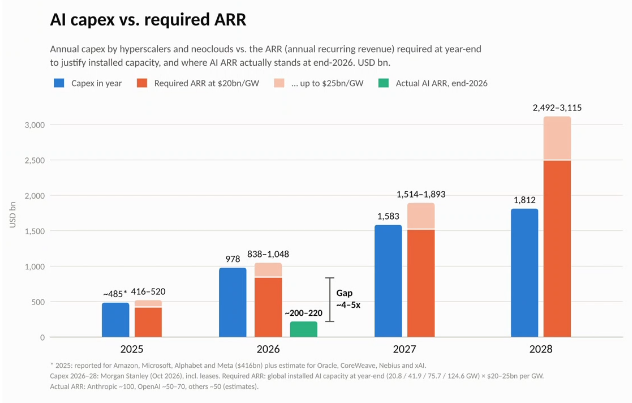
There’s a lot of talk about AI being a bubble. To be clear, AI is not a bubble; the technology is real and will most likely fundamentally change how we do business and, to some degree, how we live our lives. However, some stocks will likely go bust in the process. That is a hard fact of every major US innovation, from the railroad companies in the 1800s to today. To help appreciate the problem facing companies and how to better position yourself and try to avoid those companies that do not make it, we share the Morgan Stanley graph below.
The graph aggregates total spend and revenue by hyperscalers and neoclouds. For purposes of this discussion, let’s ignore the numbers in the graph and focus on the framework. In 2026, it shows that the money these companies spend to build out AI computing dwarfs the revenue they generate. For 2027 and 2028, it shows estimates of capex spending alongside the annual recurring revenue (ARR) that would justify such spending.
Again, ignore the numbers. The graphic really shows that AI companies face a timing issue. Can revenue grow soon enough to justify and, importantly, finance the spend? The neoclouds, like CoreWeave, now facing 15% borrowing rates, better hope revenue picks up quickly. For big hyperscalers like Amazon, Meta, and Google, they have significant revenue from other sources and the ability to keep funding, reducing reliance on revenue timing. Taking it a step further, a neocloud default could create an opportunity for a hyperscaler or other company to buy data centers and/or GPU chips for fractions of a dollar.
Tweet of the Day


Comments
Log in or sign up to join the conversation.