

As US equities continue their latest sugar high run, I thought several tweets and quotes might be informative (and perhaps, insightful). Here are the tweets that I posted today.
Proving the axiom "To a hammer everything looks like a nail", the dealmaker in chief provides his perspective.
Donald J. Trump: If Cuba is unwilling to make a better deal for the Cuban people, the Cuban/American people and the U.S. as a whole, I will terminate deal.

Pro investors choose to ignore. Economists brace for Trump rewrite of global financial diplomacy.
Real Time Economics: Economists Brace for a Donald Trump Rewrite of Global Financial Diplomacy
If the president-elect shifts away from post-World War II international institutions, ‘chaos will rule the day’, one says.
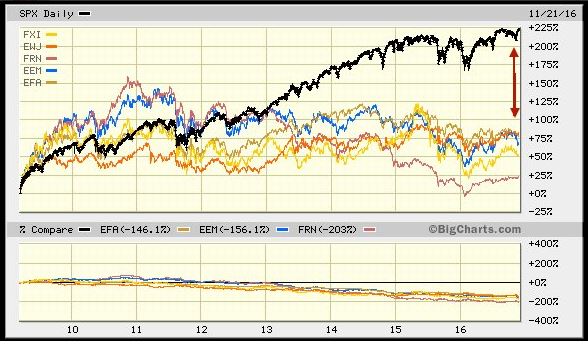
- In US dollar terms, with each new record high the gap between US and global stock markets continues to widen.
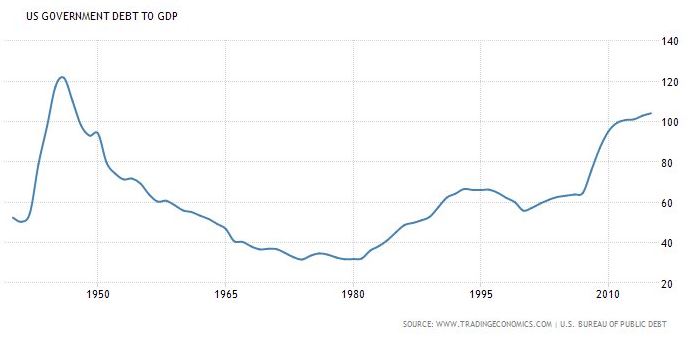
- Expectations of US fiscal spending to ramp up, US govt debt to GDP at a post-WW II high. Any economic downturn would explode the number.
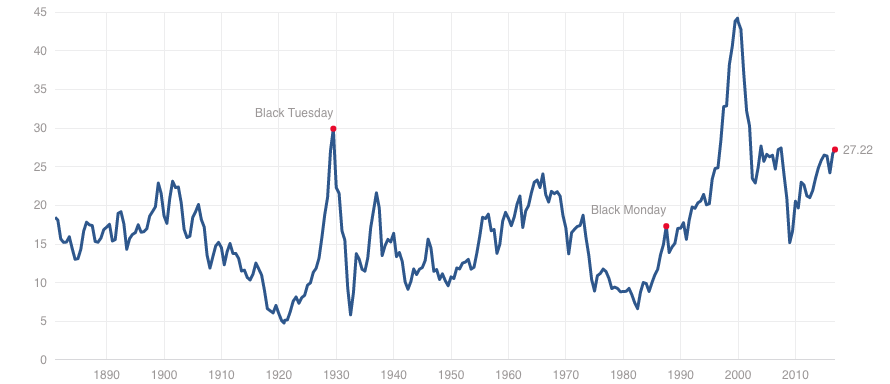
- Shiller's CAPE sits right around its 2007's level exceeded only by the 1929 and the turn of the century tech bubble peaks.
(Click on image to enlarge)
And here is a summary of some of Wall Street’s top strategists are telling their clients, including target levels for the S&P 500 and operating earnings expectations. Note the group think around both target levels and especially earnings expectations. Not a bear in the house. Then again there never is.
Bank of America, Savita Subramanian — Target: 2,300; EPS: $129
“…2017 could be anything but normal. We see fat tails and a binary set of outcomes. Against the backdrop of elevated valuations, slow growth and limited scope for credit expansion, our target and the recent rally are reliant on policymakers’ ability to deliver growth next year. Trump’s comments on trade and GOP comments on deficits/spending could drive big market swings in the coming months. Risk-reward will be more important than absolute targets. ”
Barclays, Jonathan Glionna — EPS: $127
“…Our base case forecasts indicate 3.4% growth in sales for the S&P 500 in 2017, after two years of stagnation. We expect a rebound in U.S. nominal GDP to underpin the recovery. Europe continues to offer dim prospects for sales growth although the more impactful drag comes from the U.S. dollar. While sales growth is the primary driver of EPS growth, costs certainly matter and wage inflation dampens our expectations…”
Canaccord, Tony Dwyer — Target: 2,340; EPS: $130
“…Despite the likelihood of a temporary pause in the upside given recent ramp, we remain buyers, because: (1) our positive fundamental core thesis remains in place, (2) economic data and EPS continues to improve, and (3) our key tactical indicators suggest a favorable risk/reward environment…”
Citi, Tobias Levkovich — Target: 2,325; EPS: $129
“Trumped up could trickle down (to EPS)…Tax cuts could be quite stimulative to S&P 500 EPS. If one assumes a 20% statutory tax rate with no deductions versus a current effective tax rate running at near 27%, that might add as much as $12 of 2017 EPS to Citi’s current estimate of $129…A stronger US dollar is plausible if growth and inflation ensue, thereby limiting the earnings benefits. Higher rates from the Fed and possible “crowding out” plus inflation pushing bond yields upward are viewed as offsetting negatives especially if the dollar climbs and eats into earnings. Every 10% move in the greenback might shift EPS by around 2% on an annual basis and therefore must be tracked as well…”
Deutsche Bank, David Bianco — Target: 2,350; EPS: $130
“S&P 500 likely to reach 2250 by the inauguration…we think the market is under appreciating the likely big boost to S&P EPS from a lower corporate tax rate and the boost to Bank profits from rising yields (and lower pension expense) and the much higher chance now of a long lasting economic expansion that rivals the 10 year US record. We’re more confident now that the S&P will reach 2500 in 2018 before suffering its next bear market.”
Goldman Sachs, David Kostin — Target: 2,200; EPS: $116
“Steady but unspectacular profit growth will be a hallmark of 2017 earnings…Looking under the surface, we expect two issues will drive the earnings discussion next year: 1. The US economy will remain stuck in a slow secular growth regime…2. S&P 500 margins will increase slightly next year, but remain well below the peak.”
JPMorgan, Dubravko Lakos-Bujas — Target: 2,300 (by early 2017)
“Expectations of decreased regulation, favorable tax reform, increased fiscal spending, and less congressional gridlock should drive stronger revenue growth and higher net income margins. Further, the removal of election uncertainty and some form of cash repatriation should result in increased investment activity. Also, investor equity exposure is not high given de-leveraging ahead of elections; this combined with reflation could help reverse flows from bonds into equities.”
Morgan Stanley, Adam Parker — Target: “mid-single digits”
“…our view is that more uncertainty and more fundamental volatility is likely and that historically these elements were greeted with lower multiples and more cautious risk-taking. Our bias is to get long gridlock and uncertainty relative to what has been priced in. That being said, our base case remains mid-single-digit upside to the S&P 500 on a 12-month basis.”
RBC, Jonathan Golub — Target: “double digits”; EPS: $127
“We believe that rising earnings and multiples will push equity returns into the double digits from our previous high-single-digit baseline. A pickup in inflation and rising business confidence should result in an acceleration in bottom-line growth…Multiples are likely to shift higher for three key reasons: (1) the direct impact of lower corporate tax rates; (2) the benefits of more normal nominal interest rates; and (3) improved business and investor optimism.”
UBS, Julian Emanuel — Target 2,300; EPS: $127
“…Age alone does not end the Bull – a recession, catalyzed by rising rates or an exogenous shock, has begun shortly after each major Top of the past 25 years. And while Fed hikes “start the clock”, neither valuation excesses nor signs of a recession are apparent. 2017 should see balance sheet strength, a return to earnings growth after a two-year drought, and rising interest rates.”
Investment Strategy Implications
US stocks, alone at their lofty levels, have gotten here, in large part, through the unprecedented actions of the Fed. Aided and abetted by the other two key central banks, but not producing as much of an equity kick to their stock markets, the ECB and BoJ have followed suit. China, in the meantime, continues to prop up their economy with infrastructure and building projects producing more and more ghost towns while exports are at risk of a trade war with the US1 and domestic consumption continues its slow acceptance. Lastly, we have the US about to embark on an unprecedented presidency with a man the bulls hope will be (a) reigned in and (b) produce big tax breaks and fiscal spending projects that will goose the lumbering US economy and, therefore, corporate profits to ever higher levels.
In the bizarre concoction of a global political and economic scene, professional investors cling to their methodologies of bottom line DCF inputs secure in their beliefs that economists and other experts will alert them early enough to anything that might upset their comfort levels – kind of the same feeling as 2000 and 2008, the last two US presidential years during which US stocks made new highs. And so it goes.
***
1 US dollar strength making this increasingly more likely as political commitments must, at least in part, be met.


Comments
Log in or sign up to join the conversation.