

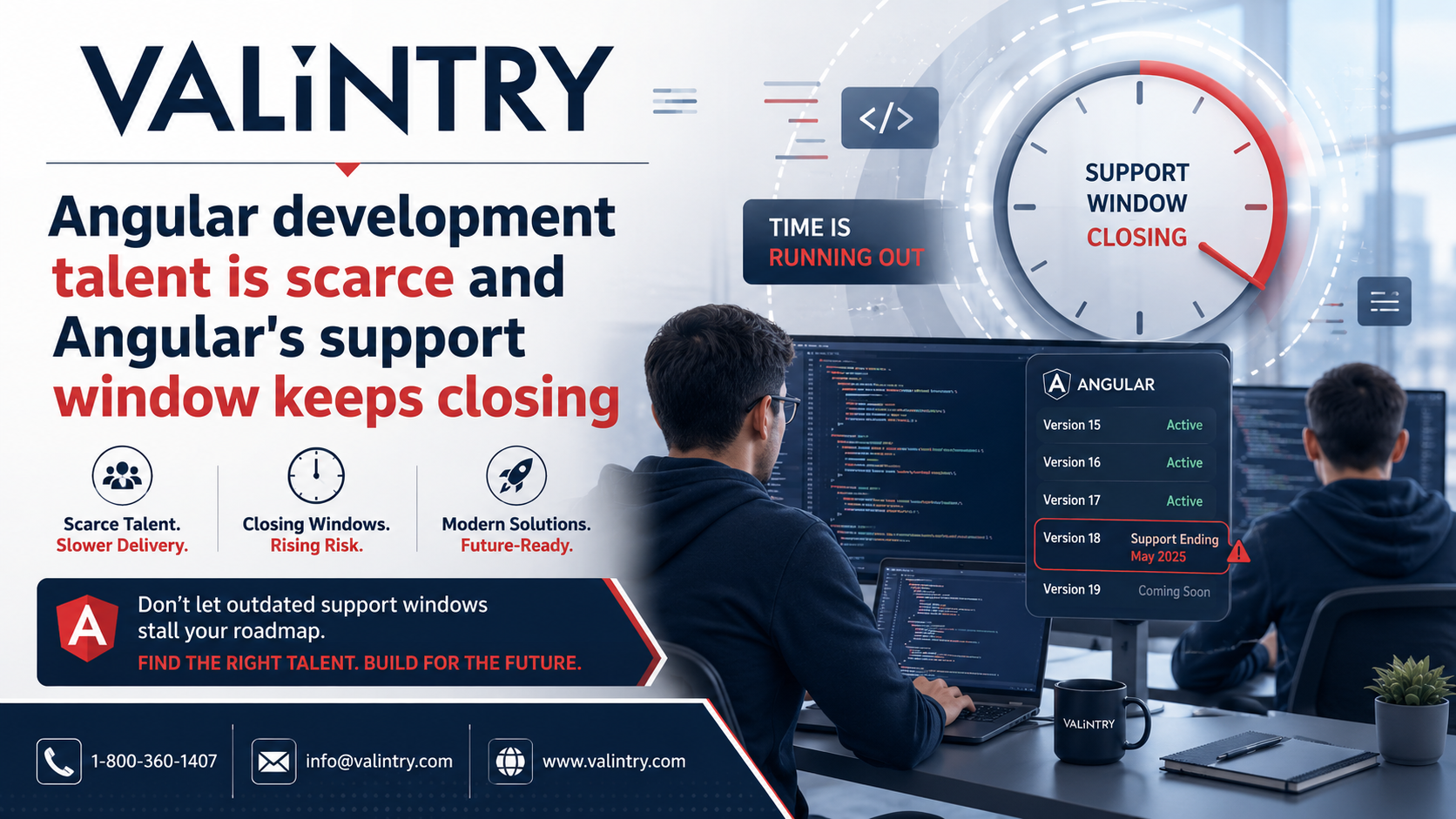
Angular gives every major version 24 months of support, then retires it: 12 months of regular updates, followed by 12 months of critical fixes only. The clock doesn't pause while you interview candidates, according to Angular's own release and support documentation. Versions 2 through 19 are already unsupported. If your team still runs one, the risk is active right now.
This creates a real problem for anyone trying to hire. Angular development talent doesn't sit idle waiting for a job post to go live. The people who know the framework well are already employed, often on teams racing the same clock you are. A slow hiring process costs more than time. It can cost you a supported application.
This article maps the constraints that control your hiring options. Some are fixed, and no strategy changes them. Others are assumptions your team has never tested. Once you know which is which, the right path gets clearer.
What actually limits your Angular hiring plan
Every hiring plan runs into limits. The real work is telling the fixed ones from the flexible ones. A fixed limit stays put no matter what you do, while a flexible one only feels fixed because nobody has tested it yet.
Budget looks fixed, but it rarely is. A team can shift money from other line items when the case is strong enough. Timeline behaves differently. If your Angular version loses support in 4 months, that date doesn't move.
Skill supply is the constraint most teams underestimate. Angular development talent draws from a smaller pool than some competing frameworks. Only 19.8% of professional developers report using Angular, according to the 2025 Stack Overflow Developer Survey, compared to 46.9% for React. That gap doesn't make Angular a poor choice. It means the search for qualified people takes longer and often costs more.
Regulation is a constraint many teams miss. Bring in contractors instead of employees, and worker classification rules apply. Getting that wrong creates real legal exposure, so it pays to resolve it before picking a staffing model.
Angular developer staffing and the shrinking pool of specialists
Angular developer staffing plans built on last year's numbers are already out of date. The Bureau of Labor Statistics puts the median wage for software developers at $133,080 as of May 2024, with 16% growth projected through 2034. That's roughly twice the average across all occupations, and it means a budget built on old numbers will fall short.
Geography adds another layer. A local-only search narrows the pool further when it's already tight. Teams open to remote or nearshore developers usually fill the role faster, without lowering their bar for skill.
Capacity matters too, and it's often the quietest constraint. A hiring manager stretched across 3 open roles can't properly screen Angular candidates on top of that load. An outside recruiting partner closes that gap faster than one more task on a full plate.
Why hiring timelines slip when demand outpaces supply
Demand for developers isn't a short-term spike. CompTIA's State of the Tech Workforce 2025 report projects tech jobs will grow at about twice the rate of the overall economy, with roughly 352,000 tech positions needing replacement every year through 2034. That demand doesn't fall evenly. Angular and other specialized frameworks feel the pressure hardest, since the qualified pool was already smaller to start.
Assumptions cause real damage here. A team may assume a senior Angular hire takes 3 weeks, since that's how long a general software role took. That assumption was never tested, and the deadline gets missed. Teams that track their own past time-to-hire make better plans than teams that guess.
Contract staffing carries its own regulatory constraint
If your response path includes contractors, the regulatory constraint from earlier gets concrete. The Department of Labor's 2024 independent contractor rule took effect on March 11, 2024, restoring a six-factor test for classifying workers correctly. The factors weigh control, investment, permanence, and how central the work is to the business.
Misclassifying a contractor isn't a paperwork slip. It creates back-pay exposure and audit risk that can outlast the project itself. Teams that plan to hire AngularJS developers on a contract basis should confirm classification before the contract starts, not after a dispute forces the question. A staffing partner who already applies this test correctly removes the guesswork from the decision.
Choosing the right response path
Once the real constraints are clear, several response paths open up. Each one fits a different situation. The conditions on the ground, not preference, should decide which path a team takes.
A direct hire suits a team with a stable, long-term Angular workload and real budget headroom. Contract staffing suits a team facing a firm deadline, like a support window closing in a few months, where speed matters more than headcount. Upskilling an internal developer suits a team with strong general skills already in place and enough runway to train before that deadline hits.
Teams without the internal capacity to run these searches have another option. A specialized IT staffing agency closes the gap between the constraint and the outcome. The right partner already has a vetted pool and already understands the classification rules, so it can move fast without cutting corners on skill.
The first constraint to resolve
Start with the support clock. Find out which Angular version your application runs and how many months of support remain. That single fact turns every other decision, budget, timeline, staffing model, from a guess into a plan. Once the deadline is real and specific, the right response path gets obvious, and the search can begin with a clear target.
Frequently asked questions
How long does Angular support a single major version?
Angular supports each major version for 24 months in total. The first 12 months include regular feature updates and patches. The following 12 months cover only critical fixes and security patches. After that window closes, the version gets no further official support. That's why teams on older releases face real security risk.
Why is Angular development talent harder to find than talent for other frameworks?
Angular has a smaller share of the developer population than some competing frameworks. Survey data puts Angular usage among professional developers well below React's, which shrinks the available pool. A smaller pool means longer searches and more competition for the same qualified candidates.
Should I hire an employee or a contractor for an Angular project?
The right choice depends on your constraints. A long-term, ongoing Angular workload usually favors a direct hire. A project with a fixed deadline, like migrating off an unsupported version, often favors a contractor instead. Either way, confirm the worker classification is correct before the engagement starts.
What is the biggest compliance risk in contract staffing?
The biggest risk is misclassifying a worker as an independent contractor when the relationship actually functions like employment. Current federal rules apply a six-factor test that looks at control, investment, and permanence together. Getting this wrong can expose a company to back pay, penalties, and audit risk.
Does remote hiring actually help fill Angular roles faster?
Yes, in most cases. Opening a search to remote or nearshore candidates widens the pool beyond a single local market, which shortens the time it takes to find a qualified match. It works best when paired with a clear process for vetting skill remotely, so speed doesn't come at the cost of quality.
How much does hiring urgency change the right approach?
Urgency shifts the balance toward contract staffing or a staffing partner, since both can move faster than a full search. Without a firm deadline, a direct hire with a longer, selective process often fits better long term. Match the approach to the actual clock you're working against, not the one you assume you have.
For more info Contact us 1-800-360-1407 or send mail at [email protected] to get a quote
Comments
Log in or sign up to join the conversation.