

“Iran has repeatedly said it needs to reach a level of output of at least 4 million bpd before it agrees to any deal, but one OPEC source said on Thursday the latest request from Iran was to set a target as high as 4.2-4.3 million bpd.” (Alex Lawler and Rania El Gamal, Reuters, Sept. 9,2016)
Iran has been the main stumbling block to an initiative earlier this year by OPEC and non-OPEC Russia to freeze output globally.
Iran has demanded to be excluded from any OPEC arrangement to curb oil supply and has been sharply increasing its oil production. Tehran has indicated that it first needed to regain market share lost due to sanctions before it would consider a freeze on production.
Once western sanctions against Iran were eased in January, crude output levels in Iran rapidly soared to 3.64 million barrels per day in June from an average of 2.84 million bpd in 2015.
From a supply side perspective to world markets, it is interesting that cut back in production of shale producers in the US has been roughly offset by Iran’s increased production.
Since June, however, Iran’s output has roughly plateaued at around 3.63 million bpd in August. In other words, the last three months of data seem to imply that Tehran is having some difficulty in expanding production above recent levels.
In the final analysis, OPEC members will be very cautious in trying to increase the price of oil.
While OPEC countries would like to see the price of oil increase, they do not want to send prices so high that North American shale producers increase their production.
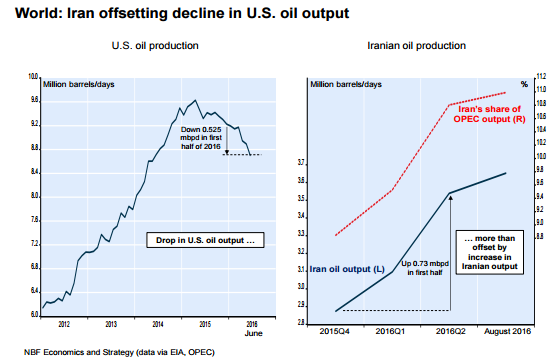
(Source: National Bank, Hot Charts, Sept. 14, 2016)


Comments
Log in or sign up to join the conversation.