

America is living on borrowed barrels. ExecSpec’s Kurt Kallaus thinks the calendar is about to make that obvious—and that the bond market is already pricing the same pressure.
Scraping the Bottom
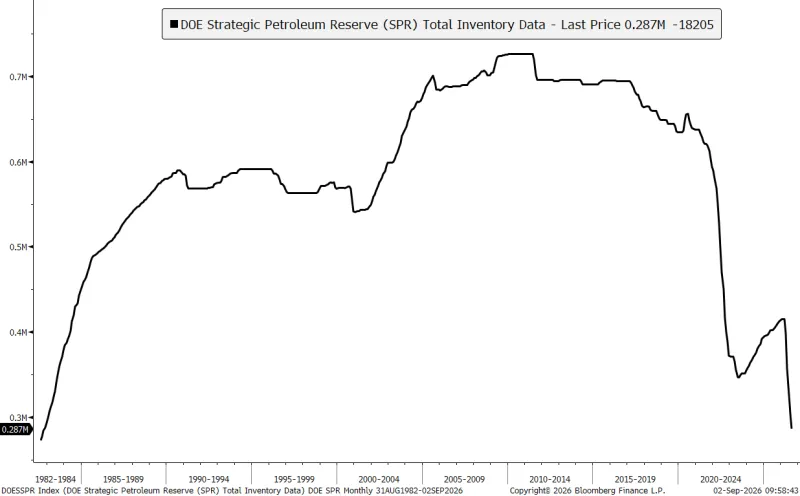
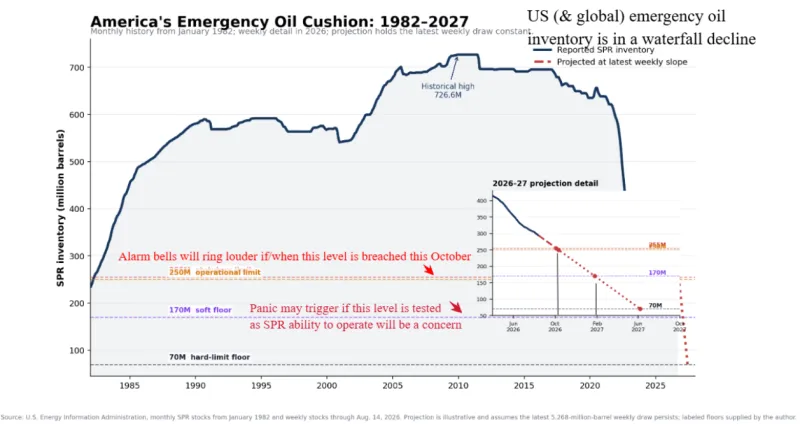
Oil in the Strategic Petroleum Reserve (SPR) is not a checking account. It sits in salt caverns, and those caverns cannot be drawn to zero. Leave too little behind and the system stops working—the way a large propane tank stops working if you drain it completely and then expect it to function without being cleaned out and rebuilt. The United States is not at that floor yet; however, at the current pace of withdrawals, Kallaus says, it could hit the first political threshold by late September or the first half of October: the level that requires approval to go lower.
US Reserves Rapidly Depleting
Source: Bloomberg
SPR Operational Limits
Source: EIA, ExecSpec.net
Crude and the Cost of Money
That date matters because crude and the cost of money are not separate stories. Kallaus has been tracking them moving “in almost military synchronicity.” Different amplitudes, same direction. Elevated oil and gasoline feed inflation statistics and, more immediately, inflation expectations. Those expectations are what bond investors demand compensation for. As the commodity complex stays firm—or rises on another disruption—Treasury yields tend to rise with it. The 10-year had already reached 4.8 percent, a print he said could project toward 4.9 percent and the psychologically charged 5 percent area. That is not, in his telling, a forecast that the economy collapses. It is a higher cost of credit and a fear factor that pushes cash up and stocks down.
Market-Moving Event
The SPR clock is what could tighten that loop. A request for permission to breach the reserve floor would not shut the system down. It would, in his view, flash a warning. “It’s a little bit of a scare in the markets, I believe, if that were to occur or be announced.” Keep drawing at the same rate into the first quarter of next year and the problem changes character. Accessible reserves run out. Exports get rationed. Supply chains get rearranged. “That would cause quite a mess.” In that world he expects oil at new record highs—and, given the oil-yields link he is watching, still-higher borrowing costs and a significantly lower stock market.
China Can Wait
The drain is not happening in a vacuum. The tether is the unresolved fight around Iran, the Red Sea, and the Strait of Hormuz. He expects that risk to rise through September and October—especially over the next nine weeks—because this is attrition, not a conflict that ends on an election timetable. More attacks, higher crude, stickier inflation expectations, higher yields: that is the coalition he is warning about.
China is not the backstop. Kallaus estimates its reserves at four or five times those of the United States, enough at mid-August draw rates to last through next year and into 2028. “If you’re being chased by a bear, the question of who’s faster is all you have to worry about.” China can outlast the United States and Europe. It has no need to force Iran’s hand.
He is not arguing that the worst case arrives on schedule. He is arguing that the SPR’s first operational and political limit is now a near-term date, and that date sits inside the same window as the oil-and-yields linkage: if crude stays elevated or breaks higher, inflation expectations—and the bond vigilantes—move with it.



Comments
Log in or sign up to join the conversation.