

“The Federal Reserve in recent years has made considerable progress in achieving its dual mandate: to promote full employment and price stability… The economy is approaching the “bliss point,” where the difference between unemployment and the natural rate of unemployment is zero and where the difference between the core PCE inflation rate and the target inflation rate is also zero.” (Federal Reserve Bank of Dallas, March 17, 2017, Update)
The U.S. Fed has always framed its monetary policy in terms of a dual mandate. Specifically, the Federal Reserve aims to foster economic conditions that achieve both stable prices and maximum sustainable employment.
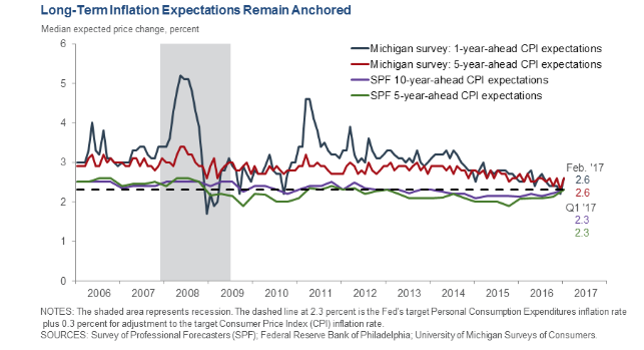
The Fed believes that a 2% inflation rate (as measured by the annual change in the price index for personal consumption expenditures, or PCE) is consistent with its longer-run objectives.
On the employment front, the Fed’s target is the long-run “normal” rate of unemployment, which is thought in the U.S. to be between 4.5% and 5%, with a median value of 4.7%.
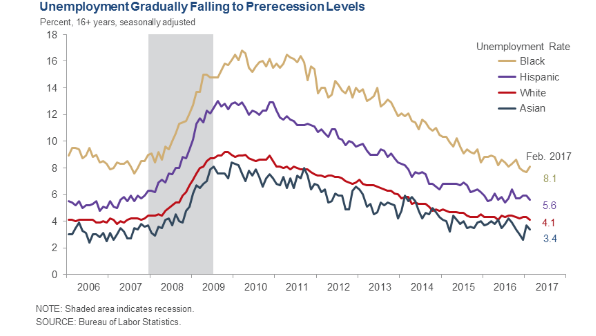
Despite a recent period of slow economic growth, the U.S. inflation and the unemployment rate are both close to the mandated targets. The latest core inflation rate was 1.8% y/y and the unemployment rate was 4.4%.
The following two charts published by the Federal Reserve Bank of Dallas highlight that the dual mandate is close to being achieved. That is, unemployment has fallen into the pre-recession low range and inflation expectations seem firmly anchored at around 2% or lower.
In other words, as in the Goldilocks fable, the American economy is neither too hot, nor too cold, but just about right.
Of course, achieving “Bliss” by central bank standards is a far cry from concluding that all is well with the economy. The American economy, perhaps even more than the Canadian economy, has severe structural challenges.
There is the unfair distribution of income and wealth that is at the core of the inequality problem, and of course, there are the longer-term concerns about the U.S. balance of payments deficits and government indebtedness.
Even though monetary policy Bliss may be in sight, few Americans are really that content.


Comments
Log in or sign up to join the conversation.