


Income growth has been slowing in recent reports, while consumer spending has remained relatively strong. One notable data point is that the bottom 20% of Americans earn just 3% of total pre-tax income but account for 9% of overall spending. This highlights the disproportionate burden of rising costs for lower-income households, as well as their relatively high spending-to-income ratio. A similar pattern appears across most income groups, with their share of total spending equaling or exceeding their share of pre-tax income. The exception is the top 20%, which accounts for 51% of pre-tax income but only 38% of spending. This gap likely reflects higher tax obligations and greater capacity to save among higher-income households.
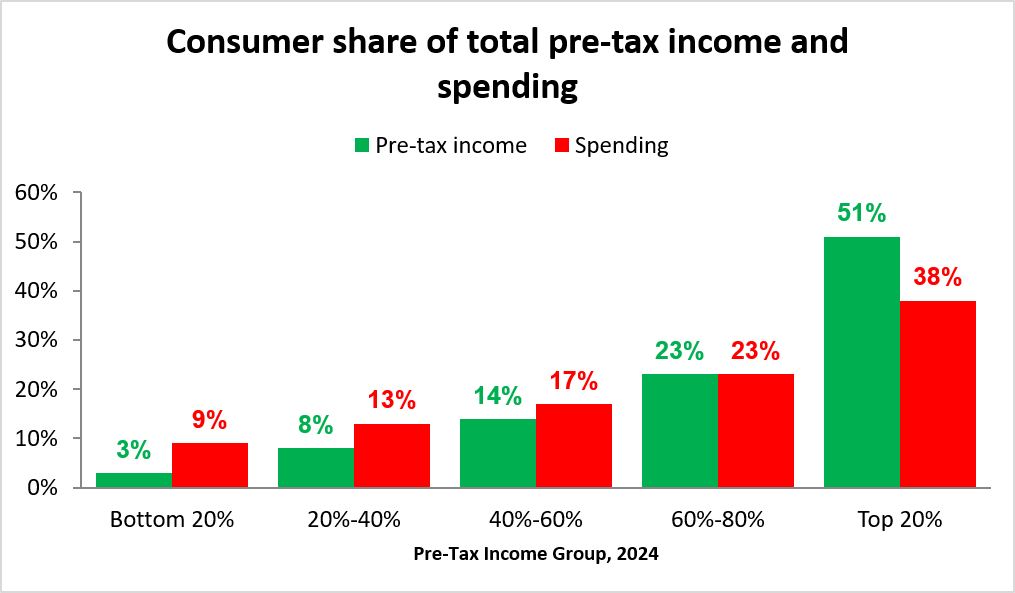
Source: J.P. Morgan Asset Management
This graph was produced by Lucas Juery, CFA, CFPⓇ and is not intended to provide financial advice.



Comments
Log in or sign up to join the conversation.