

The reality is far more innocuous than the reaction sometimes. When Amazon (AMZN) announced its acquisition of Whole Foods Market (WFM) it sent waves through the retail industry. Waves generally being a natural factor in a relative sea of tranquility that is the ocean doesn’t quite equate contextually on Wall Street. Unfortunately, waves on Wall Street tend to assimilate with context surrounding the aftermath of an earthquake, devastating and demonstrative. The devastation in the retail sector of Wall Street, after the announced acquisition, found retail stocks under immense pressure and not the type of pressure that creates lustrous gemstones. Having said that, some investors will find themselves holding diamonds once the rubble is cleared.

Conjecture and knee-jerk reactions play a large role when trading, but a lesser role when investing. The intelligent investor is able to sift through the conjecture, headlines and knee-jerk stock reactions and see a more vivid picture that disseminates truth and reality. The headlines surrounding Amazon’s acquisition of Whole Foods Market coupled with the broader retail sector adverse sell-off would have one believe Amazon would dominate grocery… starting next week. But that reaction to the news is anything but reality and everything inclusive of hyperbole. The chart by CNBC below is a breakdown of the U.S. Grocery Market share as of 2016:
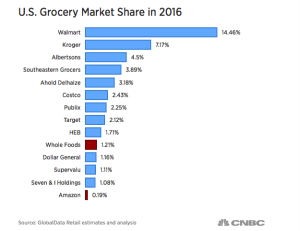
Combined, Amazon and Whole Foods Market only account for less than 2% of the total U.S. grocery market. What many traders and investors may not fully appreciate for lack of industry knowledge and/or experience is that Whole Foods Market is a very specialized grocery retailer and with a very small retail footprint when compared to its peers. While the once darling of Wall Street for several years found what seemed to be an ever-appreciating share price, in the last couple of years, that performance found itself short lived and with steep declines. Whole Foods Market’s business and total addressable market (TAM) was not what it once claimed it was to be.For years the grocer outlined a path to some 1,200 stores across America only to find itself nearing saturation of the region with fewer than 500 stores and as same-store-sales (SSS) began declining. There comes a point in every business model cycle where newness and low-hanging fruit is all picked cleaned and what you are left with is a mature business that expresses its true demand and value.As such, Whole Foods Market found sales floundering and earnings falling under the pressure of pricing, assortment, competition and generally difficult YOY comps.
It’s a tough business to create let alone to do so with as much success as Whole Foods Market has found. On Wall Street, you are either growing to the moon or you become a value stock. And that is what Amazon believed it found in Whole Foods Market, a valuable entity that could advance its desired grocery expansion. It’s not easy to distribute groceries to the masses solely from a digital marketplace and as such, the Whole Foods niche market offers Amazon a small, but potentially lucrative advancement in the category. Evidencing that mass market scale was unachievable by Whole Foods Market itself, not to mention peers like The Fresh Market and Sprouts, it will take some Amazon tweaking of the Whole Foods business model and many years before the realization of this venture is known for its value. But again, traders have already reacted to headlines despite the logical deductions offered within.
Some analysts are of the opinion that what Amazon has done in other retail categories it will bring to the organic grocery retail business segment, lower prices and forgo profits. I would tend to believe that is a possibility, but it is much lower on the spectrum of possibilities than one would have you believe. Mark Astrachan of Stifel Nicholas states the following with regards to Amazon’s Whole Foods Market acquisition and participation in grocery going forward:
We anticipate Amazon's ownership is likely to result in lower prices at Whole Foods, forcing other grocery participants to follow, negatively impacting category margins.
Here’s what I have to say about Mark Astrachan and with regards to such a forecast: “Remember, Mark Astrachan rated Keurig Green Mountain as a Sell and with a $14 price target when GMCR was trading in the $20 range and before shares rallied over 3 years to above $150 a share”. Certainly, analysts aren’t going to get every call right, but understanding where the opportunity lay for error in a forecast may reveal the true investment or trading opportunity. And that’s what we care about as investors/traders. Mark Astrachan’s reasoning and scrutiny of the GMCR business were all accurate and revealed by 2016, but between 2012 and 2016 GMCR had ample time to grow its customer base and earnings power. This is largely why the Sell rating and price target were found in error.
Moreover and with regards to Astrachan’s forecast for Amazon’s grocery pricing activity, here’s what I would recognize more prominently; Grocery is not hard goods, it is not soft goods and it is not services. There lays the problem with suggesting that Amazon can and will put pricing pressure on its peers in the grocery business segment.It’s largely why Amazon has yet to capture any meaningful share of the grocery segment. Groceries are commodities, consumables and with that already carry little margin. And that is before the actual operating of a grocery business that expresses great logistical and supply line challenges is calculated.
There very simply isn’t a lot of profit to be made in grocery for which is largely evidenced by the revolving door of grocery business liquidations that seem never ending, decade after decade and brand name after brand name. It’s why Costco (COST) doesn’t really make its monies and profits off its grocery business, but rather its membership business and fees. Take a look at Costco’s gross margin percentage for goods sold; it’s an eye-opener for sure. Costco is fortunate if it captures a gross profit margin of 13% on goods sold as a total assortment in its storefronts, much of which is the result of its grocery assortment dragging down the total gross profit margin that includes jewelry, hard goods and apparel. To offer a comparison with regards to how little profit exists in grocery, apparel or clothing, especially fashion can offer upwards of 75% profit margin. So from the potential of 75% profit margin and the inclusion of groceries in a product mix, Costco largely generates less than 14% gross profit margins annually. Kroger (KR), Albertson’s and Safeway (SW), simply name the grocer and you’ll understand the struggles in the business segment that align with capturing a profit exist in perpetuity. Target (TGT) and Wal-Mart (WMT) are no strangers to the struggles of grocery but achieve a greater profit margin due to an even assortment mix and the expansiveness of their retail footprint across the United States and abroad. Having said greater profit margin, understand it isn’t by much and when compared to those retailers that choose not to sell groceries.
It’s been a difficult week for retail stocks in the face of the Amazon/Whole Foods Market news and I’m sure when retailers report the Q2 results much will be discussed on conference calls by members of respective management teams. So with the offered rendering and better understanding as to why the news may not be as damaging to retailers in the near-term as stock valuations would have one belief, I’ll leave readers/investors/traders with my more focused thoughts and analysis as follows:
The Final Thought
Retailers, be they in the grocery, department store or other segments, have been experiencing difficulty growing sales and profits prior to the Amazon headlines. In part, retailers have found themselves in this unenviable position because of the seismic shift in consumption initiated and grown by Amazon’s e-commerce expertise as well as generational consumption changes. As such, brick and mortar retail consumption has seemingly peaked.When a peak has been reached and sales siphon into other sales channels like e-commerce, any potential and additional pressures are magnified. This is especially the case when a dominant party like Amazon is stimulating those pressures yet again and possibly more deeply.
Reactions to the fearful impact are swift and alarming even if the reality of the situation may not be realized for years. Such overreaction can find with it opportunity. However, opportunities are not always equal, but traders/investors should value the potential opportunity equally. For some, they may have found an opportunity to pick up a retail name near the floor of a trading range and profit from a swing trade. For others, the opportunity may come from an inevitable retail sector upswing whereby the long-term investor can lighten holdings.
Many retail stocks have found themselves devalued by 30,40,50 percent and more.The devaluation is warranted as the fundamentals for such stocks represent their diminishing metric performance. Brick and mortar retailers can’t “put the genie back in the bottle”, e-commerce is here to stay as technology simply has and will dictate future outcomes that align with the growth of this retail segment and at the expense of brick and mortar retail sales. The devaluing of retail brick and mortar businesses validate the previous comment. But brick and mortar businesses can find stabilization of its business model through curtailment and alignment that is on-trend with e-commerce. That is what many retailers have enacted today. Don’t let that be a point of solace as it will be with Amazon/Whole Foods Market, such stabilization will take years and has proven as such and through the most recent, pain-filled years. So while stabilization and share price appreciation can be found once again for many retail names, it may be found short lived and/or still underperforming opportunities elsewhere in the marketplace.
I’m not of the opinion that any traditional brick and mortar retailers are investible at this time. That does not mean they are not tradable for months or even a year at a time as I’m forced to recognize the term investment is largely subjective. The end game for retail is likely a foregone conclusion: There will always be storefronts just as there will always be e-commerce. Let’s face it, nearly 20 years into the e-commerce era the retail segment still only accounts for less than 10% of total retail sales. How long will it take to capture the next 10% of retail sales and is there a limit to the total addressable market for e-commerce sales that largely never, never gets discussed. When we look at how long it has taken to capture less than 10% of retail sales by the e-commerce segment, I would think this is more a red flag for the segment than analysts and the media have considered to date. So how much market share each segment will capture or maintain remains undetermined at present. For now, however, investors would be wise to exercise caution when investing or trading the major retail names.
Comments
Log in or sign up to join the conversation.