

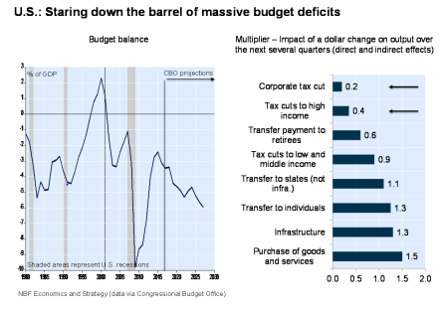
“Considering that tax cuts are tilted towards corporations and wealthy individuals, both of which have low fiscal multipliers, we’re expecting the associated economic boost to be restrained to less than half a percentage point… While the tax cut package is likely to have only a small impact on economic growth it is set to structurally alter the budget deficit.” (National Bank of Canada, Monthly Economic Monitor, January 2018)
Although the financial markets like the U.S. tax bill, we cannot ignore that it comes with a series of negative consequences.
The tax changes will likely have only a tiny positive effect of the growth of the American economy in 2018 and 2019. This is because the main thrust impact of the tax cut will benefit wealthy individuals and corporations, which have relatively tiny positive impacts of economic growth.
Moreover, as the CBO projections indicate, the tax bill will generate a huge increase in the American budget deficit over the next ten years.
According to the non-partisan CBO, the Republican tax cuts will increase federal budget deficit by $1.7 trillion or 6% of GDP by 2027.
Under the plan, U.S. debt would rise to 97.1% of GDP in 2027, up from 91.2% based on prior CBO projections.


Comments
Log in or sign up to join the conversation.