

Alphabet, Inc. (GOOGL, GOOG) stock has been flat for the last 1 to 3 months. That works for investors who short out-of-the-money (OTM) puts or do vertical put credit spreads. They collect income in both plays.
For example, GOOGL closed at $347.33 on Thursday, Sept. 17, about where it was last month ($344.00 Aug. 17) when I last wrote about GOOGL in a Barchart article: “Alphabet Stock Has Attractive Short-Put Yields As GOOGL Stock Treads Water.”
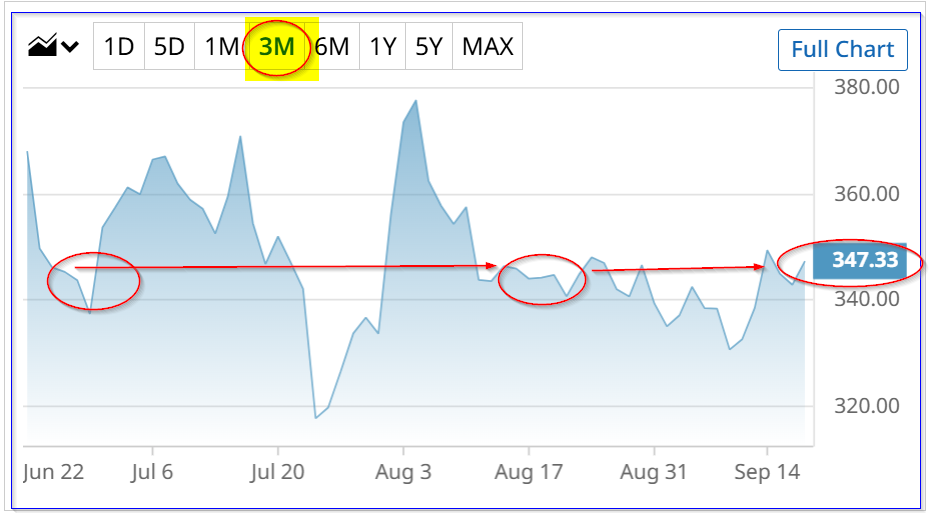
GOOGL stock - last 3 months - Barchart - Sept. 17, 2026
Moreover, the Barchart chart above shows that the stock has essentially been flat over the last 3 months.
As a result, I discussed shorting out-of-the-money (OTM) puts in the Aug. 17 Barchart article. This play turned out well and looks worth repeating, assuming GOOGL stays roughly flat.
For example, analysts' price targets have not moved much, and its upcoming earnings report is due out on Oct. 20.
So, it makes sense for investors to run another short-put play and/or a vertical (bull) put credit spread to collect additional income.
Shorting GOOGL OTM Puts
Last month I discussed shorting the $330.00 strike price GOOGL put expiring Sept. 18. The premium collected then was $4.95, for an expected yield-to-expiration of 1.50% (i.e., $4.95/$330).
The $330.00 strike price was 4.6% below the trading price at the time, and the delta ratio was just -0.2651, implying just a 26.5% chance that GOOGL would drop to $330 by Sept. 18.
Today the premium has fallen to $0.05 at the midpoint, so most of the yield has been earned, and it makes sense to roll this play over to the next month.
For example, the Oct. 16 expiry put option contract, right before the earnings release date, has a midpoint premium of $4.20 for the $330 strike, which is 5% below Thursday's close.
That means an investor in this play earns an expected one-month yield to expiry of 1.272%. That's slightly lower than last month, as volatility has fallen with the stock's flat trading.
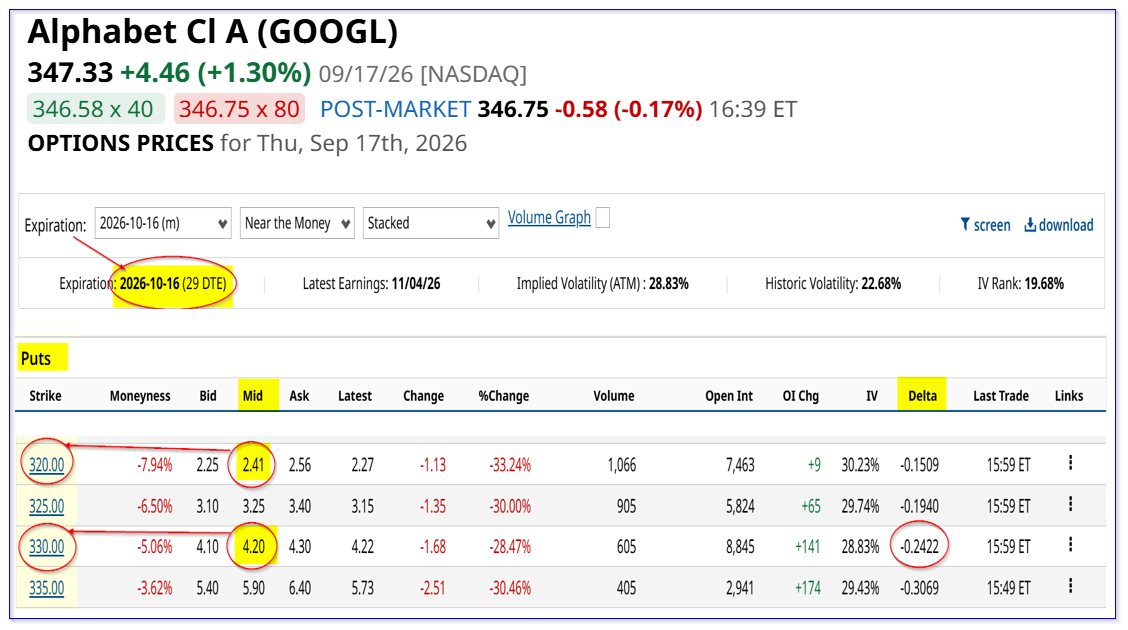
GOOGL puts expiring Oct. 16 - Barchart - As of Sept. 17, 2026
However, to do this, an investor must first post $33,000 in cash collateral (or buying power) with their brokerage firm. Then, after entering an order to “Sell to Open,” the account will receive $420.
This lowers the breakeven point to $325.80 (i.e., $330-$4.20), even if GOOGL drops to $330.00 by then. That's 6.2% lower than the $347.33 close on Sept. 17. So, it provides a good entry point for patient investors.
And don't forget that by repeating this play each month, the investor keeps collecting income while waiting. For example, over 12 months, the expected return is between 1.27% (this month) and 1.50% (last month), or
1.385% x 12 = 16.62%
Much of this depends on whether the investor's account is assigned to purchase shares, and how much monthly OTM short-put yield the investor can collect. Moreover, the investor will need to post $33K in collateral each month (in case the account is assigned to buy 100 shares at the strike price).
However, an investor can earn a much higher profit, albeit with much higher risk, by doing a put credit spread play. That way, an investor does not have to post as much collateral, and the ROI is much higher over the next month.
GOOGL Put Credit Spread Play
This is the same as a short-put play, but an investor also buys a lower-strike put for the same number of contracts. For example, in this case, the investor shorts the $330 put but also buys the $320 (or any other lower strike) put option.
Since the $320 put has a midpoint premium of $2.41 (i.e., costs $241 for each contract), the net put credit spread collected is:
$420 - $241 = $179
However, the brokerage firm will only require $1,000 in collateral to be posted (i.e., $330-$320 x 100). So, the net expected return is:
$179 / $1,000 = 17.9% over the next month
So, for example, by doing 3 put credit spreads, the investor would collect:
$179 x 3 = $537
That's more than doing one short-put play ($420). But the investor only has to post $3,000 (3 x $1000 per spread play) in collateral, instead of $33,000.
Higher Risk With This Play
The catch is that there is a much higher risk of loss. If GOOGL stock falls to below $330.00 during the next month, the investor stands to lose a portion of the $1,000 collateral per spread.
The breakeven point is $821 ($1,000-179) / 100 = $8.21 +$320, or $328.21. That is 5.50% below Thursday's close. It is also higher than the $325.80 breakeven point for a short-put play.
So, as long as the investor has the capital to withstand an assignment, or is willing to take a loss (and roll over the play to the next month), this is an attractive way to play GOOGL.
The bottom line is that, given GOOGL's flat trading history, it makes sense to do short-put or put credit spreads over the next month.



Comments
Log in or sign up to join the conversation.