

With the rapid improvement in A.I., especially agentic A.I. systems, one narrative is these programs will eliminate many jobs. Our firm has opined on this in earlier blog posts, concluding the job disruption issue is overstated. A recent report from Citadel Securities reinforces this view by highlighting a different constraint: the rising cost of A.I. implementation itself.
In its paper, Tokenomics, Citadel notes,
"The salient point is that even the most powerful technologies must pass through the prosaic discipline of cost curves, capacity constraints, and marginal returns. Adoption is therefore becoming less about what frontier models can do in principle and more about the price and scarcity of the inputs required to make AI operational at scale. Compute, power, cooling, memory bandwidth, and inference budgets are real and binding constraints."
Because of the expense associated with running AI programs, firms have scaled back deployment.
Amazon has now removed its token leaderboard
Microsoft has cancelled Claude Code subscriptions, and
companies report of unexpectedly large token bills
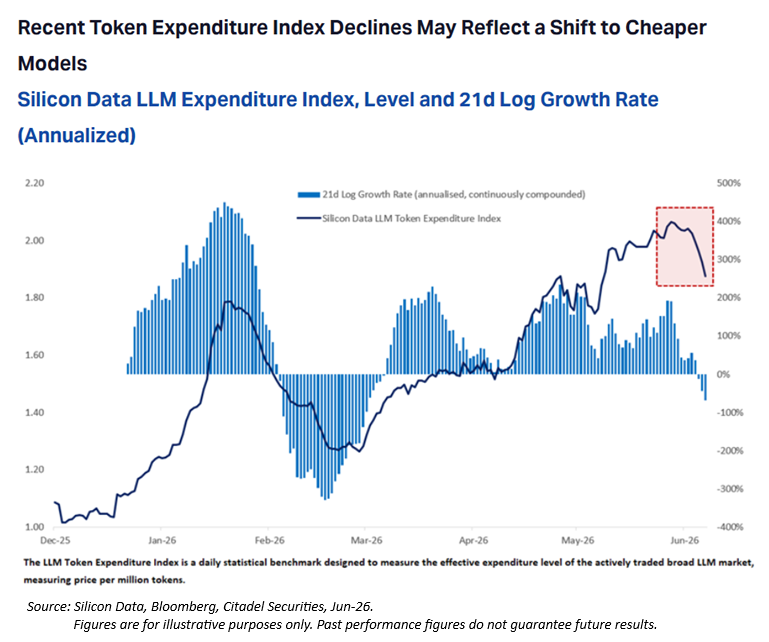
As with any product or service, higher prices reduce demand. As firms look to reduce the tokenization cost, they will look for cheaper alternatives, and the below chart is reflective of this.
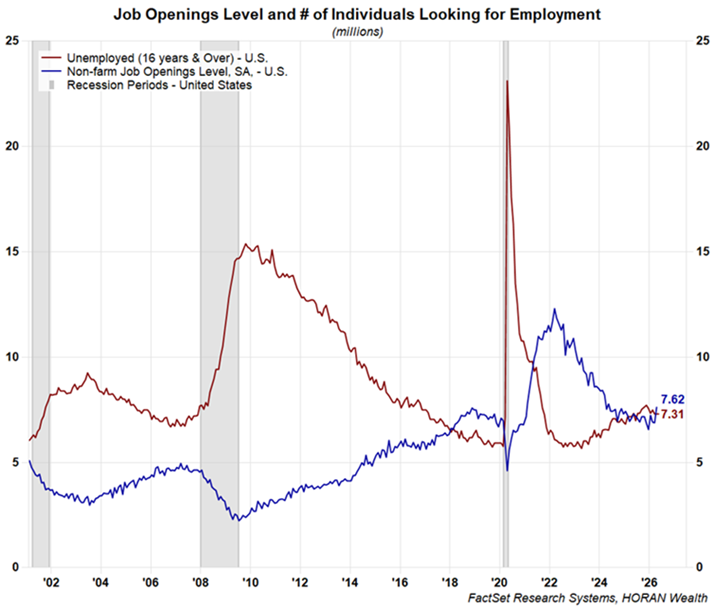
The cost pressure also tempers the idea of widespread job disruption. As the below chart shows, the most recent Job Openings and Labor Turnover Survey (JOLTS) shows the number of job openings once again exceed the number of individuals unemployed. This is not a common occurrence, but consistent with a strong and expanding economy.
In conclusion, AI is not going away, but it is unlikely to eliminate entire categories of jobs or wipe out the software industry as some market reactions have implied. Software companies will adapt and find ways to incorporate AI into their products, thus creating a better product and other revenue sources. The more realistic near‑term story is not mass displacement; it’s measured adoption shaped by real‑world costs.



Comments
Log in or sign up to join the conversation.