

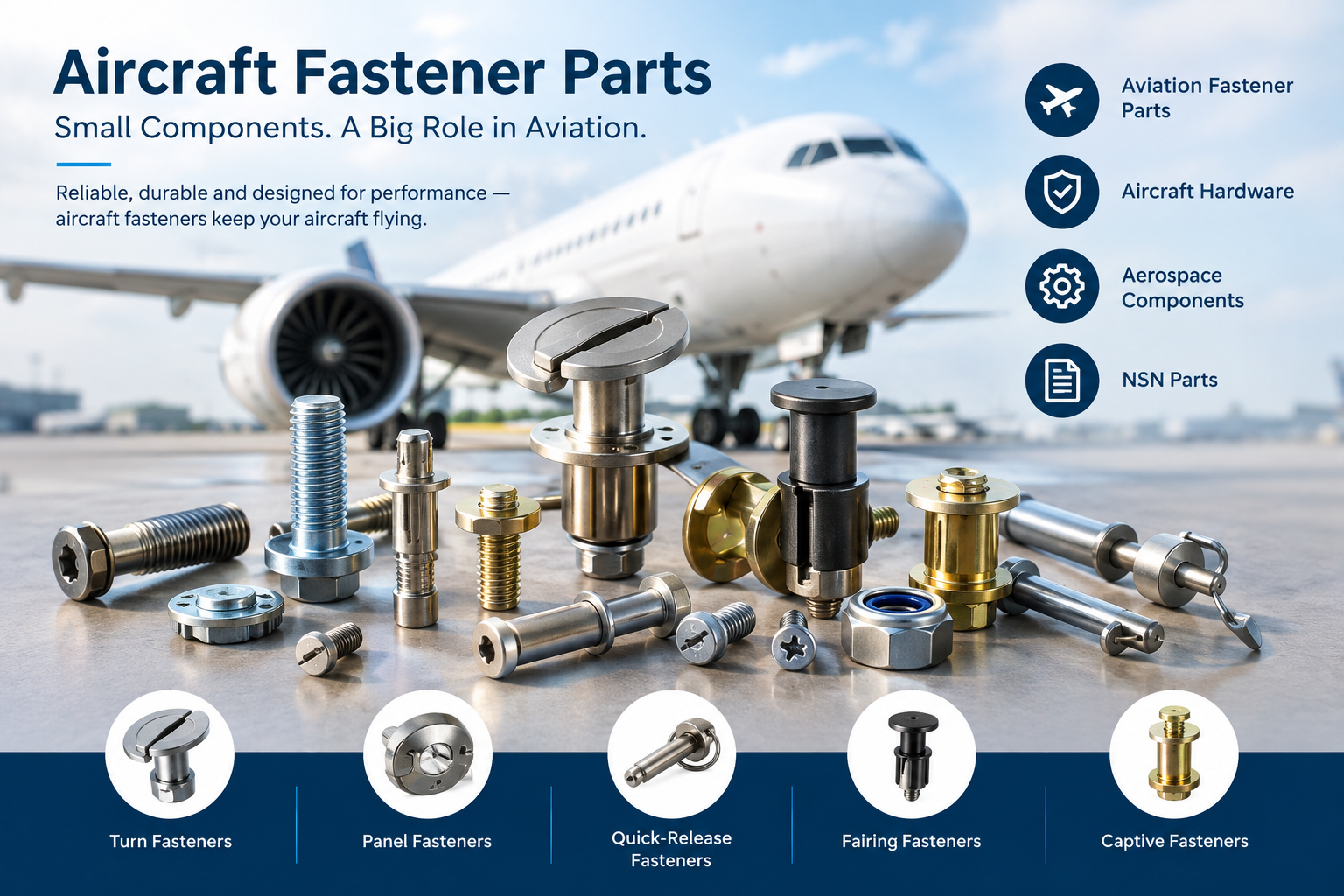
Fasteners are among the most important components used throughout modern aircraft. Although they are often small compared with other aircraft systems, they play a critical role in securing panels, assemblies, structural elements, and equipment. From standard screws and nuts to specialized quick-release and turnlock designs, aircraft fastener parts are manufactured to meet demanding requirements for strength, reliability, and precise installation.
For aviation maintenance teams, manufacturers, repair stations, and procurement professionals, identifying the correct fastener is essential. Keep You Flying provides a dedicated catalog of aviation fastener part types, including turn fasteners, panel fasteners, quick-release fasteners, fairing fasteners, and numerous specialized configurations.
What Are Aviation Fastener Parts?
Aviation fastener parts are hardware components designed to join or secure aircraft structures and assemblies. Depending on the application, a fastener may provide permanent attachment, removable access, vibration resistance, or controlled clamping.
Aircraft can use many different fastener configurations because each installation has specific requirements. For example, removable access panels may require quick-release or quarter-turn fasteners, while structural applications can require high-strength fastening systems.
The Keep You Flying catalog includes numerous fastener categories, such as 1/4-turn fasteners, stud assemblies, panel fasteners, fairing fasteners, captive fasteners, quick-locking fasteners, and quick-release fasteners.
Why Aircraft Fasteners Are Important
Aircraft operate under demanding environmental and mechanical conditions. Components may experience vibration, temperature changes, pressure variations, and repeated maintenance cycles. A properly selected fastener helps maintain the required connection between components throughout the service life of an assembly.
Fasteners can be used in areas such as:
Aircraft interior and exterior panels
Fairings and access covers
Engine and equipment assemblies
Cabin components
Structural assemblies
Maintenance access points
Electrical and avionics equipment installations
Because each application can have different requirements, maintenance personnel should verify the correct part number, dimensions, material, specifications, and installation requirements before ordering or installing a replacement.
Common Types of Aircraft Fastener Parts
The aviation industry uses a wide variety of fastening solutions. Some common categories include:
Turn Fasteners
Turn fasteners are designed to provide convenient attachment and removal. Quarter-turn configurations can be particularly useful for panels and covers that require regular maintenance access.
Panel Fasteners
Panel fasteners secure removable aircraft panels while allowing maintenance personnel to access underlying equipment. They are available in different designs and configurations depending on the application.
Quick-Release Fasteners
Quick-release fasteners allow components or panels to be removed efficiently without extensive disassembly. This can be valuable when frequent inspections or maintenance are required.
Fairing Fasteners
Fairings help create smooth aerodynamic surfaces around aircraft structures. Specialized fasteners can be used to secure these components while allowing access during inspection and maintenance.
Captive Fasteners
Captive designs help keep the fastening hardware associated with the panel or assembly during removal. This can simplify maintenance and reduce the possibility of loose hardware being misplaced.
Aircraft Hardware and Aerospace Components
Fasteners form an important part of the broader Aircraft Hardware category. They work alongside washers, nuts, bolts, screws, fittings, pins, and other components to create secure assemblies.
Within the wider range of Aerospace Components, fastening hardware must be selected according to the requirements of its intended application. Procurement teams often need to match a specific part number or specification with an approved replacement.
Accurate identification is therefore an important part of aviation parts sourcing. Factors such as thread type, dimensions, material, finish, head style, grip length, and installation method may need to be considered.
Finding the Correct Aviation Parts
Aircraft maintenance and procurement professionals frequently work with detailed part numbers and technical specifications. Searching by an exact part number can help narrow down available options and reduce the possibility of ordering an unsuitable component.
For organizations sourcing NSN Parts, documentation and traceability can also be important considerations. Procurement teams should review applicable specifications, certifications, and documentation when evaluating aviation components.
Keep You Flying's fastener catalog organizes numerous aviation fastener part types alphabetically, allowing users to browse categories and individual listings. The site also provides an RFQ option for customers looking to request pricing and purchasing information.
Choosing the Right Fastener Supplier
Selecting the correct fastener is only one part of the procurement process. Buyers may also need to consider availability, traceability, documentation, delivery requirements, and sourcing support.
Keep You Flying states that it maintains a database covering civil aviation components and offers traceable and warrantied parts. Its website also highlights AS9120B and ISO 9001:2015 certification and FAA AC 00-56B accreditation.
For time-sensitive maintenance requirements, having access to a broad supply network can also be valuable. The company indicates that expedited shipping options are available for domestic and international customers, including situations involving aircraft-on-ground requirements.
Conclusion
Aircraft fasteners may be small components, but they are essential to the safe and reliable assembly of aircraft systems and structures. From panel and fairing fasteners to quarter-turn, captive, and quick-release designs, different applications require different fastening solutions.
When sourcing aircraft fastener parts, buyers should pay close attention to part numbers, specifications, compatibility, documentation, and traceability. A reliable aviation supplier can make the procurement process easier by providing access to a broad range of Aviation Parts, NSN Parts, Aircraft Hardware, and other Aerospace Components.
For maintenance organizations and aviation procurement teams, an organized fastener catalog can be a useful starting point for identifying the required component and submitting an RFQ for further purchasing assistance.
Comments
Log in or sign up to join the conversation.