

Introduction
Customer service is experiencing one of the most significant transformations in modern business.
For many years, human agents were the primary source of customer support. Whether customers needed assistance with billing, appointment scheduling, or product-related questions, speaking with a live representative was usually the only option available.
Today, that landscape is changing rapidly.
Artificial Intelligence (AI) has evolved far beyond basic chatbots and automated phone systems. Modern AI-powered voice agents can engage in natural conversations, provide instant responses, and manage thousands of customer interactions simultaneously.
As organizations continue investing in automation, a common question arises:
Will AI replace human customer support agents, or will human involvement remain essential in 2026 and beyond?
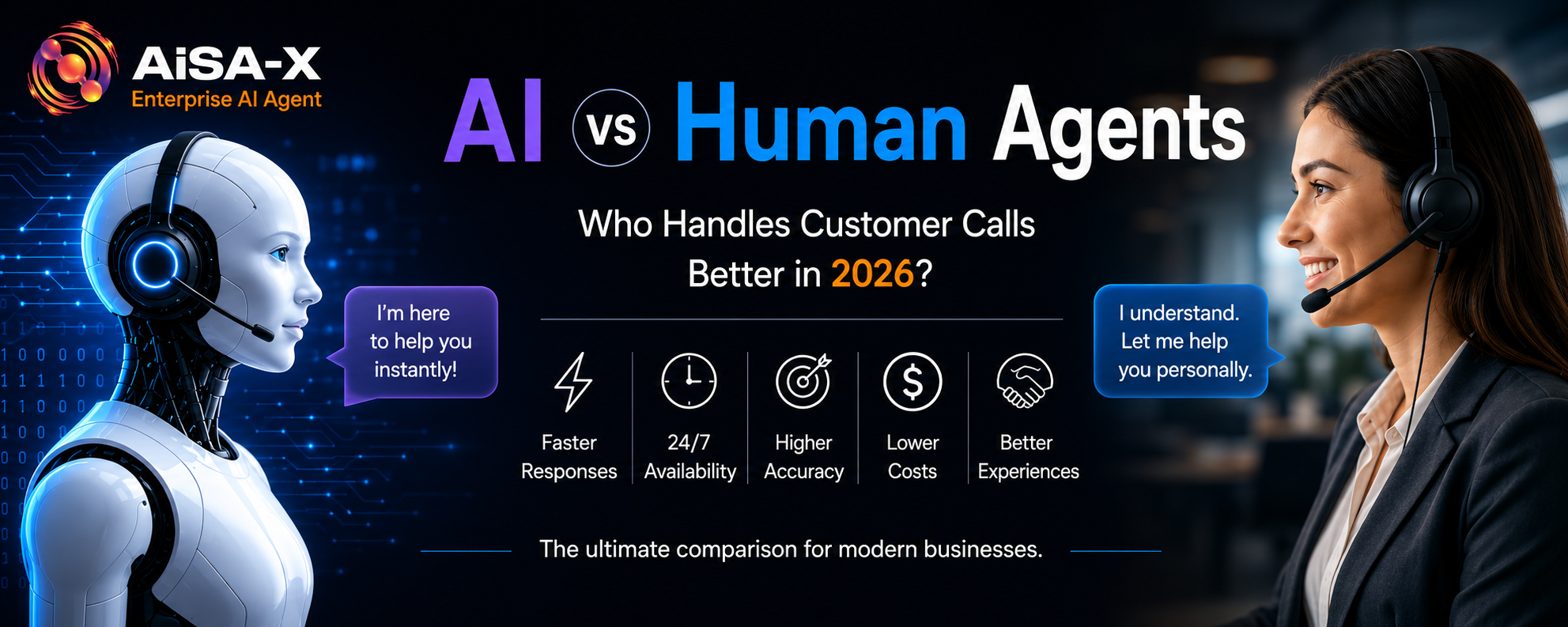
The reality is more balanced than a simple replacement scenario. Rather than competing against each other, AI and human agents are increasingly working together to deliver faster, smarter, and more personalized customer experiences.
The Evolution of Customer Support
Customer expectations have changed dramatically in recent years. Today's consumers expect:
Immediate responses
24/7 support availability
Personalized interactions
Fast issue resolution
Consistent communication across multiple channels
Meeting these expectations through traditional support teams alone can be challenging.
As businesses grow, customer inquiries naturally increase, resulting in:
More support tickets
Higher call volumes
Longer waiting times
While hiring more staff can help, it also increases operational costs and management complexity. This challenge has accelerated the adoption of AI-powered customer support solutions.
Why AI Customer Support Is Growing Rapidly
Modern AI systems are significantly more advanced than traditional Interactive Voice Response (IVR) systems, which often frustrated customers with rigid menus and robotic responses.
Today's AI agents use:
Natural Language Processing (NLP)
Machine Learning
Conversational AI
These technologies enable AI to understand customer intent and respond naturally.
Common Tasks AI Agents Can Handle
Answering incoming calls
Scheduling appointments
Processing routine service requests
Tracking orders and deliveries
Providing account information
Intelligent call routing
Collecting customer data
Qualifying sales leads
Performing basic troubleshooting
By understanding natural speech, AI creates a smoother and more efficient customer experience.
Key Advantages of AI Agents
1. 24/7 Availability
One of AI's greatest strengths is continuous accessibility.
Unlike human agents, AI systems do not require:
Breaks
Vacations
Shift changes
Time off
Benefits
Support available 24 hours a day
Service available 7 days a week
Consistent assistance throughout the year
This is especially valuable for businesses serving global customers.
2. Faster Response Times
Customers dislike waiting for support.
AI significantly reduces waiting times by:
Responding instantly
Handling routine inquiries immediately
Reducing call queues
Simple customer requests that once took several minutes can often be resolved within seconds.
3. Unlimited Scalability
Human teams have capacity limitations.
When customer demand increases unexpectedly, businesses often need to recruit and train additional staff.
AI systems can scale much more efficiently by managing multiple interactions simultaneously.
Ideal During:
Seasonal peaks
Product launches
Marketing campaigns
Emergency situations
Rapid business growth
4. Lower Operational Costs
Customer support operations involve various expenses, including:
Employee salaries
Benefits
Training programs
Management costs
Infrastructure expenses
By automating repetitive tasks, AI can significantly reduce long-term operational costs.
5. Consistent Customer Experiences
Human performance can vary between agents.
AI ensures consistency by:
Following the same procedures every time
Delivering standardized responses
Reducing human error
Business Benefits
Improved quality control
Better compliance
Consistent customer experiences
Reduced operational mistakes
Areas Where Human Agents Still Excel
Despite major advances in AI technology, human agents continue to offer capabilities that machines cannot fully replicate.
1. Emotional Intelligence
Customers often contact support when they are:
Frustrated
Confused
Concerned
Upset
Human agents can:
Recognize emotional cues
Demonstrate empathy
Adjust communication styles
Build trust
Calm difficult situations
These human qualities remain difficult for AI to authentically reproduce.
2. Complex Problem Solving
Many customer issues require judgment, flexibility, and critical thinking.
Examples Include:
Unique billing disputes
Technical escalations
Contract negotiations
Account recovery cases
High-value customer concerns
Human agents remain more effective when dealing with situations that fall outside predefined workflows.
3. Relationship Building
Customer service is not only about resolving issues—it is also about building lasting relationships.
Experienced support professionals can:
Strengthen customer loyalty
Identify growth opportunities
Increase retention rates
Improve brand perception
Build long-term trust
This relationship-focused approach remains a major advantage for human support teams.
AI vs Human Agents: A Practical Comparison
Category | AI Agents | Human Agents |
|---|---|---|
Availability | 24/7 | Limited Hours |
Response Speed | Instant | Variable |
Scalability | Very High | Limited |
Cost Efficiency | High | Lower |
Consistency | High | Moderate |
Empathy | Limited | Excellent |
Creativity | Moderate | Strong |
Complex Decision-Making | Limited | Excellent |
Relationship Building | Limited | Strong |
Key Takeaway
Neither AI nor human agents are universally superior.
Each brings unique strengths that complement the other.
What Customers Actually Prefer
Many people assume customers always prefer speaking with a human representative.
In reality, customers generally prioritize:
Fast responses
Accurate information
Convenience
Quick resolutions
Customers Often Accept AI For:
Order tracking
Appointment confirmations
Business hour inquiries
Account balance checks
Shipping updates
Customers Usually Prefer Humans For:
Complaints
Refund requests
Technical issues
Sensitive situations
Major purchasing decisions
This difference in customer preferences has contributed to the rise of hybrid support models.
The Rise of Hybrid Customer Support
Leading organizations are no longer choosing between AI and human agents.
Instead, they are combining both to maximize efficiency and customer satisfaction.
Tasks Best Handled by AI
Frequently asked questions
Call routing
Appointment scheduling
Lead qualification
Order tracking
Data collection
Basic troubleshooting
Tasks Best Handled by Human Agents
Escalations
Complex support cases
Customer retention efforts
Sales consultations
Sensitive conversations
Relationship management
Benefits of a Hybrid Model
Greater efficiency
Reduced workload for staff
Faster customer service
Improved customer satisfaction
Better use of human expertise
Industries Leading AI Adoption
Healthcare
AI is helping healthcare providers:
Schedule appointments
Answer patient questions
Send reminders
Reduce administrative burdens
Real Estate
Real estate companies use AI for:
Lead qualification
Property inquiries
Appointment scheduling
Follow-up communication
E-Commerce
Online retailers rely on AI to:
Track orders
Process returns
Recommend products
Handle customer inquirieSaaS Companies
Software businesses use AI for:
Managing support tickets
Assisting user onboarding
Answering technical questions
Enhancing customer experiences
The Future of Customer Support Beyond 2026
As AI technology continues to evolve, future customer support systems are expected to become even more advanced.
Better Context Awareness - AI will gain a deeper understanding of customer history and previous interactions.
More Personalized Support - Customer conversations will become increasingly tailored to individual needs and preferences.
Enhanced Multilingual Communication - AI will support seamless communication across multiple languages without requiring large multilingual teams.
Predictive Customer Assistance - Future AI systems may identify and resolve issues before customers even report them.
Stronger CRM Integration - Customer support platforms will become more connected with business systems, creating smoother experiences across departments.
Conclusion
The future of customer support is not about choosing between AI and human agents.
Instead, success will come from combining the strengths of both.
AI Provides:
Speed
Scalability
Consistency
Cost efficiency
Human Agents Provide:
Empathy
Creativity
Critical thinking
Relationship-building skills
Organizations that effectively balance automation with human expertise will be best positioned to meet customer expectations in 2026 and beyond.
The companies that thrive will not be those that choose AI over humans or humans over AI—they will be the ones that successfully integrate both to create exceptional customer experiences throughout the entire customer journey.
Read Full Blog : https://aisa-x.ai/blog/ai-vs-human-agents-who-handles-customer-calls-better-in-2026/
Comments
Log in or sign up to join the conversation.