
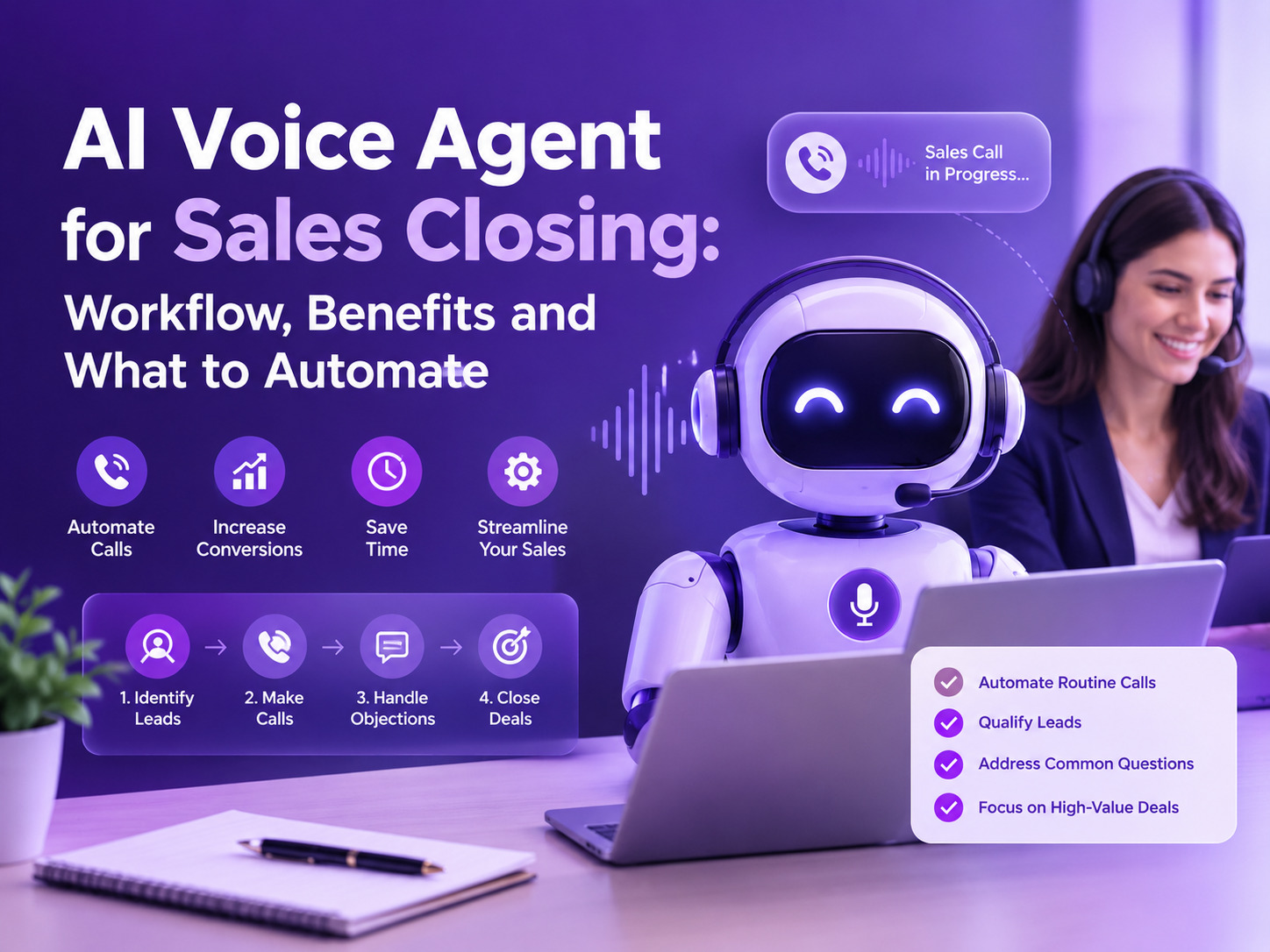
Sales teams often spend a large amount of time following up on proposals, answering repeated questions, handling predictable objections, and checking whether a prospect is ready to make a decision. These activities are important, but they can also take sales representatives away from complex negotiations and high-value conversations.
An AI voice agents support the sales closing process can automate many structured parts of the closing process while keeping human sales representatives involved when judgement, negotiation, or relationship management is required. This approach helps businesses maintain consistent follow-ups and keep qualified opportunities moving.
What Is an AI Voice Agent for Sales?
An AI voice agent is a voice-based system designed to communicate with prospects through natural conversations. In the sales closing stage, it can follow up on proposals, answer common questions, identify objections, confirm details, and determine whether a prospect is ready for the next step.
The goal is not necessarily to replace sales representatives. Instead, the AI voice agent can manage repetitive conversations and route complex situations to the appropriate human representative.
This makes automation particularly useful for businesses that have a large number of qualified leads but limited sales team bandwidth.
How AI Voice Agents Support the Sales Closing Process
AI voice agents support the sales closing process by creating a structured workflow around follow-ups and decision-stage conversations.
1. Proposal Follow-Up
After a proposal or quotation has been shared, the agent can make a follow-up call when there has been no response for a defined period. The conversation can refer to the proposal and ask whether the prospect has questions or needs additional information.
2. Handling Common Objections
Many sales conversations involve predictable questions about pricing, terms, timelines, features, or implementation. An AI agent can be trained to provide approved responses to these recurring objections.
Complex negotiations or requests outside the defined scope can be transferred to a human representative.
3. Identifying Purchase Readiness
The agent can use the conversation to understand where the prospect stands. A prospect may be ready to proceed, still considering the offer, or have concerns that need further discussion.
Based on the response, the workflow can determine the appropriate next action.
4. Human Handoff
Not every closing conversation should be automated. Custom pricing negotiations, complex enterprise deals, unusual objections, and relationship-sensitive discussions may require human involvement.
A properly designed workflow can transfer these conversations to sales representatives with the relevant conversation context.
AI Voice Agent Sales Closing Workflow
A structured workflow can move through several stages:
Proposal sent → Follow-up trigger → AI voice call → Objection handling → Decision identification → Human handoff or next follow-up → CRM update
This process allows sales teams to maintain a consistent follow-up cadence instead of relying completely on individual representatives to remember every pending opportunity.
For straightforward transactions with defined pricing and terms, the agent may also be able to complete the next step directly within the conversation.
What Should Businesses Automate First?
Businesses should begin with repetitive, predictable activities rather than trying to automate the entire sales closing process immediately.
Proposal and Quote Follow-Ups
Automating follow-up calls for unanswered proposals can help ensure that qualified opportunities do not remain inactive simply because a sales representative is busy.
Common Objection Handling
Start with objections that occur frequently and have clear, approved responses. This makes it easier to monitor accuracy and improve the conversation flow.
Stalled Deal Re-Engagement
An AI voice agent can contact prospects who have stopped responding and check whether they are still interested, need clarification, or want to schedule another conversation.
CRM Updates
Call outcomes, objections, next steps, and follow-up requirements can be captured and added to the sales workflow, giving the team better visibility into the pipeline.
Benefits of AI Voice Agents for Sales Closing
Using voice automation in the closing process can provide several operational benefits.
Consistent Follow-Ups
Every qualified opportunity can follow a defined follow-up schedule instead of depending entirely on sales representative availability.
More Sales Team Productivity
Sales representatives can spend more time on negotiations, strategic conversations, and complex opportunities while repetitive follow-ups are handled automatically.
Faster Response
AI voice agents can initiate conversations according to predefined triggers, helping businesses respond when a prospect reaches the decision stage.
Better Pipeline Visibility
Structured call information can help sales teams understand which deals are progressing, which are stalled, and what objections are affecting decisions.
Multilingual Conversations
For businesses serving different regions, multilingual voice interactions can make sales follow-ups more accessible to prospects who prefer communicating in regional languages.
Best Practices for Sales Closing Automation
Successful implementation starts with clearly defining what the AI should and should not handle. Set specific rules for deal values, objection categories, pricing discussions, and human escalation. The agent should have a clear route to a sales representative whenever the conversation moves beyond its defined scope.
Businesses should also review call transcripts and outcomes regularly. This helps identify inaccurate responses, recurring objections, and areas where the workflow needs improvement. Starting with lower-complexity deals can also provide useful data before expanding automation to more complicated sales processes.
Conclusion
An AI voice agent for sales can help businesses maintain consistent follow-ups, manage predictable objections, and identify when prospects are ready for the next step. The most effective approach is to combine automation with human judgement instead of treating AI as a complete replacement for the sales team.
Vomyra provides an Agentic Voice AI Platform designed to support structured sales workflows, including follow-ups and closing-stage conversations. With the right automation strategy, Vomyra can help businesses keep qualified opportunities moving while allowing sales teams to focus on conversations that require human decision-making.
Frequently Asked Questions
1. Can an AI voice agent close sales?
An AI voice agent can handle defined closing activities such as follow-ups, common objections, confirmation of details, and simple transactions. Complex negotiations and high-value relationship-driven deals may still require human involvement.
2. What is an AI Voice Agent for Sales used for?
It can be used for proposal follow-ups, lead re-engagement, objection handling, appointment scheduling, decision-stage conversations, and other repetitive sales activities.
3. Can AI voice agents handle sales objections?
Yes. They can handle predefined and predictable objections when appropriate responses and escalation rules are configured. New or complex objections can be routed to a human sales representative.
4. Should businesses automate the complete sales closing process?
Not necessarily. A better approach is to automate structured and repetitive tasks while keeping human representatives involved in negotiation, complex pricing decisions, and sensitive conversations.
5. Can AI voice agents communicate in Indian languages?
AI voice systems can support multiple languages, including regional Indian languages, depending on the platform and voice configuration being used.
Comments
Log in or sign up to join the conversation.