
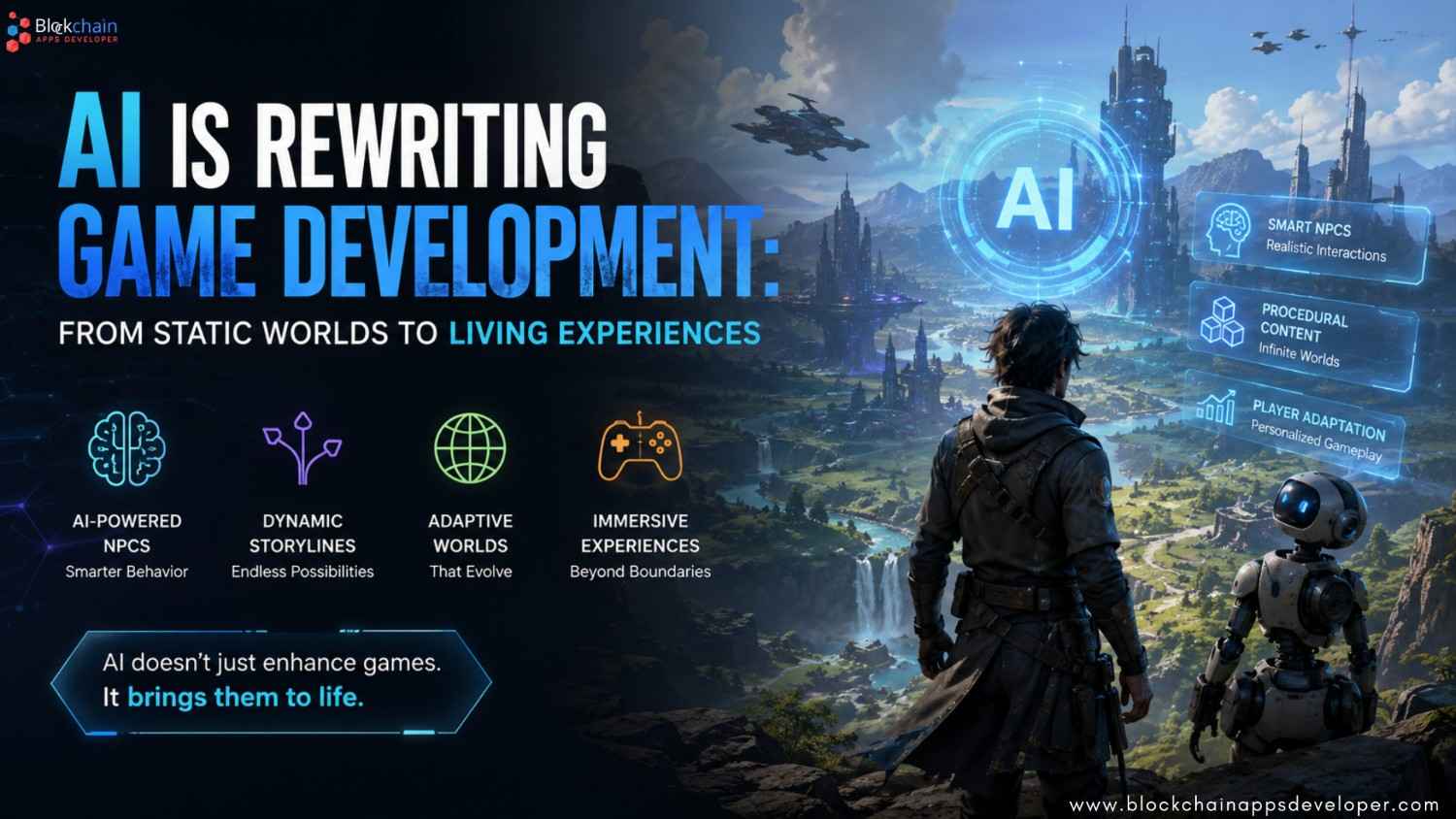
The gaming industry is entering a period where artificial intelligence is becoming more than a supporting technology. Traditionally, games have relied on predefined scripts, fixed environments, predictable NPC behavior, and manually designed content. Developers carefully determine how characters respond, how quests progress, and how players interact with the world.
AI is changing this model by introducing systems capable of analyzing player behavior, generating content, adapting difficulty, and creating more dynamic interactions. Instead of every player experiencing exactly the same predetermined environment, games can increasingly respond to individual actions and decisions.
This evolution is creating a new vision for gaming: living digital worlds. These worlds can react, adapt, and evolve while players interact with them, making gameplay less predictable and potentially more immersive.
AI Is Rewriting Game Development: Why Static Worlds Are Becoming Dynamic
Traditional game worlds are generally designed before players enter them. Developers create maps, missions, characters, environments, and dialogue, while game engines control how these elements behave. This approach provides consistency but can limit how much a world changes in response to players.
AI introduces adaptive intelligence into this structure. Systems can analyze player actions, identify behavioral patterns, and adjust elements of gameplay accordingly. An aggressive player might encounter different challenges from someone who prefers exploration, while repeated actions could influence future events.
This does not mean that developers will stop designing game worlds manually. Instead, AI can operate alongside traditional development techniques, creating environments where predefined design and dynamic intelligence work together.
From Scripted Gameplay to Intelligent Game Systems
Scripts have traditionally controlled many game interactions. An NPC may follow a predetermined route, respond with specific dialogue, or trigger an event when a player reaches a particular location. These systems are reliable but can make interactions feel repetitive.
Intelligent game systems can introduce more flexibility. AI-powered characters can interpret player input, select responses based on context, and potentially change their behavior according to previous interactions. This can make characters feel less like programmed objects and more like responsive participants.
The transition toward intelligent systems also changes development priorities. Developers must think about how AI should behave, what information it can access, which decisions it can make, and how those decisions affect the broader game world.
AI-Powered NPCs: Creating Characters That Think, Learn, and React
NPCs are among the most visible areas where AI can transform gameplay. Traditional NPCs typically have limited behavioral patterns, which can make repeated interactions predictable. Modern AI can provide characters with more sophisticated conversational and behavioral capabilities.
An AI-powered NPC could understand natural-language questions, remember certain interactions, respond differently depending on the player's actions, and contribute to evolving storylines. Instead of selecting from a limited collection of dialogue options, players could interact more naturally with characters.
The same principle can apply to enemy behavior and companions. AI systems can analyze player strategies and adjust behavior accordingly. A companion could provide context-aware assistance, while an opponent could change its tactics based on the player's previous actions, creating more challenging and dynamic encounters.
Generative AI and Adaptive Content: Building Worlds That Evolve
Generative AI is expanding the possibilities for game content creation. Developers can use AI-assisted systems to support the creation of dialogue, narratives, environmental concepts, character variations, quests, and other forms of content.
The more interesting development is the possibility of generating or modifying content during gameplay. Instead of every quest being completely predetermined, AI could help create variations based on player decisions, progression, or preferences.
This could allow games to offer more diverse experiences without requiring every possible scenario to be manually authored. However, developers still need strong creative direction and technical controls to maintain consistency, quality, performance, and appropriate game design.
Personalized Gameplay: How AI Can Respond to Every Player
Not every player approaches a game in the same way. Some players enjoy exploration, others prioritize competition, storytelling, strategy, or fast-paced action. AI can help games recognize these behavioral differences and adapt experiences accordingly.
A personalization system could analyze factors such as play style, progression speed, preferred activities, and interaction patterns. It could then adjust recommendations, challenges, missions, or content to better match the individual player.
This creates the possibility of games becoming increasingly personalized. Instead of delivering one fixed experience to millions of players, developers can create systems capable of producing variations based on player behavior while maintaining the game's core identity.
AI Development and the Rise of Autonomous Game Agents
The emergence of AI agents introduces another major opportunity for game development. Rather than limiting AI to individual NPC responses, developers can create agents capable of pursuing objectives, making decisions, interacting with game systems, and responding to changing circumstances.
For example, an autonomous faction agent could manage resources, respond to player actions, form relationships with other factions, and influence events within the game world. Multiple agents could interact with one another, creating unexpected situations and emergent gameplay.
An AI Game Development Company can help implement these capabilities by combining AI models with game engines, behavioral systems, APIs, data pipelines, and gameplay logic. The objective is not simply to add AI to a game but to make intelligence part of the underlying gameplay architecture.
How BlockchainAppsDeveloper Combines AI Game Development and Blockchain Game Development
BlockchainAppsDeveloper can combine AI capabilities with decentralized gaming technologies to create more advanced interactive experiences. The integration of AI with blockchain can support games where intelligent gameplay systems operate alongside digital ownership, tokenized assets, and decentralized ecosystems.
A Blockchain Game Development Company can design blockchain-based game mechanics, while AI can add intelligence to characters, environments, recommendations, and gameplay systems. Together, these technologies can create games where digital assets and intelligent interactions become connected components of the broader ecosystem.
The development process can involve selecting appropriate blockchain infrastructure, designing smart contracts, integrating AI models, connecting game engines, and establishing secure data flows. With the right architecture, AI and blockchain can complement each other without compromising gameplay performance or user experience.
The Next Generation of Living Game Worlds: Where AI Development Goes Next
The future of gaming could move toward worlds that continuously respond to player behavior. Characters may remember interactions, environments could change based on collective activity, and quests could evolve according to decisions made throughout the game.
This transformation will require developers to rethink how games are designed. Instead of building every interaction as a fixed sequence, development teams may create intelligent frameworks that define boundaries within which AI can operate. This could produce more emergent experiences while preserving creative control.
An AI Development Company can contribute to this evolution by helping gaming businesses build intelligent systems that combine machine learning, generative AI, reasoning, agents, and real-time data. Ultimately, the goal is to create games that feel less like static collections of programmed events and more like living worlds that respond, adapt, and evolve with their players.
Comments
Log in or sign up to join the conversation.