


While geopolitics, interest rates, inflation, and economic growth constantly influence financial markets, the primary driver of stock prices over recent years remains the rapid global adoption of artificial intelligence. Ever since OpenAI’s ChatGPT sparked the AI revolution in November 2022, the technology landscape has been permanently altered. Although local pushback against the massive AI infrastructure rollout is intensifying, the AI genie is out of the bottle – and it cannot be put back in.
Data Center Angst, Chinese Competition, and Bubble Spending Concerns
Last month proved to be a choppy period for equity investors. In addition to escalating geopolitical tensions in the Middle East, markets were rattled by surging Chinese AI capabilities and semiconductor competition. The China tech rivalry is highlighted by the release of Moonshot’s Kimi K3 model and the IPO (Initial Public Offering) of chipmaker CXMT, the largest company trading on mainland China, valued near $500 billion.
The technology sector took the largest brunt of the selling pressure. The NASDAQ index fell -3.2% and the Magnificent 7-heavy QQQ index tumbled -6.6%. The S&P 500 index and Dow Jones Industrial Average had more modest moves, down -0.1% and up +0.3%, respectively for the month.
The AI Data Center Backlash
While consumers and businesses enjoy the instant productivity gains of AI software, a groundswell of community opposition is rising against the physical footprint required to power these tools. Critics frequently cite concerns over potential job losses, rising electricity bills, regional water consumption, rogue agent cyber-attacks, negative effects on residential property values, and other environmental damages.
A recent Gallup survey revealed that 71% of Americans oppose data center construction in their local communities. Currently, 15 states have enacted or proposed moratoriums/bans on new data center construction (see States Banning Data Centers).
While “NIMBY” (Not In My Back Yard) opposition may delay or defer localized builds, the overarching economic and strategic advantages of AI mean development will press forward. To win over reluctant municipalities, hyperscalers (including, Amazon (AMZN), Google (GOOGL), Microsoft (MSFT), and Meta (META)) are offering tailored community benefit agreements, local grid investments, and environmental commitments (see Hyperscalers Put Community Investment First).
As Doug Sims, Managing Director at Green Finance & Economic Development, notes, hyperscalers are funding “investments in weatherization, home repairs, heat pumps, distributed solar and storage, and demand-management technologies.” These initiatives lower peak energy demand and reduce household costs while helping secure local permits. Communities that embrace this infrastructure stand to reap substantial long-term rewards in high-paying jobs and expand their local tax base.
Does AI Work? Is it Worth Trillions in Investment?
A central debate across Wall Street is whether the estimated $6 trillion in projected spending on AI chips, data centers, and power grid upgrades over the next five years will generate sufficient economic returns (see my previous article, The Multi-Trillion AI Tsunami).
From my vantage point, the answer is a resounding yes. One need look no further than the massive $760 billion in combined capital expenditure projected for 2026 alone across Meta, Microsoft, Amazon, and Alphabet – an 84% increase over the $413 billion spent in 2025 (see chart below).
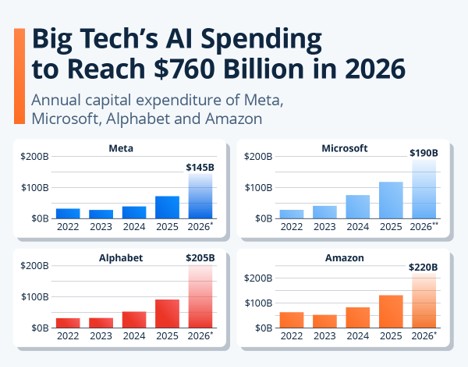
Source: Statista
Where’s the Beef?
Given these staggering capital outlays, investors are understandably asking when and where the payoff will materialize.
I may be dating myself but an iconic commercial introduced when I was a kid captures this sentiment. For any hamburger enthusiasts, you may remember the 1984 Wendy’s “Where’s the Beef?” commercial, in which three elderly customers examine a massive, fluffy bun only to find a tiny patty buried inside. Wall Street is currently looking at hyperscaler capital expenditures and asking the same question: “Where is the meat on this multi-billion-dollar AI burger?”
While free cash flow profiles are temporarily compressed by infrastructure buildouts, there is already plenty of high-protein evidence demonstrating that these investments are paying off:
· Accelerating Top-Line Cloud Revenues
· Record Commercial Backlogs/Remaining Performance Obligations (RPO)
· Substantial Productivity Gains
Let’s review the latest growth figures from the four major hyperscalers:
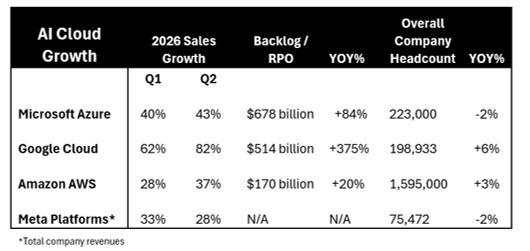
The $760 billion in spending by the “Big 4” hyperscalers is astounding but the backlogs (orders received but not fulfilled) for just the top three (Microsoft, Google, and Amazon) are even more gigantic at approximately $1.4 trillion (see Backlog/RPO column total in table above). If AI technology lacked real-world utility or failed to generate economic returns, enterprise customers would not be locking in massive orders in multi-year forward commitments. Despite achieving surging revenue growth, hyperscaler headcount growth remains remarkably subdued (see far-right column in table above). This is proof positive that internal AI deployment is unlocking operating leverage and efficiency.
Looking Ahead
We remain in the early innings of the enterprise AI adoption curve. Even if political maneuvering or regulatory friction slows the pace of data center construction in certain jurisdictions, it will simply extend the runway of this infrastructure super-cycle rather than trigger a boom-and-bust collapse. The AI genie has granted far more wishes than it has denied – and despite attempts to throttle its momentum, the AI transformation continues to march forward.



Comments
Log in or sign up to join the conversation.