
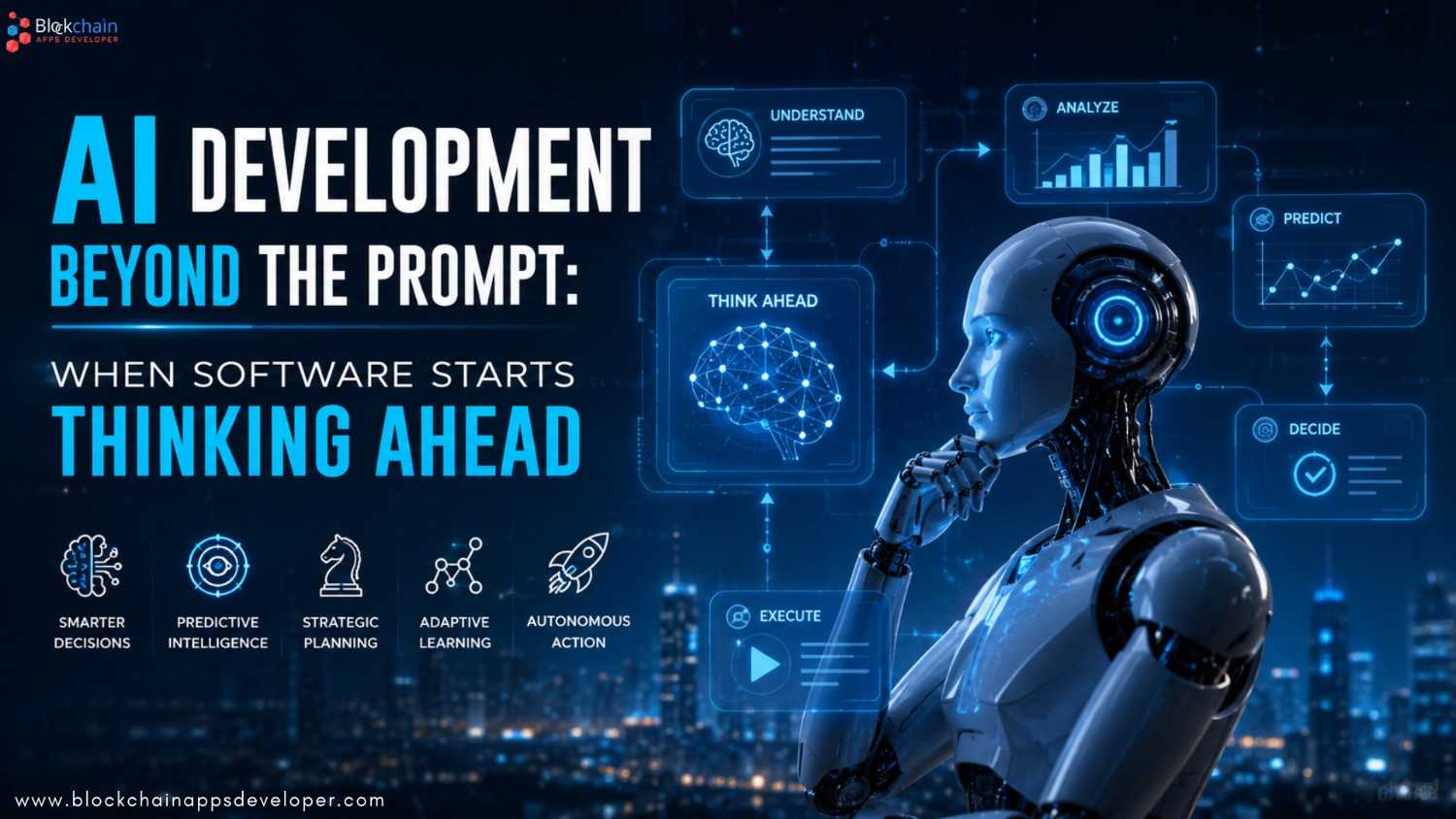
Artificial intelligence is moving beyond the traditional prompt-and-response model. Earlier AI applications primarily waited for users to provide instructions before generating an answer. Today, intelligent software is increasingly capable of understanding context, analyzing information, planning steps, and taking action with less human intervention. This shift is changing how businesses approach application development and digital experiences.
The growing adoption of reasoning models, AI agents, memory systems, and multimodal technologies is making software more proactive. Instead of simply responding to what users ask, modern applications can identify patterns, anticipate requirements, and recommend or execute the next appropriate action.
AI Development Beyond the Prompt: Why Software Is Learning to Think Ahead
Traditional AI interactions usually follow a simple pattern: a user enters a prompt, the system processes it, and an output is generated. While this approach remains valuable, businesses increasingly need applications that can handle multi-step processes rather than isolated questions.
Thinking-ahead software introduces another layer of intelligence. It can evaluate available information, understand objectives, determine possible actions, and continuously adjust its response based on changing conditions. This makes AI more useful for workflows where decisions involve multiple variables.
For businesses, the change is significant. AI can become an active component of applications instead of being limited to a chatbot or content-generation feature. Software can increasingly support decision-making, workflow management, customer interactions, and operational processes.
From Prompt-Based AI to Goal-Driven Intelligent Systems
The next generation of AI applications is increasingly focused on goals rather than individual prompts. A user may provide an objective, and the system can determine the steps required to accomplish it.
For example, instead of asking an AI system to analyze sales data every morning, an intelligent application could monitor the data automatically, identify unusual changes, prepare a summary, and notify the appropriate team when attention is required.
This goal-driven approach is particularly valuable for complex business workflows. AI systems can break larger objectives into smaller tasks, evaluate available information, and coordinate different tools or services to complete those tasks.
How AI Reasoning Helps Software Understand Context and Intent
Reasoning is becoming an important capability in modern AI applications. Rather than simply matching a prompt with a generated response, reasoning-oriented systems can evaluate relationships between information and work through more complex problems.
Context also plays a major role. An intelligent application needs to understand previous interactions, user preferences, business rules, available data, and the current state of a workflow. Combining these elements can help AI produce more relevant and useful decisions.
This can improve applications across industries. Financial platforms can analyze multiple indicators, healthcare applications can organize complex information, and enterprise software can evaluate operational data before recommending an action.
The Role of Memory, Context Engineering, and Real-Time Data
For software to think ahead effectively, it needs more than an AI model. It needs access to the right information at the right time. Memory systems allow applications to retain useful information from previous interactions, while context engineering helps determine which information should be presented to the model.
Real-time data adds another important dimension. An AI application connected to continuously changing information can make decisions based on current conditions rather than outdated datasets.
Together, memory, context, and real-time data can create more personalized and responsive experiences. Applications can recognize recurring patterns, understand ongoing workflows, and adapt their behavior as new information becomes available.
From Recommendations to Actions: The Rise of Agentic AI
AI is gradually moving from simply recommending what users should do toward performing actions on their behalf. Agentic AI enables systems to interact with tools, APIs, databases, and other software components to complete defined objectives.
An AI agent could, for instance, review incoming customer requests, categorize them, retrieve relevant account information, prepare an appropriate response, and route complex cases to human employees.
The important distinction is that the AI is no longer limited to generating information. It can participate directly in a workflow. With appropriate permissions, validation mechanisms, and human oversight, these capabilities can automate increasingly sophisticated processes.
How AI-Powered Software Can Predict, Plan, and Execute Tasks
Predictive capabilities allow intelligent applications to identify possible outcomes before an event occurs. Planning capabilities then help determine which actions could produce the desired result.
This combination can make applications significantly more proactive. An e-commerce platform could detect changes in customer behavior and adjust recommendations. A logistics system could identify potential delivery disruptions and suggest alternative routes. Enterprise applications could detect workflow bottlenecks before they become major operational problems.
Building these capabilities requires a carefully designed architecture. An AI Development Company can combine machine learning models, reasoning systems, data pipelines, APIs, business logic, and monitoring mechanisms to create applications capable of responding intelligently to changing situations.
Real-World Applications of AI That Thinks Ahead
The concept of proactive AI can be applied across numerous industries. In banking, intelligent systems can monitor transactions and identify unusual patterns. In retail, AI can anticipate customer interests and personalize product experiences.
In gaming, intelligent systems can dynamically adjust gameplay, generate content, and create more responsive non-player characters. In enterprise environments, AI can support employees by analyzing documents, summarizing information, and initiating routine workflows.
Generative AI also expands these possibilities by allowing applications to produce text, images, code, audio, and other content dynamically. A Generative AI Development Company can help organizations incorporate these capabilities into applications designed around specific business requirements rather than using generic AI tools alone.
How BlockchainAppsDeveloper Builds Intelligent AI Solutions
BlockchainAppsDeveloper focuses on developing technology solutions where AI can become an integrated part of a larger digital ecosystem. Instead of treating AI as an isolated feature, intelligent capabilities can be connected with application logic, databases, APIs, automation workflows, and other technologies.
This approach allows businesses to explore use cases such as AI-powered applications, intelligent automation, recommendation systems, conversational interfaces, AI agents, and decision-support platforms.
The development process can also include model selection, data integration, application architecture, security considerations, testing, deployment, and performance monitoring. These components are important for turning experimental AI concepts into practical software experiences.
The Challenges of Building Proactive and Autonomous AI Systems
Building software that can think ahead introduces new technical and operational challenges. AI systems must operate with reliable data, appropriate permissions, clear business rules, and strong security controls.
Accuracy is another critical consideration. An autonomous system making an incorrect decision can create greater consequences than a simple chatbot producing an imperfect response. Organizations therefore need mechanisms for validation, monitoring, human review, and controlled execution.
AI Integration Services can help businesses connect AI capabilities with existing applications, databases, APIs, and workflows while maintaining appropriate controls. A well-designed integration strategy can make AI more useful without requiring organizations to completely replace their existing technology infrastructure.
What Comes Next for AI Development Beyond the Prompt
AI development is increasingly moving toward applications that understand objectives, maintain context, reason through problems, and take meaningful actions. The prompt will remain an important interface, but it is becoming only one part of a much broader interaction model.
The most valuable AI applications may not simply answer questions. They may continuously observe relevant information, identify opportunities, recommend decisions, and execute approved tasks.
As AI models, agents, memory systems, and intelligent application architectures continue to evolve, businesses have an opportunity to rethink how software is designed. The shift beyond the prompt is ultimately about making intelligence a functional layer of the application, one capable of understanding what is happening now and determining what should happen next.
Comments
Log in or sign up to join the conversation.