
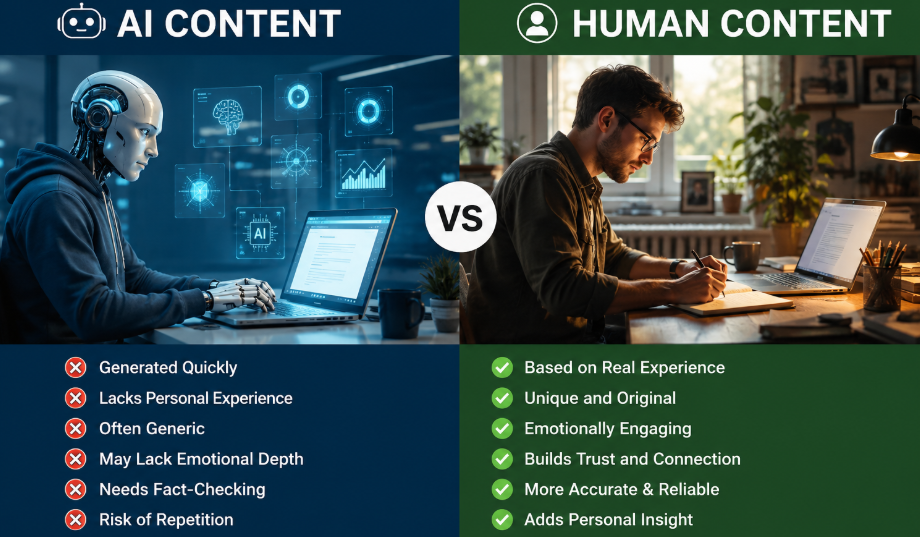
The evaporation of organic discovery traffic represents the defining commercial crisis for digital marketing executives this year. When auditing the current digital landscape, the most pressing strategic question becomes AI Content vs Human Content: What Ranks in 2026? The answer is no longer a theoretical projection; it is a mathematically verified reality. Search behavior has fundamentally fractured. According to recent data from Similarweb and Semrush, roughly 60 percent of Google searches in the US now conclude without a single click to an external website. This zero-click reality is driven by the ubiquitous deployment of AI Overviews and Search Generative Experiences, which extract, synthesize, and serve answers directly on the results page.
The real-world complication for enterprise marketing teams is the profound cost of zero-click traffic evaporation and pipeline stagnation. Executives are witnessing catastrophic traffic declines often 30 to 40 percent year-over-year and instinctively blaming technical algorithm penalties or poor backlink profiles. The reality is that Large Language Models are absorbing the top-of-funnel buyer journey. If an algorithm can synthesize a comprehensive answer directly on the search engine results page, the user has zero incentive to click through to a publisher's site. Organizations are experiencing a complete decoupling of rankings from traffic; maintaining a position-one ranking no longer guarantees visibility or clicks.
Outdated strategies compound this pipeline stagnation. Standardized SEO packages built on legacy principles such as keyword density, generic link building, and mass-produced synthetic text fail entirely to address the modern architecture of Answer Engine Optimization. You need to learn about strategies for optimizing content for google ai overviews. Visibility in 2026 requires a completely new operational baseline focused on machine parsing, strict factual density, and semantic entity relationships. Relying on raw traffic volume as a primary performance indicator obscures the underlying health of digital acquisition channels, forcing organizations to pivot toward metrics that capture multi-surface authority and generative engine visibility.
Field notes from a recent enterprise recovery campaign illustrate this crisis vividly. A major B2B consultancy experienced a 40 percent collapse in organic traffic despite maintaining stable first-page rankings. The initial instinct of the stakeholders was to execute a standard technical audit to find crawl errors. However, deep forensic analysis revealed the traffic was not lost to competitors; it was absorbed entirely by AI Overviews. The recovery strategy did not involve acquiring more backlinks or publishing thinner content at a higher velocity. It required restructuring the existing content into semantic triplets and prioritizing Information Gain. This technical pivot ultimately increased organic conversions despite the lower overall traffic volume, proving that targeted Answer Engine Optimization drives pipeline efficiency even when top-line traffic diminishes.
The Great Decoupling: When Rankings No Longer Equal Clicks
The foundational crisis of 2026 search engine optimization is the "Great Decoupling." Historically, holding the number one organic position guaranteed an average click-through rate of approximately 39.8 percent. The integration of AI Overviews has dismantled this predictability, fundamentally altering how users interact with commercial and informational queries.
Recent large-scale data analyses demonstrate the severity of this shift. Seer Interactive’s analysis of 25.1 million organic impressions revealed that when an AI Overview is present, the organic click-through rate plummets by 61 percent dropping from an already compressed 1.76 percent down to 0.61 percent for informational queries. Paid search click-through rates suffered an even sharper 68 percent decline under the exact same SERP conditions.
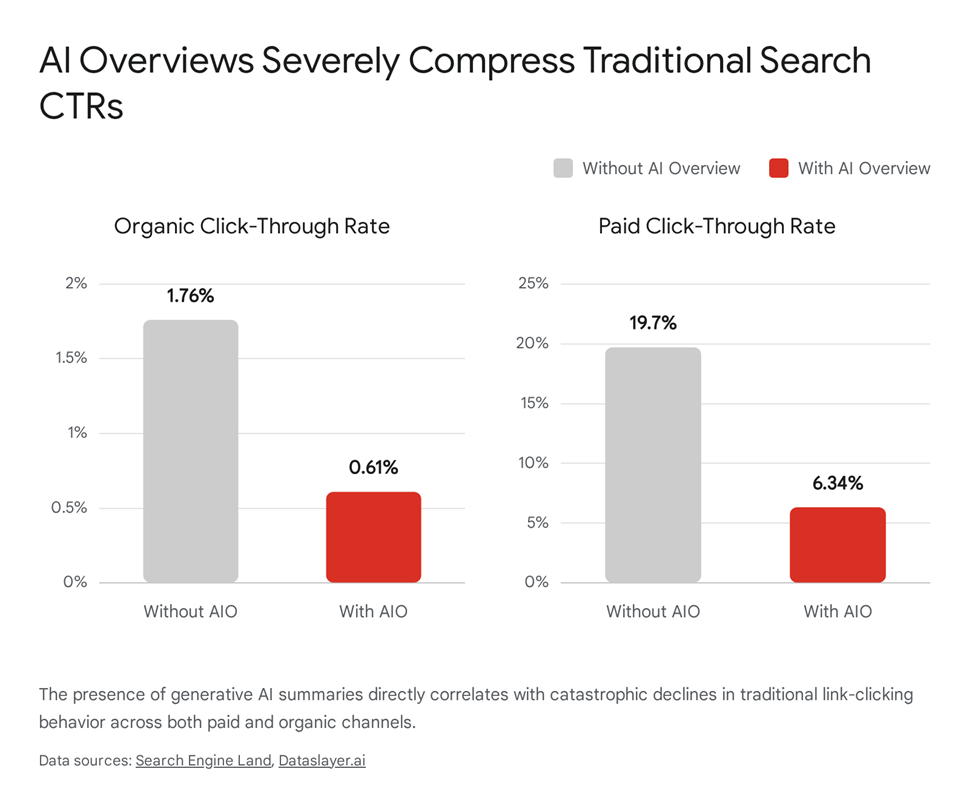
Even more concerning for traditional search practitioners is a December 2025 Ahrefs study, which found that the presence of an AI Overview correlates with a 58 percent lower average click-through rate for the top-ranking organic page compared to queries without AI summaries. The pain point is acute: organizations are spending premium budgets to secure top rankings, only to find those rankings yield negligible traffic.
Furthermore, traditional rankings no longer predict AI citations. In mid-2025, roughly 75 percent of URLs cited within AI Overviews also ranked in the traditional top 10 organic results. By early 2026, that overlap collapsed to between 17 and 38 percent. AI systems are pulling citations from deeper within the web often from positions 21 through 30 because they are optimizing for factual extraction and Information Gain rather than traditional backlink velocity.
Metric Shift (2025 to 2026) | Pre-AI Overview Baseline | Post-AI Overview Implementation | Commercial Impact |
Top 10 Citation Overlap | 75% alignment | 17% - 38% alignment | Rankings no longer guarantee AI inclusion.3 |
Organic CTR (Informational) | 1.76% average | 0.61% average | 61% traffic loss for top-of-funnel queries.6 |
Paid Search CTR | 19.7% average | 6.34% average | 68% decline in ad engagement efficiency.6 |
Zero-Click Search Volume | ~50% of queries | >60% (77% on Mobile) | Users decide without visiting publisher domains.5 |
The solution requires a fundamental pivot in how digital success is measured. The goal is no longer solely to capture a click, but to achieve a high Answer Inclusion Rate the frequency with which a brand is cited as the primary source within the AI-generated response. Data indicates that brands cited in AI Overviews earn 35 percent more organic clicks and 91 percent more paid clicks than un-cited competitors appearing on the exact same page. Visibility within the zero-click layer is the defining top-of-funnel acquisition strategy.
The Semrush Data: Human Originality vs AI Scale
The proliferation of generative AI tools led to an initial assumption that pure synthetic content would overrun the search results. The empirical data proves the exact opposite. According to a comprehensive 2026 Semrush analysis of 42,000 blog posts across 20,000 keywords, human-written content absolutely dominates the top of the search engine results pages.
Pages identified as purely human-written occupy the No. 1 position 80.5 percent of the time. Purely AI-generated pages hold that top spot a mere 9 percent of the time.10 Human-authored content is eight times more likely to secure the primary ranking for competitive commercial queries. While AI content does appear on the first page, its frequency nearly doubles as rankings move downward from Position 1 to Position 4.10
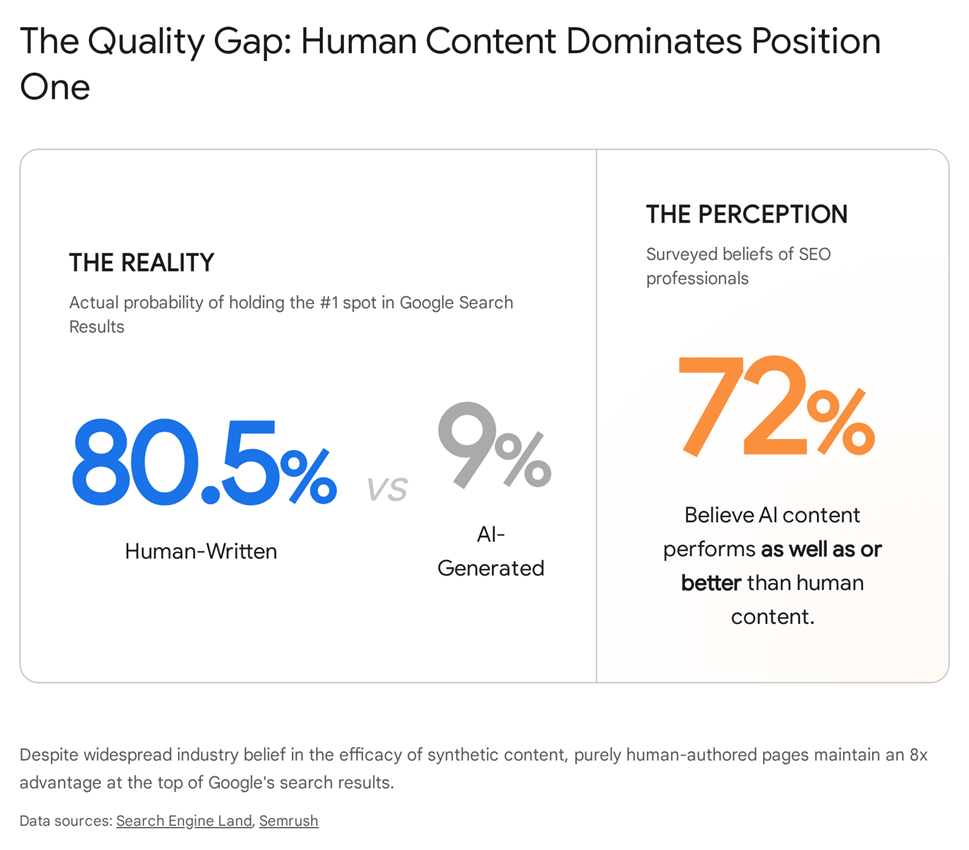
There is a severe perception gap within the digital marketing industry. The Semrush study revealed that 72 percent of SEO professionals believe AI content performs as well as, or better than, human content. This false confidence leads to the mass production of synthetic content that Google's algorithm updates actively suppress. AI-generated text is highly proficient at synthesizing existing information, but it fundamentally lacks the capacity for original thought, unique data generation, or first-hand experiential insight.
This overreliance on automation creates semantic drift and index bloat. As AI regurgitates consensus information, it creates a homogenization of data an "AI Echo" where every article on a specific topic reads identically. Search engines evaluate this duplicate synthetic text and frequently classify it as "Crawled currently not indexed," recognizing that it adds zero incremental value to the search corpus.12
The most successful deployment of AI in 2026 is a hybrid, human-led workflow. Approximately 64 percent of top-performing teams utilize AI for research, structural outlining, and on-page technical optimization, but rely strictly on human editorial judgment for the final output. Search engines do not penalize content explicitly because it is AI-generated; they penalize it because pure AI content usually lacks Experience, Expertise, Authoritativeness, and Trustworthiness. Google’s evaluation systems reward information that demonstrates first-hand involvement, a factor that a Large Language Model fundamentally cannot possess.13
Information Gain Score: The Currency of Generative Search
To survive the zero-click transition, the concept of "Information Gain" must become the central pillar of content production. Granted as a Google patent in June 2022, the Information Gain Score calculates the amount of novel, previously unseen information a specific page adds to a topic compared to the existing corpus of web pages.
When a generative model summarizes a topic for an AI Overview, it compresses the consensus data. If a newly published article merely rewrites the top five existing results the standard output of purely AI-generated text its Information Gain Score is effectively zero. The search engine has no logical reason to rank or cite this page because it offers no new data to enrich the AI's response.
Conversely, pages that inject unique data, proprietary research, contrarian viewpoints, or verifiable first-party statistics score exceptionally high. In the post-March 2026 core updates, sites exhibiting high Information Gain scores realized average visibility improvements of 15 to 22 percent.
Practical implementation of Information Gain requires moving beyond textbook definitions and deploying the following assets:
● Proprietary Data Extraction: Injecting internal company metrics, customer survey data, or original research that cannot be hallucinated by a language model.
● The "War Story" Approach: Documenting highly specific, real-world failures and successes. Authentic, lived experience serves as an impenetrable moat against synthetic content generation.
● Granular Data Slicing: Instead of stating broadly that "page speed is important," an Information Gain approach dictates a hyper-specific claim: "Analysis of 400 B2B sites revealed that reducing Largest Contentful Paint from 2.5s to 1.2s increased lead form completions by 14.3%."
Advanced teams measure this value through sophisticated metrics. The Explanatory Efficiency Index compares fact density against narrative bloat, rewarding concise information over fluffy prose. The Conceptual Depth Score evaluates the hierarchical depth of topics, ensuring the content maps perfectly to the Knowledge Graph rather than simply repeating primary keywords.
RAG Optimization and Semantic Triplets
If Information Gain is the conceptual foundation, Answer Engine Optimization is the technical execution. Traditional search engine optimization was built for web crawlers; Answer Engine Optimization is built for Retrieval-Augmented Generation models. These models process information differently than algorithmic bots. They demand factual density, structural clarity, and unambiguous semantic relationships.
To ensure an AI model extracts and cites a brand's content, the text must be engineered for machine comprehension. The most vital technical framework for 2026 is the deployment of semantic triplets. The conceptual mapping of a semantic triplet involves breaking down unstructured text blocks into a clean, node-based triad. The flow moves from the Entity or Subject, through the Action or Predicate, and concludes with the Value or Object. By structuring content into clear Subject-Predicate-Object relationships, brands provide AI models with easily extractable, highly confident data nodes for generative summaries.
Instead of writing a flowing, narrative sentence such as, "Because of its robust infrastructure, our latest CRM software effectively helps large enterprise clients reduce their customer churn rates by automating follow-ups," the text must be restructured.
The optimized semantic triplet approach breaks this down into extractable, undeniable facts:
● ** Apollo CRM [Predicate] reduces [Object] enterprise churn.
● ** The software [Predicate] automates [Object] email follow-ups.
This framework aligns perfectly with how search engines construct Knowledge Graphs using the Resource Description Framework. When content explicitly defines these relationships, AI models can parse the facts without ambiguity. Every paragraph should serve as a standalone, fact-dense entity that makes perfect logical sense even when extracted entirely out of context.
AI engines prioritize direct, immediate answers. The Bottom Line Up Front method mandates that the core answer to any query must appear in the very first sentence of a section. Using standard HTML definition lists for technical specifications makes the format 30 to 40 percent more likely to be cited by a language model. The model interprets the definition term as the Entity and the definition description as the corresponding Value. Furthermore, content featuring specific statistics paired with clear citations achieves significantly higher visibility. Vague statements are ignored by algorithms, while hard, cited data is aggressively extracted and prioritized.
Generative Engine Optimization vs Answer Engine Optimization
The semantic overlap between various optimization disciplines causes significant operational confusion. Understanding the distinction between Generative Engine Optimization and Answer Engine Optimization is critical for allocating marketing resources efficiently.
Answer Engine Optimization specifically targets the structured features within traditional search engines. This discipline focuses on securing Google Featured Snippets, optimizing for "People Also Ask" boxes, and capturing visibility within Google's AI Overviews. The primary goal is satisfying immediate user intent directly on the search engine results page. Success in this arena relies heavily on clean HTML formatting, FAQ schema, and direct, concise answers placed at the top of the content.
Generative Engine Optimization represents a broader, off-platform strategy. It focuses on ensuring a brand is cited and referenced by standalone Large Language Models, such as OpenAI's ChatGPT, Anthropic's Claude, and Perplexity AI. Users are increasingly treating these chatbots as primary search engines. Traditional keyword rankings have absolutely no bearing on whether ChatGPT recommends a specific software product. Generative Engine Optimization requires building massive topical authority, securing co-citations on platforms that AI models already trust, and ensuring entity clarity across the entire digital ecosystem.
Optimization Discipline | Primary Target Platform | Core Technical Focus | Ultimate Success Metric |
Traditional SEO | Google Blue Links | Backlinks, Keyword Density, PageRank | Traffic Volume, Organic Sessions.30 |
Answer Engine Optimization (AEO) | Google AI Overviews, Featured Snippets | Semantic Triplets, BLUF method, Schema | SERP Capture Rate, Zero-Click Visibility.27 |
Generative Engine Optimization (GEO) | ChatGPT, Perplexity, Claude | Entity Density, Information Gain, Citations | Share of Voice, AI Citation Frequency.27 |
Both disciplines require rigorous technical foundations. Forward-thinking organizations are deploying llms.txt files in their root directories. This specialized file acts as a priority map for AI crawlers, explicitly defining the semantic relationships of the site, establishing priority URLs, and restricting the indexing of outdated or low-quality content. Early adopters of this semantic mapping report a 34 to 41 percent improvement in citation accuracy and a 27 percent higher citation frequency.
Quantifiable Benefits: What the Client Gains in 2026
Transitioning from a legacy traffic-chasing model to a sophisticated, entity-based visibility strategy yields profound, measurable improvements across the enterprise. When organizations stop optimizing for clicks and start optimizing for machine comprehension, the efficiency of their digital pipelines drastically improves.
By implementing strict semantic triplets and prioritizing Information Gain, organizations secure placement within the generative answer box, effectively owning the industry narrative before the user ever clicks a link. This zero-click dominance translates into direct commercial outcomes.
Strategic Implementation | Quantifiable Business Benefit | Mechanism of Action |
AI Citation Optimization | 35% higher organic engagement | Being cited as a source in an AI Overview drives highly qualified, high-intent referral traffic directly to the conversion page.6 |
Information Gain Focus | 15% - 22% visibility improvement | Supplying unique data sets and proprietary research protects the domain from Google's Helpful Content Update suppressions.19 |
Semantic Triplet Restructuring | 30% - 40% higher extraction rate | Formatting content into Subject-Predicate-Object structures allows LLMs to confidently parse and serve the brand's data.25 |
LLM.txt File Deployment | 27% higher AI citation frequency | Directing AI crawlers to priority technical documentation prevents citation pollution and ensures accurate brand representation.31 |
The real-world implications of these implementations are stark. Massive B2B properties that built their empires on broad, top-of-funnel informational queries suffered devastating losses in 2025 and 2026. Domains that ranked highly for queries like generic textbook definitions saw traffic declines ranging from 70 to 80 percent. AI Overviews excel at aggregating commodity information, rendering long-form generic articles completely obsolete.
Conversely, sites that focused on proprietary perspectives, strong brand affinity, and formats resistant to AI summarization experienced explosive growth. Entertainment and lifestyle sites, leveraging authentic voices, first-hand experiential reviews, and visual-heavy content, achieved massive year-over-year traffic increases. Large Language Models struggle to compress original, lived experiences without losing the inherent value of the narrative, making human-centric originality the ultimate competitive moat.
Shifting KPIs: Measuring Success in a Zero-Click World
In an ecosystem where the click is an endangered metric, digital marketing leaders must restructure their performance dashboards. Optimizing for visibility requires transitioning from traditional traffic-centric models to multi-surface authority models. Success is indirect, observed through influence, recall, and assisted outcomes rather than direct session volume.
The primary metric of 2026 is Answer Inclusion Rate, which tracks the exact percentage of times a brand is cited as a source across Google AI Overviews, Perplexity, and ChatGPT for target entity queries. This replaces raw rank tracking as the definitive measure of market penetration.
Secondly, Branded Search Lift serves as a vital lagging indicator. As users rely on AI for initial research, they bypass generic informational searches. Instead, they read the AI summary, identify the recommended vendor, and subsequently perform a direct navigational search for that specific brand. A sustained increase in branded search volume proves that the Generative Engine Optimization strategy is actively influencing the buyer's day-one shortlist.
Finally, organizations must measure Assisted Conversions and pipeline velocity over raw sessions. While total organic sessions may flatten or decline by 15 to 25 percent, the traffic that does click through is highly qualified, having already bypassed the AI summary. Organizations must track the organic channel's contribution to customer lifetime value and CRM pipeline influence, recognizing that lower traffic volume can mathematically yield higher overall revenue when the acquisition targets are hyper-specific.
Success in the 2026 search ecosystem requires acknowledging that search engines have permanently evolved into answer engines. The algorithms no longer reward those who shout the loudest with the highest keyword density; they reward the entities that provide the clearest, most verifiable, and most uniquely valuable data to the machine. By embracing Information Gain, enforcing strict human editorial authority, and mastering the technical extraction layers of generative models, organizations can capture the zero-click landscape and convert AI visibility into tangible commercial growth.
Frequently Asked Questions (FAQs)
What exactly is a "Zero-Click Search"?
A zero-click search occurs when a user enters a query into a search engine and their intent is entirely satisfied by the results page itself typically via an AI Overview, Featured Snippet, or Local Pack resulting in zero clicks to external websites.2 In 2026, roughly 60 percent of all US Google searches end this way, requiring brands to optimize for SERP visibility rather than just click-through rates.1
Does Google penalize AI-generated content?
Google does not issue manual algorithmic penalties strictly because content is written by artificial intelligence. Instead, algorithms penalize content that is unhelpful, repetitive, or lacks E-E-A-T (Experience, Expertise, Authoritativeness, and Trustworthiness). Because pure AI content often synthesizes existing data without adding original value, it naturally fails Google's quality thresholds and struggles to index or rank.13
Why does human-written content rank higher than AI content?
Human-written content holds an 8x ranking advantage at Position 1 because it naturally incorporates original research, nuanced editorial judgment, and first-hand, lived experience.10 These elements generate a high Information Gain Score, which search algorithms actively prioritize over the homogenized consensus output typically generated by Large Language Models.
What is the Information Gain Score?
Information Gain is a computational metric, based on a 2022 Google patent, that evaluates how much unique, novel information a piece of content adds to a specific topic compared to the articles already ranking on the first page. Content that merely regurgitates consensus data scores zero, while content providing new data points, unique frameworks, or proprietary statistics is rewarded with significantly higher visibility.15
What is the difference between SEO, AEO, and GEO?
Traditional SEO optimizes content to rank as a blue link on search results to drive clicks.28 AEO (Answer Engine Optimization) optimizes content structure using schemas and the BLUF method to be featured in Google's AI Overviews and Featured Snippets.27 GEO (Generative Engine Optimization) focuses on ensuring a brand is cited across standalone AI models like ChatGPT and Perplexity by establishing entity clarity and broad topical authority.27
What are Semantic Triplets and why are they important?
Semantic triplets constitute a structural writing method that breaks complex information into a clear Subject-Predicate-Object format (e.g., "Our software reduces [Predicate] data errors [Object]"). This specific format mirrors how search engines build Knowledge Graphs, making it dramatically easier for AI models to confidently extract, understand, and cite the information without semantic ambiguity.22
How do I measure SEO success if organic traffic is dropping?
In a zero-click environment, marketers must pivot away from raw session volume. Success should be measured through the Answer Inclusion Rate (how often AI models cite your brand), Branded Search Lift (increases in users searching your specific company name after AI discovery), and the conversion rate of the organic traffic that does arrive, which often increases in quality even as total volume drops.4
Can a site recover traffic lost to Google's AI Overviews?
Direct recovery of broad, top-of-funnel informational traffic is highly unlikely, as AI efficiently handles those exact queries now. However, organizations can recover business value by pivoting their strategy. This involves identifying defensible transactional keywords, building proprietary data assets that AI must cite, and optimizing for Share of Voice within the AI Overviews themselves to drive assisted conversions.37
What is the BLUF method in Answer Engine Optimization?
BLUF stands for "Bottom Line Up Front." It is an essential formatting strategy where the direct, concise answer to the primary query is placed in the very first sentence of a paragraph or section. Because Large Language Models prioritize parsing efficiency, positioning the core answer immediately under a descriptive heading greatly increases the likelihood of algorithmic extraction and citation.25
How should an enterprise approach link building in 2026?
Traditional volume-based link building is giving way to stringent authority and entity building. The focus has shifted to securing digital PR placements, contextual brand mentions on high-authority industry hubs, and acquiring links that validate a brand's specific topical expertise. Unlinked brand mentions and co-citations on platforms already implicitly trusted by AI models are now as critical as traditional follow links.33
Comments
Log in or sign up to join the conversation.