
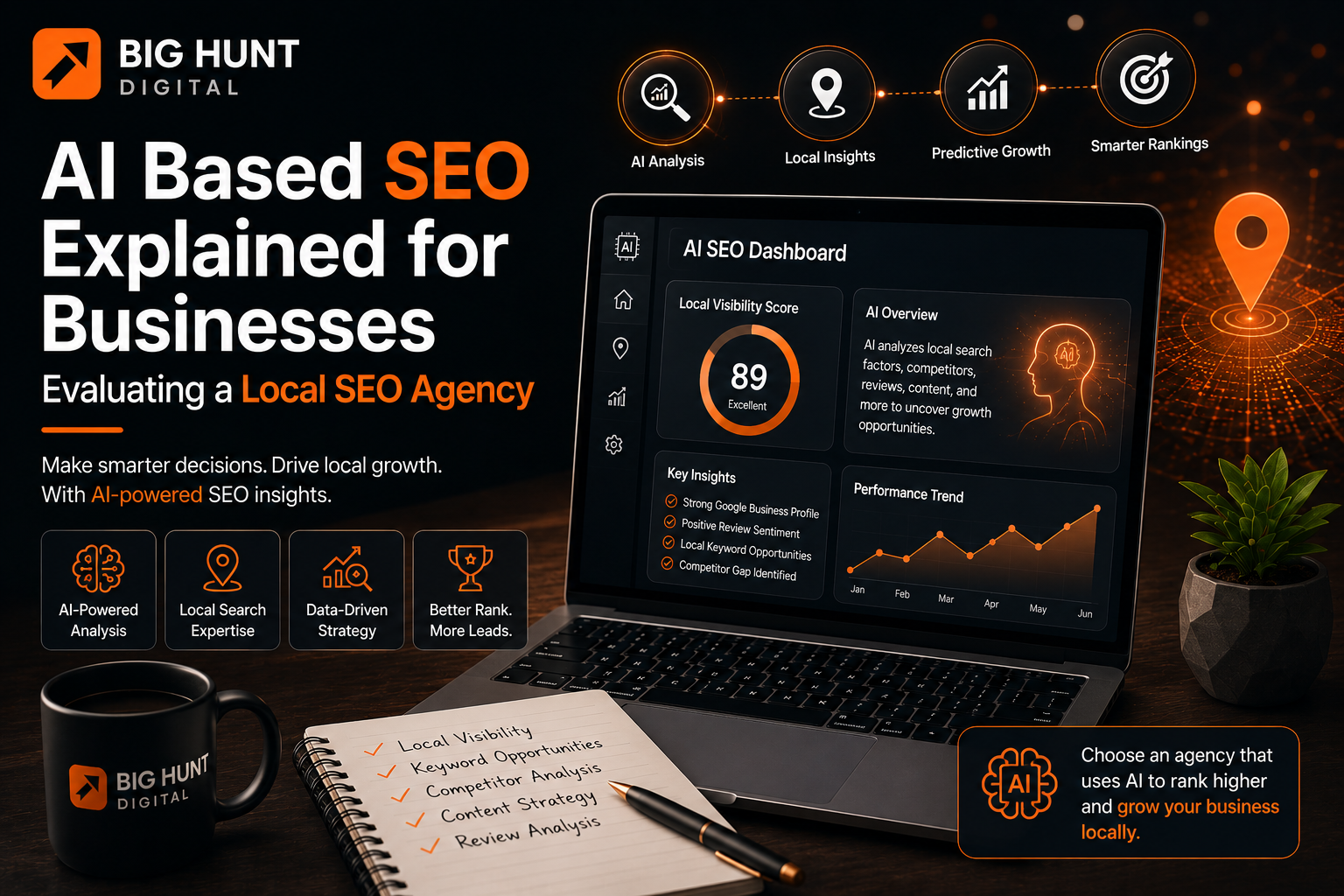
AI Based SEO means a business shows up when someone asks an AI tool for a local recommendation, not just when they search Google directly. Any Local SEO Agency working today should be able to show this happening for at least one real client, not just describe it as a concept.
That's the direct answer. The rest explains why this distinction has become a genuine evaluation criterion, and how a business can actually verify whether an agency delivers on it.
A Concrete Example of Why This Matters
Consider a homeowner who types "architect for a Victorian terrace extension in Ealing" into ChatGPT instead of Google. The AI tool returns a short list of recommendations, drawn from whichever businesses have consistent, well-structured information across the web. A practice that ranks first on Google but has never touched structured data or AI-specific citations may not appear in that list at all. The homeowner never sees a search results page, they see three names, and the practice missing from that list has lost the enquiry entirely, invisibly, without ever knowing a search happened.
This isn't hypothetical. Extension Architecture, a London-based practice, is currently tracked across 15 different AI platforms as part of its ongoing SEO work, precisely because its agency treats this as a distinct, measurable channel rather than an assumption baked into general SEO reporting. That kind of visibility didn't happen by accident, it required deliberately structuring content and citations with AI discovery in mind, alongside the traditional ranking work already underway.
Why Local Businesses Feel This Shift First
National brands have more room to absorb weak AI visibility, paid advertising and brand recognition can compensate for gaps elsewhere. A local business competing for a specific radius has almost no fallback. If an AI tool doesn't mention a business when someone asks for a recommendation in that exact area, there's no equivalent channel catching that moment of intent later, the enquiry simply goes to whichever competitor did appear.
This is why local SEO and AI visibility overlap so heavily in practice. Both depend on the same underlying signals, consistent business information, genuine citations, content that demonstrates real local expertise, which means a local agency already executing strong fundamentals has a real head start, provided it's actually tracking the AI side deliberately rather than assuming traditional local SEO automatically covers it.
What Should Actually Sit in the Scope of Work
A properly built local retainer covering this ground includes a few specific things, not a vague line about "AI optimisation" tucked into a broader package:
Local business schema and structured data implemented as a named deliverable, not assumed to happen as a side effect of general SEO work
NAP consistency, name, address, phone, checked and corrected across every directory an AI tool is likely to draw from
Content written to directly answer common local questions, in a format AI tools can extract cleanly rather than burying the answer in marketing language
Monthly or quarterly reporting showing citation frequency across ChatGPT, Perplexity, and Google AI Overviews specifically, separate from standard local ranking data
None of these require exotic tooling or an entirely new discipline. They require an agency treating AI visibility as a specific, trackable line item rather than folding it silently into a report that never actually measures it.
How a Business Can Check This Themselves
Before relying entirely on an agency's report, a business can run a simple check: ask ChatGPT or Perplexity the exact question a customer might ask, naming the service and the area, and see whether the business appears. Doing this every few months creates a rough but genuinely useful benchmark, independent of whatever an agency reports back, and it costs nothing beyond a few minutes of time.
If the business never appears across several attempts, that's a concrete data point worth raising directly with the provider, not an abstract concern to mention in passing during a monthly call. Bringing a specific example, the exact question asked and the businesses that did appear instead, tends to produce a far more useful conversation than a general question about whether AI SEO is being handled.
Why This Verification Step Matters More Than It Seems
Agencies are, understandably, inclined to report on the metrics that show progress most clearly. Traditional rankings and traffic are easy to demonstrate with a screenshot. AI citation frequency is harder to show convincingly without deliberate tracking, which means it's also easier for an agency to quietly skip reporting on it if the results aren't strong yet. A business running its own periodic check removes that blind spot entirely, rather than depending solely on what gets included in a monthly report.
This doesn't require distrust of a provider, it's simply a sensible habit given how new and unevenly understood this area of SEO still is across the industry as a whole.
What This Means Practically for Choosing a Provider
A business comparing local SEO agencies should ask to see this exact kind of evidence, a real client, tracked across named AI platforms, with a reporting cadence that separates AI visibility from standard local rankings. An agency that has genuinely built this into its process can usually produce that example without hesitation, walking through the platforms tracked and the reporting format used. One that hasn't tends to answer in generalities about "staying ahead of AI trends" instead, without ever naming a specific client, platform, or metric.
The gap between the two isn't subtle once you ask for something specific. It's the difference between a service that's actually running, with a real client and real numbers behind it, and one that exists mainly in a sales conversation, waiting to be built only once a client specifically asks for it.
Comments
Log in or sign up to join the conversation.