
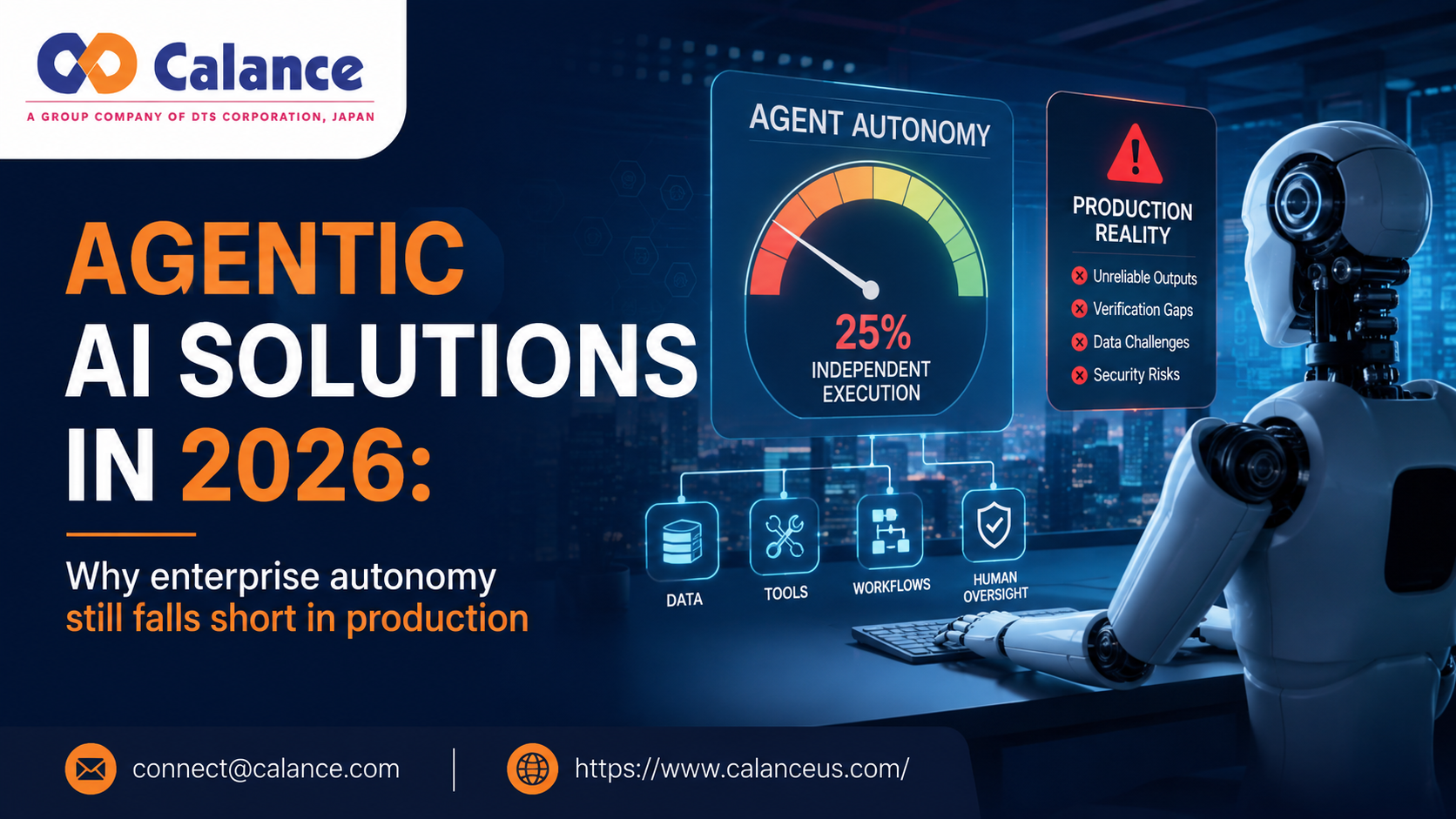
Only 25% of agentic AI solutions studied by Information Services Group allowed agents to work on their own. Another 45% used agents to support human decisions. The finding shows a clear gap between a common promise of agentic AI and what many companies use today. ISG's State of the Agentic AI Market report also found that old systems, poor data, and unclear operating models still create problems.
This gap matters as companies move beyond chatbots. AI agents can now use tools, read business data, and carry out tasks across several systems. Yet the main question is simple: how much work can an agent complete safely without a person checking every step?
Agent autonomy depends on the systems around it
The core promise of enterprise AI agents is possible in the right setting. An agent can receive a goal, choose an action, and use business software to complete part of a task. Its success still depends on the data, access rules, and business process around it.
This is why Agentic AI Solutions need more than a capable AI model. Calance describes agents that can connect with business tools and data, handle multi-step work, and send sensitive cases to people for review. These controls affect how much freedom an agent can safely have.
Recent data shows that companies are adopting this type of system. Snyk studied 3,044 enterprise accounts and about 1.39 million code repositories in June 2026. Its 2026 State of Agentic AI Adoption report found agentic architecture in 33.0% of all organizations studied. The figure rose to 46.9% among organizations where AI use was detected.
Adoption doesn't prove that agents can work well on their own. The same study found that only 50.8% of accounts with models declared any dataset. That gap can make it harder to track where data came from and whether an agent used the right information before taking an action.
Wider agent access requires stronger checks
An agent should gain more control only after its work can be checked with confidence. Evidence from real companies shows why this matters.
A 2026 industrial study included people from 12 companies. Seven companies were using AI at an assistant level, while 4 had reached a more advanced level. Only 1 was using multi-agent orchestration. Four companies had tested more advanced uses but couldn't move them into production because they lacked good ways to check the output. The industrial agentic AI study also found problems linked to uncertain AI behavior, private technology, and confidential data.
This evidence gives companies a useful way to assess AI Agent Solutions. A successful test doesn't prove that an agent is ready for broad access. Teams need to know how often the agent completes the task correctly. They also need to know what happens when the agent meets a case it hasn't seen before.
Calance uses a staged process that starts with assessment and design. Development is followed by controlled testing before a wider release. Human approval can also remain part of sensitive tasks, including financial approvals or policy changes.
Tool access can turn an AI error into a business error
An incorrect chatbot answer may be inconvenient. An incorrect agent action can change a business system.
An agent linked to a CRM could change a customer record. One linked to an ERP system could start part of a financial process. The risk depends on what the model does and how much access the company gives it.
NIST launched its AI Agent Standards Initiative in February 2026. Its work covers agent security, identity, authorization, and the ability of different systems to work together. NIST also notes that agents need dependable access to outside systems and internal data if they're going to work well in real settings.
This gives enterprises a practical rule for Agentic AI Services. Start with a limited task and increase access only after the agent has shown reliable behavior. A service desk agent that drafts a reply from approved information carries less risk than an agent that can close incidents or change user permissions.
Human review doesn't mean the idea has failed. Some tasks simply carry enough risk to justify an approval step.
Agent security must cover actions as well as data
Agent security is still developing. Companies need to think about what an agent can do after it receives information, not only how that information is stored.
A UK government review published in July 2026 studied 9,109 publications released between January 2021 and January 2026. It found important gaps in research on agentic AI security. The UK government's AI security review identified risks linked to agents, the tools they can use, and communication between agents.
These findings affect how companies should build AI Agent Development Solutions. Security rules need to be part of the workflow from the start. Calance lists controls such as restricted access, audit logs, and human review for enterprise agents.
These controls reduce the harm that can follow from a wrong or unauthorized action. They also give teams a record of what the agent did and why human review may still be needed.
Agent autonomy works best under clear conditions
Agentic AI can create real business value when a task has clear limits and measurable results. Current evidence doesn't show that every business process is ready for a fully independent agent.
The better approach is to match the agent's freedom to the risk of the task. A company should know what data the agent can use, what systems it can change, and how errors will be found before those errors affect customers or business records.
This matters when choosing AI Agent Development Services. Teams should first define the business result they want and decide how much error they can accept. They can then identify the systems the agent needs and test the workflow under conditions that are close to real use.
The checks should continue after launch. Snyk found that 77.4% of detected AI tools came from third-party packages. This means an enterprise agent may depend on many parts outside the main AI model. Those parts can include frameworks, retrieval systems, software packages, and connected tools.
A company that measures only the model may therefore miss part of the risk. The full system needs to be checked as the agent gains more responsibility.
Check the operating conditions before accepting the promise
Current evidence supports a more limited view of agent autonomy than many public claims suggest. AI agents are entering enterprise systems, but data problems, weak checking methods, and security risks still limit how much control companies can safely give them.
Before accepting a claim about autonomous work, examine the task, the agent's access, the evidence behind its results, and the controls used when something goes wrong. Greater autonomy makes sense when those conditions support it and real results justify the added authority.
Frequently asked questions
Can enterprise AI agents already work without people?
Some agents can complete limited tasks with little human help. Full independence is less common. ISG found that 25% of the solutions it studied allowed agents to operate independently, while more systems used agents to help people make decisions. The right level of freedom depends on the task and the damage an error could cause.
Why do successful AI agent tests fail in production?
Real business systems are harder than controlled tests. Production brings changing data, access limits, old software, and cases that weren't part of the original test. Research with industrial organizations also found that weak methods for checking agent output can stop advanced systems from moving into production. A good pilot therefore needs to test real operating conditions as closely as possible.
Does human review mean an AI agent has failed?
No. Human review can be a planned safety control. Some high-risk actions should require approval even when an agent completes most of the work correctly. Companies should decide where review is needed based on the possible cost of a wrong action.
What should a company measure before giving an agent more control?
The measures should match the task. A company may track completion rates, error rates, correction needs, processing time, and the cost of failed actions. It should also track how often an agent sends work to a person. These figures help show whether more agent freedom is producing a real benefit.
What should buyers check before accepting an agentic AI claim?
Check the conditions behind the claim. Ask what data the agent uses, which systems it can access, what actions it can take, and how those actions are recorded. Buyers should also ask which decisions still need human approval. Real production results provide stronger evidence than a controlled demonstration.
For more info Contact Us or send mail : [email protected] to get a quote.
Comments
Log in or sign up to join the conversation.