

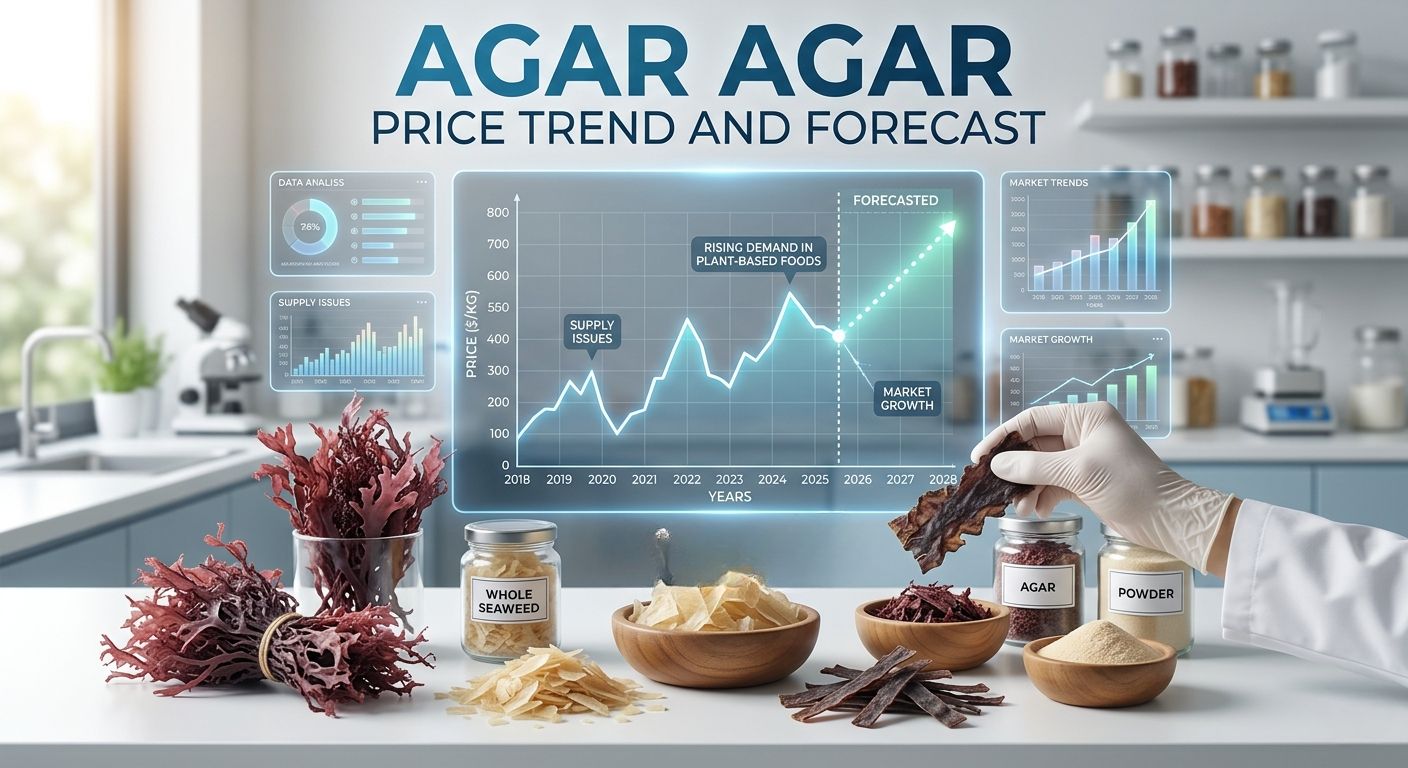
The global Agar Agar market witnessed a softer pricing environment during the recent quarter, with major regions recording quarter-over-quarter declines due to balanced inventories, moderate downstream demand, and weaker import quotations. Agar Agar prices across North America, Europe, and Asia-Pacific reflected stable supply chains and subdued procurement activity from food processing, pharmaceutical, microbiology, and cosmetic industries.
Latest Agar Agar Price Trend: - https://www.chemanalyst.com/Pricing-data/agar-agar-1437
Agar Agar remains a critical hydrocolloid extracted primarily from red seaweed and is widely used as a gelling, stabilizing, and thickening agent. The product continues to play an important role in food manufacturing, biotechnology laboratories, pharmaceuticals, and vegan product formulations. Despite its long-term demand outlook remaining positive, short-term market fundamentals showed signs of easing pressure during the quarter.
What is Agar Agar?
Agar is a natural polysaccharide obtained from marine algae, particularly red seaweed species such as Gelidium and Gracilaria. It is commonly used in:
Food and beverage manufacturing
Bakery and confectionery products
Vegan gelatin alternatives
Pharmaceutical capsules
Cosmetic formulations
Microbiological culture media
Due to its plant-based origin and strong gelling characteristics, Agar Agar demand has steadily increased in vegan and clean-label product categories globally.
Agar Agar Price Trend in North America
USA Agar Agar Price Analysis
In the United States, the Agar Agar Price Index declined quarter-over-quarter, reflecting softer import quotations and adequate domestic inventories. Market participants observed balanced supply conditions as import flows from Asian producers remained stable throughout the quarter.
The average Agar Agar market level in the USA was supported by:
Consistent import arrivals
Stable distributor inventories
Moderate downstream consumption
Softer international freight pressure
Reduced urgency in spot procurement
Food processing industries remained the primary demand driver; however, procurement activity was largely contract-based rather than aggressive spot buying. Pharmaceutical and biotechnology sectors maintained stable consumption patterns, but these were insufficient to create upward pricing momentum.
The easing of shipping costs and improved supply chain efficiency also contributed to softer market sentiment. Buyers preferred maintaining optimized inventories rather than expanding stock positions, especially amid uncertain global economic conditions.
Read the LinkedIn Article: - https://www.linkedin.com/pulse/agar-price-trend-2026-global-market-analysis-regional-kishan-singh-l3huc/
Key Factors Influencing USA Agar Agar Prices
Lower import quotations from APAC exporters
Adequate warehouse inventories
Stable demand from food applications
Softer freight and logistics costs
Balanced distributor supply networks
APAC Agar Agar Price Trend
Japan Agar Agar Market Analysis
Japan recorded one of the more visible declines in the global Agar Agar market during the quarter. The Agar Agar Price Index fell by 4.35% quarter-over-quarter due to softer FOB offers from exporting countries and the strengthening Japanese Yen.
The average Agar Agar price in Japan during the quarter stood at approximately USD 12,390/MT. Market conditions reflected subdued import parity alongside ample domestic inventories.
Several factors contributed to the bearish pricing environment:
Reduced import replacement costs
Improved currency purchasing power
Comfortable inventory availability
Stable domestic consumption
Weak urgency in restocking activity
Japan remains an important consumer of Agar Agar due to its extensive usage in food processing, confectionery, desserts, and biotechnology applications. However, the quarter saw relatively moderate procurement behavior from buyers, which reduced pricing pressure.
Additionally, stable seaweed harvesting conditions in producing countries helped maintain adequate export availability, preventing any major supply shortages.
Major Drivers Behind Japan Agar Agar Prices
Stronger Japanese Yen
Softer FOB export offers
Stable regional supply conditions
Comfortable importer inventories
Controlled downstream procurement
Europe Agar Agar Price Trend
Germany Agar Agar Market Analysis
In Germany, the Agar Agar Price Index also declined quarter-over-quarter. The market was influenced by softer import offers and sufficient distributor inventories across the European supply chain.
The average Agar Agar market level reflected:
Balanced import parity
Stable distributor stock levels
Consistent import arrivals
Moderate food sector demand
Stable supply conditions
European buyers remained cautious with procurement volumes amid ongoing economic uncertainties and controlled manufacturing activity in some downstream industries. Food and beverage sectors continued to support baseline demand; however, the overall market lacked strong bullish momentum.
Importers and distributors across Germany focused on inventory optimization rather than aggressive stock accumulation. As a result, market activity remained balanced with limited price volatility.
Key Market Drivers in Germany
Softer international supplier offers
Stable European inventories
Balanced downstream consumption
Moderate industrial demand
Improved logistics conditions
Global Factors Affecting Agar Agar Prices
Several macroeconomic and industry-specific factors influenced global Agar Agar Price movements during the quarter.
Seaweed Harvesting Conditions
Agar Agar production depends heavily on red seaweed availability. Stable harvesting conditions across major producing nations helped maintain sufficient raw material supply.
Any future disruption caused by:
Climate conditions
Ocean temperature changes
Regulatory fishing restrictions
Seaweed disease outbreaks
could significantly impact global pricing.
Freight and Shipping Costs
Global freight markets remained relatively stable compared to previous periods of elevated logistics pressure. Lower container freight rates helped reduce import replacement costs across North America and Europe.
This contributed to softer Agar Agar pricing in importing countries.
Currency Fluctuations
Currency movements played an important role in regional pricing trends, especially in Japan. The strengthening Yen reduced effective import costs and weakened domestic price pressure.
Similarly, exchange rate fluctuations continue to influence import competitiveness globally.
Food Industry Demand
The food industry remains the largest consumer of Agar Agar worldwide. Demand trends from:
Vegan products
Dairy alternatives
Bakery products
Confectionery
Functional foods
continue to shape long-term market fundamentals.
Although demand remained stable during the quarter, buying activity was relatively conservative.
Inventory Management Strategies
Distributors and importers across key regions maintained comfortable inventory levels during the quarter. Buyers avoided aggressive spot purchases due to sufficient stock availability and stable supply chains.
This inventory stability contributed to weaker price momentum globally.
Agar Agar Applications Driving Market Demand
Food and Beverage Industry
The food sector continues to dominate Agar Agar consumption globally. It is widely used as a:
Thickening agent
Stabilizer
Gelling agent
Vegan gelatin substitute
The rising popularity of plant-based foods continues supporting long-term demand growth.
Pharmaceutical Industry
Agar Agar is used in pharmaceutical formulations, capsules, and suspensions due to its stabilizing and emulsifying properties.
The healthcare industry's growing preference for plant-derived ingredients is expected to support future market expansion.
Biotechnology and Microbiology
Microbiology laboratories utilize Agar Agar extensively in culture media preparation because of its excellent gel-forming properties and biological stability.
Increasing biotechnology research activities continue supporting baseline demand.
Cosmetic Industry
The cosmetic sector uses Agar Agar in skincare products, creams, gels, and personal care formulations.
Growing consumer preference for natural ingredients may support stronger future demand from this sector.
Agar Agar Market Forecast
Short-Term Outlook
The short-term Agar Agar Price outlook suggests that global prices may remain relatively stable to slightly soft if:
Import flows remain balanced
Seaweed harvests stay healthy
Freight markets remain stable
Inventory levels stay sufficient
Buyers are expected to continue cautious procurement strategies amid balanced market fundamentals.
Medium-Term Outlook
Over the medium term, the Agar Agar market could experience moderate recovery supported by:
Rising vegan food demand
Expanding pharmaceutical applications
Growth in biotechnology industries
Increasing clean-label product adoption
Any tightening in seaweed supply or sharp increase in shipping costs could create upward pricing pressure.
Long-Term Market Expectations
Long-term demand fundamentals for Agar Agar remain positive due to:
Growth in plant-based food industries
Sustainable ingredient preferences
Rising global food processing demand
Expanding biotechnology research
Asia-Pacific is expected to remain the dominant production hub, while North America and Europe continue serving as major import-dependent consuming regions.
Challenges in the Agar Agar Market
Despite positive long-term prospects, the market faces several challenges:
Supply Chain Dependence
The global Agar Agar industry depends heavily on limited seaweed-producing regions, creating vulnerability to environmental and climatic disruptions.
Price Sensitivity
Food manufacturers remain highly sensitive to ingredient cost fluctuations, limiting aggressive price increases.
Environmental Risks
Climate change and ocean ecosystem disruptions could affect seaweed cultivation and harvesting efficiency.
Competition from Alternative Hydrocolloids
Agar Agar competes with:
Carrageenan
Gelatin
Pectin
Xanthan gum
Pricing competitiveness remains important for market stability.
Conclusion
The global Agar Agar Price market experienced a softer quarter across North America, Europe, and Asia-Pacific due to balanced supply conditions, adequate inventories, and weaker import quotations. In the USA, stable distributor supply and moderate procurement activity contributed to softer pricing. Japan recorded a 4.35% quarter-over-quarter decline amid Yen strength and subdued import parity, while Germany witnessed softer prices due to sufficient inventories and balanced imports.
Although current market conditions remain stable to slightly bearish, long-term demand fundamentals for Agar Agar continue to appear positive. Expanding applications in vegan foods, pharmaceuticals, cosmetics, and biotechnology are expected to support future market growth.
Going forward, global Agar Agar prices will continue to depend on seaweed harvesting conditions, international freight markets, currency fluctuations, and downstream industrial demand trends.
Contact US:
Email-Id: - [email protected]
Contact No: - +1 (332) 258-6602
Address: - 420 Lexington Avenue, Suite 300
New York, NY
United States, 10170
Comments
Log in or sign up to join the conversation.