


Image: Bigstock
Key Takeaways
ADMA Biologics rides strong on Asceniv demand, with 2025 revenues up 20% and 2026 sales expected above $635 million.
Takeda leverages a broad plasma portfolio and global infrastructure to drive growth in rare disease therapies.
ADMA Biologics (Free Report) and Takeda (Free Report) are prominent players in the plasma-derived immunoglobulin space. ADMA Biologics focuses on plasma-based biologics to treat immune deficiencies and help prevent certain infectious diseases. In contrast, Takeda operates a broadly diversified portfolio spanning gastroenterology, rare diseases, plasma-derived therapies, oncology, and neuroscience.
With both companies holding strong positions in the plasma-derived therapies market, selecting one over the other is not easy. A closer look at their fundamentals, growth outlook, key risks, and valuations can help determine the better investment choice.
The Case for ADMA Biologics
ADMA Biologics markets plasma-derived biologics for the treatment of immune deficiencies and the prevention of certain infectious diseases.
Asceniv, its lead product, is a plasma-derived IVIG that contains naturally occurring polyclonal antibodies. It is indicated for the treatment of primary immunodeficiency disease (PIDD) or inborn errors of immunity in adults and adolescents.
Record demand for Asceniv, expected expansion in payer coverage, and growing confidence in long-term plasma supply are providing clear visibility into accelerating revenues in 2026.
The product is manufactured using ADMA Biologics’ unique, patented plasma donor screening methodology and tailored plasma pooling design, which blends normal source plasma with respiratory syncytial virus plasma obtained from donors tested using the company’s proprietary microneutralization assay.
Third-party suppliers outperformed expectations in 2025, and newly executed agreements now provide access to more than 280 plasma collection centers, significantly strengthening Asceniv’s long-term supply outlook.
Management believes Asceniv is in the early stages of penetrating a large total addressable market and represents a key long-term growth driver for ADMA Biologics (supported by a differentiated, patented supply, and manufacturing platform).
Revenues of $510.2 million in 2025 were up 20% from 2024, driven by higher Asceniv sales due to continued growth in physician, payer, and patient adoption. Asceniv delivered record utilization in 2025, with revenues climbing 51% year-over-year to $363 million on strong demand and growing prescriber adoption. The company expects 2026 revenues to exceed $635 million, while 2027 revenues are forecasted to exceed $775 million.
ADMA Biologics is also positioned to benefit in 2026 from a continued shift in product mix toward higher-margin IVIG therapies, supporting further gross margin expansion. This improvement is expected to be driven by the first full year of yield-enhanced production, reinforcing the company’s operating leverage and supporting its profitability trajectory.
ADMA Biologics is also advancing SG-001, a hyperimmune globulin targeting S. pneumonia. It plans to submit a pre-Investigational New Drug (“IND”) meeting package to the FDA in 2026, potentially enabling direct progression into a registrational trial. Management estimates peak annual sales of $300-$500 million, adding meaningful long-term optionality beyond its IVIG products.
The Case for Takeda
Takeda has established a dedicated plasma-derived therapies (PDT) unit that oversees the entire value chain, from plasma collection and manufacturing to R&D and commercialization, aimed at delivering life-saving treatments for rare and complex diseases.
Takeda’s broad immunoglobulin portfolio includes Hyqvia, Cuvitru, Gammagard Liquid, and Gammagard Liquid Erc. Among these, Hyqvia is a product consisting of human normal IG and recombinant human hyaluronidase (licensed from Halozyme).
Hyqvia is the only subcutaneous IG treatment for primary immunodeficiencies (PID) patients with a dosing regimen that requires only one infusion up to once per month and one injection site per infusion to deliver a full therapeutic dose of IG. It is approved in the United States for adults with PID, and in Europe for patients with PID syndromes and myeloma or CLL with severe secondary hypogammaglobulinemia and recurrent infections. Hyqvia was also approved for maintenance treatment in adult patients with chronic inflammatory demyelinating polyneuropathy (CIDP) in the United States and in CIDP patients of all ages in Europe.
Cuvitru is indicated as replacement therapy for primary humoral immunodeficiency in adults and pediatric patients two years of age and older.
Gammagard Liquid/Kiovig is a liquid formulation of the antibody replacement therapy immunoglobulin (IG), for the treatment of adult and pediatric patients two years of age or older with PID and adult patients with multifocal motor neuropathy (MMN) (administered intravenously). It is also approved for adult patients with CIDP. Kiovig is the brand name used for Gammagard Liquid in many countries outside the United States.
The company is also advancing next-generation products like TAK-881 and early-stage candidates such as TAK-411, while recent regulatory approvals and device innovations are supporting broader adoption and easier administration of key therapies.
Takeda is advancing a next-generation immunoglobulin therapy, TAK-881 (20% facilitated SCIG), while exploring early-stage candidates such as TAK-411 (hypersialylated immunoglobulin). These efforts are expected to further strengthen its already diverse global portfolio of more than 20 marketed therapies.
A Look at Estimates: ADMA Biologics vs. Takeda
The Zacks Consensus Estimate for ADMA Biologics' 2026 sales implies a year-over-year increase of 19.81%, and the estimate for earnings per share (EPS) suggests an improvement of 55%. EPS estimates for 2026 and 2027 have both moved north in the past 60 days.
ADMA Biologics’ Estimate Movement
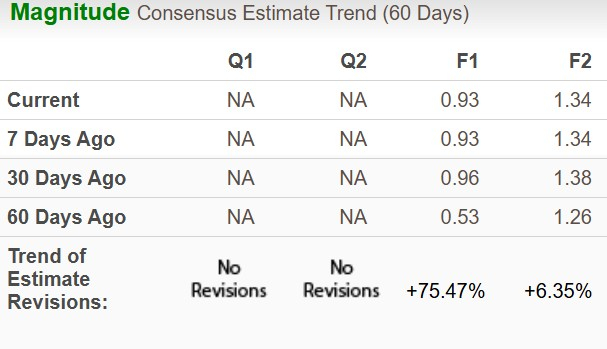
Image Source: Zacks Investment Research
The Zacks Consensus Estimate for Takeda’s 2025 sales implies a year-over-year decrease of 3.74%, while the estimate for EPS suggests a decline of 2.48%. EPS estimates for 2026 and 2027 have both moved north in the past 60 days.
Takeda's Estimate Movement
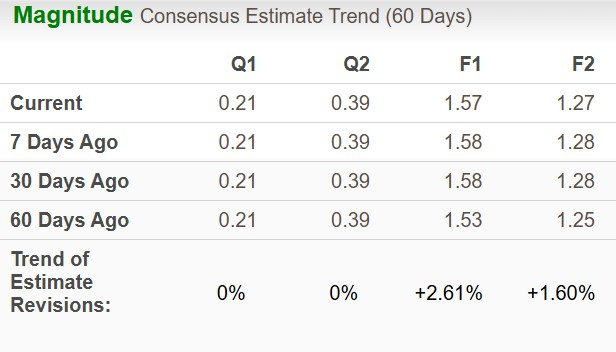
Image Source: Zacks Investment Research
Price Performance and Valuation of ADMA Biologics and Takeda
From the perspective of price performance, Takeda has fetched better returns than ADMA Biologics so far this year. Shares of Takeda have gained 6.7%, while those of ADMA Biologics have plunged 39.3%. The industry has gained 1.3% in the same period.
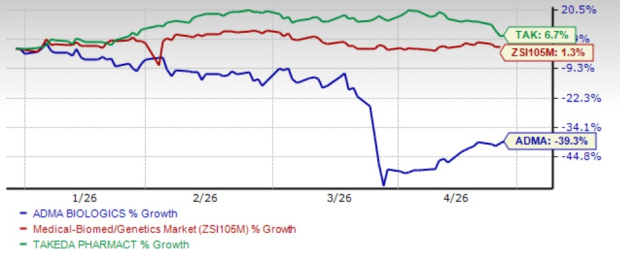
Image Source: Zacks Investment Research
From a valuation standpoint, Takeda appears to be more expensive than ADMA Biologics. Takeda's shares have recently been trading at 12.70X forward earnings, higher than the 10.51X rate for ADMA Biologics.
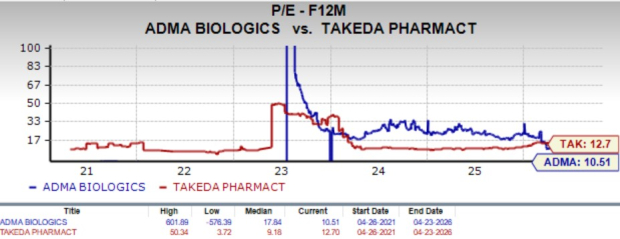
Image Source: Zacks Investment Research
Which Stock Is a Better Pick Now?
Large biotech companies are generally considered safe havens for investors interested in this sector. However, with both ADMA Biologics and Takeda stocks currently carrying a Zacks Rank #2 (Buy) rating, choosing one over the other could be tricky.
Takeda is a drug giant with an extremely broad and diverse portfolio. It is one of the three largest producers of plasma derivatives in terms of total sales. The company’s diversified plasma drug portfolio, global infrastructure, and encouraging R&D efforts should help it drive growth in its PDT business.
On the other hand, ADMA Biologics' top line is witnessing steady growth on the back of robust Asceniv demand. However, the recent pullback in the stock in response to short seller Culper Research’s allegations is worrisome even though the company emphasized that demand for its key product remains strong and growing, supported by distributor and end-user data.
Large-cap Takeda offers more stability and has outperformed ADMA Biologics year-to-date, potentially making it the better pick currently.



Comments
Log in or sign up to join the conversation.