

Adi Shankara is one of the most influential philosopher-saints in the history of Hindu thought. Revered as the reviver of Advaita Vedanta, the philosophy of non-dualism, he traveled the length of India as a young ascetic, engaged in some of the most celebrated philosophical debates of his age, and established monastic institutions that continue to guide Hindu religious life to this day. Though he lived only a few decades, his impact on Indian philosophy, worship, and monastic tradition has lasted well over a thousand years.
For anyone exploring the roots of Vedantic philosophy or the lives of India's greatest spiritual teachers, understanding who Adi Shankara was explains why his image, his writings, and his institutions remain such an enduring presence in Hindu thought - a legacy that continues to be studied and honored by devotees and scholars featured on platforms such as Idol Bronze.
Who Is Adi Shankara?
Early Life and Family
Adi Shankara is traditionally believed to have been born in the early 8th century CE in the village of Kalady, on the banks of the Purna River in present-day Kerala. His parents, Shivaguru and Aryamba, were a Brahmin couple who had remained childless for many years and are said to have prayed at the Vadakkunnathan Temple in Thrissur for a son, dedicating him, according to legend, to a life devoted to Lord Shiva. Shankara lost his father at a young age and, from childhood, showed an extraordinary aptitude for scripture, reportedly mastering the Vedas and classical texts far earlier than was customary.
Guru and Philosophical Lineage
While still a boy, Shankara resolved to take up sannyasa, the life of a renunciate, against his widowed mother's wishes. He eventually became a disciple of Govinda Bhagavatpada, a sage who lived in a cave hermitage on the banks of the Narmada river, and who was himself a disciple of Gaudapada, an early and important expounder of Advaita ideas. Through this teacher-lineage, Shankara inherited and then dramatically expanded a strand of Vedantic thought that had existed in seed form for generations.
Classification Within Vedantic Thought
Shankara is best known as the principal architect of Advaita Vedanta, the "non-dual" school of Vedantic philosophy. Advaita holds that the ultimate reality, Brahman, is one, formless, and beyond all attributes, and that the individual self, or Atman, is not different from Brahman. This position set his school apart from the two other major Vedantic streams that would develop after him: Vishishtadvaita ("qualified non-dualism"), later associated with Ramanujacharya, and Dvaita ("dualism"), later associated with Madhvacharya. Where those schools preserved a real distinction between the soul and the divine, Advaita taught that this distinction is ultimately an illusion born of ignorance.
Iconography of Adi Shankara
The Danda and Kamandalu
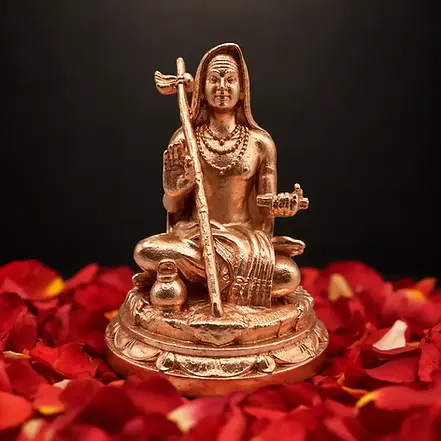
Adi Shankara is traditionally depicted as a youthful ascetic carrying two simple objects: the danda, a wooden staff, and the kamandalu, a water pot. Both are standard emblems of a wandering monk in Indian tradition. The staff represents discipline and the renunciate's authority over the senses, while the water pot signals a life of minimal possessions, sustained only by what is essential for survival and ritual purity.
Ochre Robes and Simplicity of Form
He is almost always shown in the ochre or saffron-colored robes worn by sannyasis, a color historically associated with fire, renunciation, and the burning away of worldly attachment. Unlike depictions of deities, Shankara's iconography avoids multiple arms, elaborate crowns, or divine weapons — a deliberate visual restraint that reflects his own teaching that liberation lies not in outward form but in the recognition of one's true, formless nature.
The Life and Legend of Adi Shankara
Birth at Kalady and Early Miracles
Popular tradition surrounds Shankara's birth and boyhood with several miraculous episodes. One well-known account describes him being threatened by a crocodile while bathing in the river and using the moment to persuade his mother to grant permission for his renunciation, since a vow taken while facing death could not be revoked. Whether read literally or symbolically, the episode marks the decisive turning point at which Shankara's worldly life gave way to his spiritual calling.
Renunciation and Meeting His Guru
After leaving home, Shankara traveled north in search of a teacher capable of guiding him toward the highest truth. His meeting with Govinda Bhagavatpada on the Narmada is remembered as the moment his personal search for meaning became formal philosophical training. Under his guru's guidance, and drawing on Gaudapada's earlier commentary on the Mandukya Upanishad, Shankara began to develop the systematic reasoning that would become his lasting contribution to Indian philosophy.
The Debate with Mandana Mishra
Among the most famous episodes of Shankara's life is his debate with Mandana Mishra, a formidable scholar and defender of ritualistic, Mimamsa-based Vedic practice. According to tradition, the contest was judged by Mandana Mishra's wife, Ubhaya Bharati, and lasted many days before Shankara prevailed. In a further twist often recounted in hagiographies, Ubhaya Bharati is said to have then challenged Shankara on matters of worldly and conjugal life, a debate he could only continue after temporarily entering another man's body to gain the required experience — an episode used to illustrate both his intellectual completeness and his mastery over the body itself.
Establishing the Four Mathas
Having triumphed in debate after debate across the subcontinent, a campaign traditionally called his "Digvijaya" or "conquest of the directions," Shankara set about institutionalizing his teachings so they would outlast him. He is credited with establishing four principal mathas, or monastic seats, at Sringeri in the south, Dwarka in the west, Puri in the east, and Jyotirmath (Badrinath) in the north, each entrusted to one of his four chief disciples and each associated with one of the four Vedas. This structure ensured that Advaita Vedanta would be preserved, taught, and defended by an organized monastic order long after his own lifetime.
Sacred Shrines Associated with Adi Shankara
Several sites across India are closely tied to Shankara's life and legacy. Kalady, his birthplace in Kerala, houses temples commemorating his mother and his own early life, and remains a pilgrimage destination for followers of Advaita. Sringeri Sharada Peetham, in present-day Karnataka, is regarded as the first and most senior of the four mathas he founded, home to a continuous line of pontiffs known as the Sringeri Jagadgurus. The Kanchi Kamakoti Peetham in Tamil Nadu, though its precise historical link to Shankara is debated by scholars, has for centuries claimed descent from his tradition and remains one of the most prominent Advaita institutions in South India. Tradition holds that Shankara's final years were spent at Kedarnath in the Himalayas, where he is believed to have taken samadhi, having completed his mission of restoring and systematizing Vedantic thought.
Spiritual Significance of Adi Shankara
Restoring the primacy of knowledge (jnana): Shankara argued that liberation, or moksha, comes through direct realization of the identity between Atman and Brahman, not through ritual action alone.
Systematizing scattered teachings: Through his commentaries on the Upanishads, the Bhagavad Gita, and the Brahma Sutras, he gave Advaita a rigorous, textually grounded philosophical structure that could be taught and debated.
Unifying diverse worship practices: He is traditionally credited with organizing the Panchayatana puja, a method of worship that allows devotees to honor Shiva, Vishnu, Devi, Surya, and Ganesha together, easing sectarian rivalries among Hindu worshippers of his time.
Founding a lasting monastic order: By establishing the four mathas and the Dashanami order of monks, he built durable institutions that carried Advaita philosophy forward across generations.
Why Is Adi Shankara Different from Other Vedantic Teachers?
Versus Ramanujacharya (Vishishtadvaita): Ramanuja held that the individual soul, though inseparable from Brahman, retains a real, eternal distinctiveness — a "qualified" non-dualism, in contrast to Shankara's view that all distinction is ultimately illusory (maya).
Versus Madhvacharya (Dvaita): Madhva taught an unambiguous dualism, insisting that the soul and God remain eternally and fundamentally separate — a direct philosophical counterpoint to Shankara's non-dual position.
Versus the bhakti saints: Where many later saints emphasized loving devotion to a personal deity as the primary path to liberation, Shankara's Advaita centers on jnana, the intellectual and experiential realization of one's identity with the formless Absolute, even as he personally composed devotional hymns to a wide range of deities.
As a systematizer rather than an innovator alone: Unlike founders of new devotional movements, Shankara presented himself as reviving and clarifying the Upanishads' oldest teachings, using rigorous commentary rather than new revelation as his primary method.
Adi Shankara's Literary Legacy and Shankara Jayanti
Beyond his philosophical commentaries, Shankara is remembered for a body of devotional and instructive literature that remains widely read today. Bhaja Govindam is a short, deceptively simple hymn urging the listener to turn away from worldly pursuits and toward devotion and self-inquiry, and remains one of the most recited Sanskrit compositions in Indian households and schools. Soundarya Lahari, meaning "Waves of Beauty," is a lyrical hymn to the Divine Mother that blends poetic devotion with subtle references to tantric philosophy, and is treasured both for its literary beauty and its spiritual depth. Vivekachudamani, or "The Crest Jewel of Discrimination," is a more systematic instructional text that lays out the path of self-inquiry and the distinction between the eternal Self and the transient world, and is often used as an introductory text for students of Advaita.
Shankara's birth anniversary is observed each year as Shankara Jayanti, typically falling on the fifth day of the bright half of the Vaishakha month. The day is marked at the mathas he founded, particularly Sringeri and Kanchipuram, with special worship, recitations of his works, and discourses on Advaita philosophy, and is observed more broadly by followers of Vedanta as an occasion to reflect on his teachings and continuing influence on Hindu philosophical and monastic life.
Conclusion
Adi Shankara's life bridges the world of scholarly debate and the world of devotional practice in a way few figures in Indian history have matched. Through his commentaries, his hymns, and the monastic order he built, he gave Advaita Vedanta a structure durable enough to survive more than a thousand years of change. Whether approached through his philosophy, his poetry, or the institutions that still bear his imprint, Adi Shankara remains a central figure for understanding the intellectual and spiritual currents that continue to shape Hindu thought.
Comments
Log in or sign up to join the conversation.