

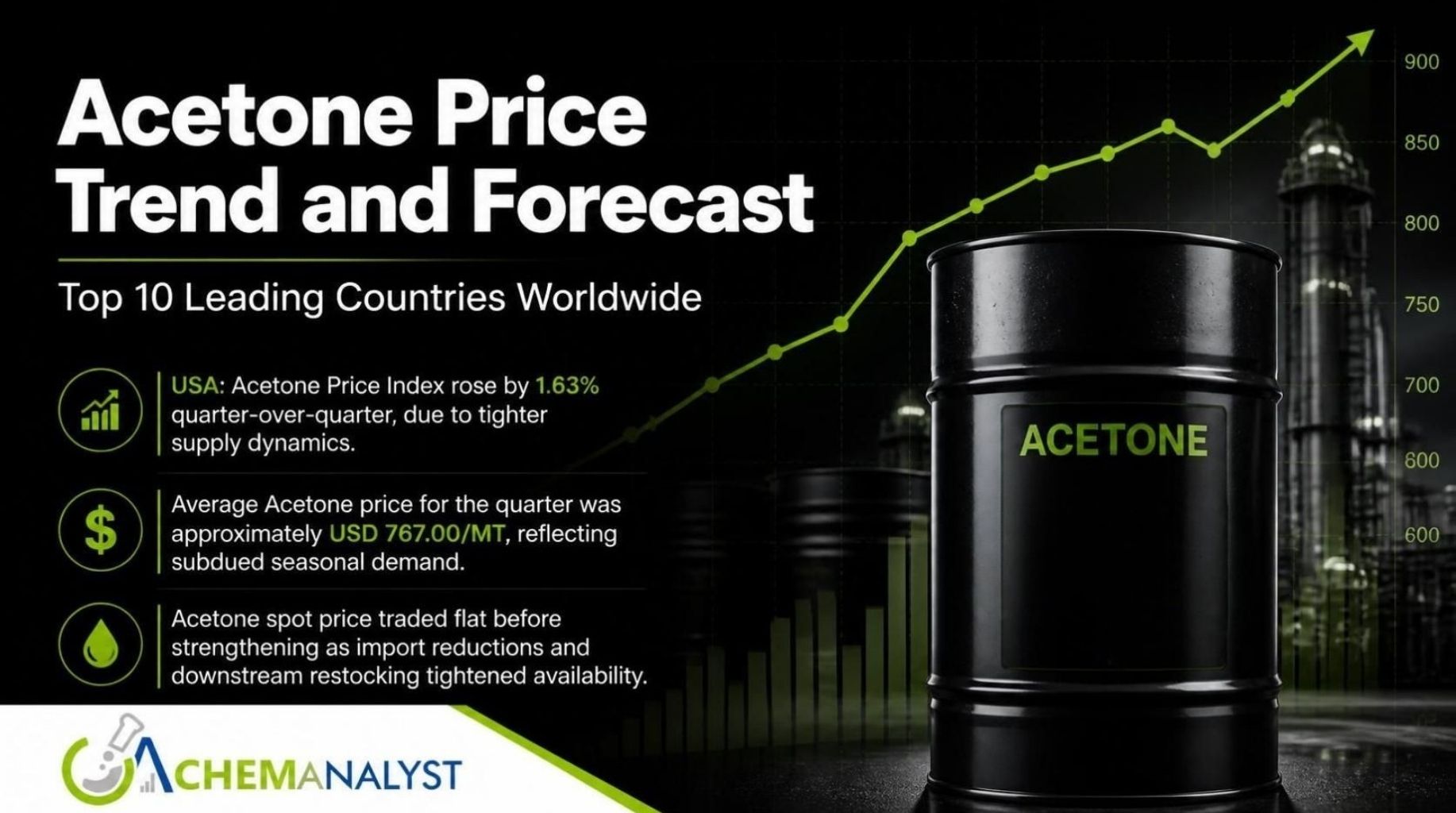
The Acetone Price experienced varied movements across major global markets during the first quarter of 2026, reflecting a combination of regional supply constraints, feedstock volatility, inventory adjustments, and shifting downstream demand. As one of the world's most widely used industrial solvents, acetone remains a critical raw material for the production of bisphenol-A (BPA), methyl methacrylate (MMA), pharmaceuticals, cosmetics, paints, adhesives, and specialty chemicals.
According to ChemAnalyst Acetone Price: - https://www.chemanalyst.com/Pricing-data/acetone-12
For procurement managers, manufacturers, traders, and investors, monitoring the latest Acetone Price Trend is essential for making informed sourcing decisions and managing procurement risks. While North America witnessed modest price gains due to tighter domestic supply, Europe experienced an exceptional surge driven by supply shortages and aggressive restocking. Meanwhile, Asia-Pacific showed a different pattern as Japan registered declining prices despite feedstock-related challenges.
Global Acetone Market Overview
Acetone is primarily manufactured as a co-product during phenol production through the cumene process. Consequently, acetone prices are heavily influenced by:
Benzene prices
Propylene prices
Phenol operating rates
Crude oil fluctuations
Refinery utilization
Downstream solvent demand
International freight costs
Plant maintenance schedules
Because acetone production depends on phenol demand, any disruptions within the phenol market often create immediate impacts on acetone availability and pricing.
North America Acetone Price Analysis
USA Acetone Price Trend
During Q1 2026, the Acetone Price in the United States increased by 1.63% quarter-over-quarter. Although the increase was moderate, it reflected tightening domestic supply conditions rather than significant growth in demand.
According to ChemAnalyst, the average quarterly acetone price reached approximately USD 767.00 per metric ton.
Several factors contributed to the price increase.
Tighter Domestic Supply
Multiple producers operated with lower inventories while scheduled maintenance at selected phenol-acetone facilities reduced merchant availability.
As acetone production is linked to phenol manufacturing, reduced operating rates limited fresh market supply.
Stable Industrial Demand
Demand from coatings, automotive components, adhesives, and pharmaceutical manufacturers remained relatively stable.
However, seasonal buying activity remained subdued, preventing stronger upward momentum.
Feedstock Stability
Propylene and benzene prices remained relatively balanced throughout much of the quarter, limiting production cost volatility.
Consequently, supply tightness—not raw material inflation—became the primary pricing driver.
APAC Acetone Price Analysis
Japan Acetone Price Trend
Japan recorded a contrasting market movement during Q1 2026.
The Acetone Price Index declined by 4.82% compared with the previous quarter despite tightening feedstock conditions.
According to ChemAnalyst, Average quarterly prices reached approximately USD 1,212.33 per metric ton, making Japan the highest-priced market among the three regions.
Demand Weakness Offset Supply Constraints
Although feedstock availability tightened, downstream purchasing slowed considerably.
Industries including:
Electronics
Paints
Industrial solvents
Chemical intermediates
reduced procurement volumes due to cautious inventory management.
Read the LinkedIn Article: - https://www.linkedin.com/pulse/acetone-price-trends-2026-global-market-analysis-kishan-singh-oc9rc/
Export Competition
Japanese producers also faced increasing competition from neighboring Asian suppliers, limiting pricing power despite tighter production economics.
Inventory Adjustments
Many buyers preferred purchasing only immediate requirements rather than building inventories, creating additional downward pressure on market prices.
Europe Acetone Price Analysis
Germany Acetone Price Trend
Germany experienced the strongest market performance globally during Q1 2026.
The Acetone Price Index surged by 47.49% quarter-over-quarter, representing one of the largest quarterly increases observed in recent years.
According to ChemAnalyst, Average prices reached approximately USD 930.67 per metric ton.
Severe Supply Tightness
The European market experienced limited merchant availability as several producers reduced operating rates.
Maintenance turnarounds, constrained imports, and reduced inventories significantly tightened regional supply.
Strong Restocking Activity
Unlike North America and Asia, European buyers aggressively rebuilt inventories after previous periods of cautious purchasing.
This restocking cycle created substantial buying pressure.
Higher Production Costs
Elevated energy prices across Europe continued increasing manufacturing costs.
Combined with higher feedstock expenses and transportation costs, producers successfully implemented significant price increases.
Factors Influencing the Global Acetone Price
Propylene Prices
Propylene remains one of the most important cost components in acetone production.
Any fluctuations in refinery operations or cracker utilization directly influence production economics.
Benzene Market
Benzene prices significantly affect phenol manufacturing costs.
Higher benzene prices often translate into increased acetone production costs.
Phenol Production
Because acetone is produced alongside phenol, reduced phenol demand frequently limits acetone supply regardless of acetone consumption.
This unique relationship makes acetone pricing particularly sensitive to phenol market conditions.
Plant Maintenance
Unexpected shutdowns and scheduled maintenance at phenol-acetone plants frequently reduce market availability, supporting higher prices.
Downstream Demand
Major consuming industries include:
Paints & coatings
Pharmaceuticals
Cosmetics
Plastics
Electronics
Automotive
Adhesives
Chemical intermediates
Any slowdown or acceleration within these sectors directly impacts acetone demand.
Logistics and Freight
Ocean freight rates, port congestion, and shipping disruptions continue influencing international acetone trade flows.
Import-dependent regions remain particularly vulnerable to logistics disruptions.
Regional Comparison
North America
Market Characteristics
Moderate price increase
Balanced demand
Tight supply
Stable feedstock
Controlled inventories
Overall market sentiment remained cautiously optimistic.
Asia-Pacific
Market Characteristics
Falling prices
Weak purchasing activity
Inventory optimization
Competitive exports
Mixed production costs
The region continued facing pressure from cautious industrial demand.
Europe
Market Characteristics
Exceptional price growth
Supply shortages
Strong restocking
Higher manufacturing costs
Limited imports
Europe remained the strongest performing acetone market during Q1 2026.
Procurement Intelligence for Acetone Buyers
Procurement teams should closely monitor several indicators before negotiating future contracts.
Supply Availability
Monitor scheduled maintenance activities at major phenol-acetone production facilities.
Feedstock Markets
Track movements in:
Propylene
Benzene
Crude oil
These significantly influence production costs.
Inventory Trends
Regional inventory levels often provide early indications of upcoming price movements.
Import Activity
Changes in international trade flows can rapidly alter domestic supply-demand balances.
Downstream Manufacturing
Growth in automotive, electronics, pharmaceuticals, and coatings industries will remain important indicators of future acetone demand.
Acetone Price Forecast
Looking ahead, the Acetone Price Forecast suggests that regional dynamics will continue to diverge depending on supply availability and downstream industrial activity.
In North America, prices are expected to remain relatively stable with slight upside potential if maintenance-related supply constraints persist and industrial demand improves.
In Asia-Pacific, market participants are likely to monitor export demand, inventory levels, and feedstock costs closely. Any recovery in manufacturing activity could provide support for prices after the recent decline.
Europe may continue to experience elevated pricing in the near term if merchant availability remains limited and restocking activity continues. However, improved operating rates and increased imports could gradually ease supply pressure over the coming quarters.
Overall, procurement teams should maintain flexible sourcing strategies and closely monitor changes in feedstock costs, phenol production, logistics, and downstream demand to effectively manage purchasing risks.
Conclusion
The global Acetone Price landscape in Q1 2026 highlighted the importance of regional supply-demand dynamics in shaping market outcomes. The United States recorded a modest increase supported by tighter supply, Japan experienced a decline amid cautious purchasing despite feedstock constraints, while Germany posted a remarkable surge driven by severe supply shortages and robust restocking activity.
As acetone remains an essential feedstock across multiple industrial sectors, future price movements will depend on feedstock availability, phenol operating rates, logistics, energy costs, and downstream manufacturing demand. Businesses that leverage timely market intelligence, monitor regional trends, and adopt proactive procurement strategies will be better positioned to navigate price volatility and secure reliable supply in an evolving global chemical market.
Frequently Asked Questions (FAQs)
What is driving the Acetone Price in 2026?
Acetone prices are primarily being influenced by supply tightness, feedstock costs, phenol production rates, plant maintenance, energy prices, and downstream demand from industries such as coatings, pharmaceuticals, and plastics.
Which region recorded the highest Acetone Price in Q1 2026?
Japan recorded the highest average acetone price at approximately USD 1,212.33 per metric ton, although prices declined by 4.82% quarter-over-quarter.
Why did Germany witness such a sharp increase?
Germany experienced severe supply tightness, aggressive restocking, limited merchant availability, and rising production costs, leading to a substantial 47.49% quarter-over-quarter increase in the Acetone Price Index.
Why is tracking the Acetone Price important?
Monitoring the Acetone Price helps manufacturers, procurement professionals, distributors, and investors optimize sourcing strategies, reduce procurement risks, manage budgets, and anticipate market changes.
Contact -
Address:
420 Lexington Avenue, Suite 300
New York, NY 10170
United States
Phone: +1 332 258 6602
Website: www.chemanalyst.com
LinkedIn: https://www.linkedin.com/company/chemanalyst/
X (Twitter): https://x.com/chemanalysts
Facebook: https://www.facebook.com/ChemAnalysts/
Comments
Log in or sign up to join the conversation.