


AI related capex revised up, but AI related imports also revised up. Accounting-wise, about equal contributions to GDP growth.
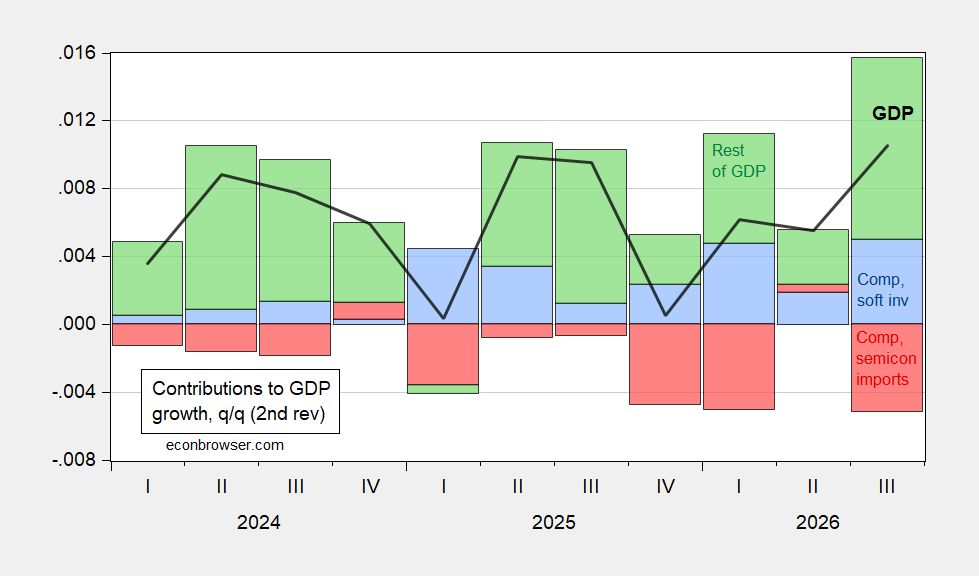
Figure 1: Quarter on Quarter GDP growth (black line), contributions to quarter on quarter GDP growth from computer and software investment (blue bar), from imports of computers, peripherals, and semiconductors (red bar), rest of GP (green bar) (all not annualized). Source: BEA 2026Q3 2nd release, author’s calculations.
Short run macroeconomic impact depends on Keynesian multipliers for capex vs. imports. For the latter, they might be small because there are few domestic substitutes for the imports. For capital expenditures, the same might be true excepting data center and power station construction (which is not broken out in the above decomposition – see this post).
Real imports of semiconductors were revised down, while the sum of computers and semiconductors were revised up.
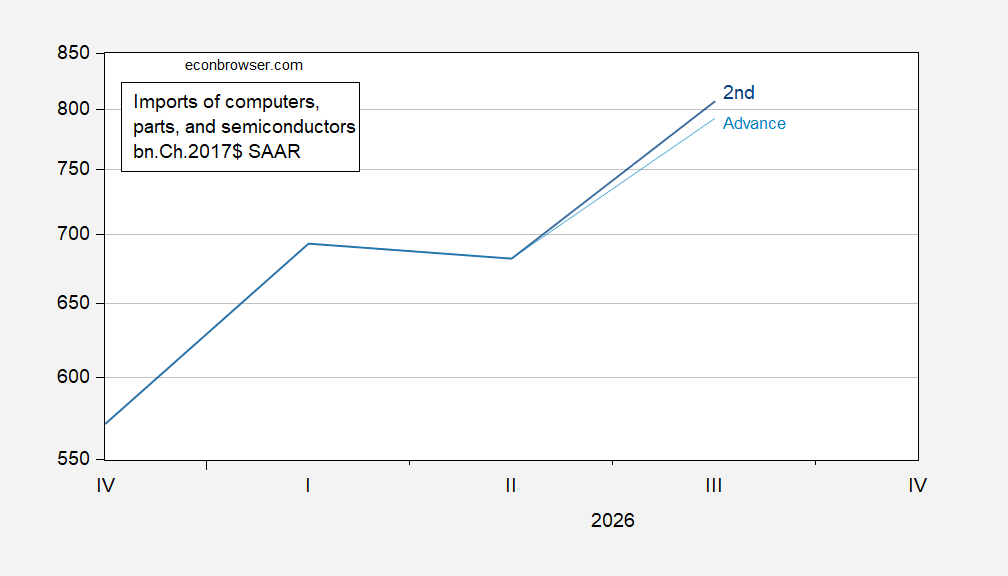
Figure 2: Imports of Computers and parts, and semiconductors, 2nd release (blue), advance release (light blue), in bn.Ch.2017$, SAAR. Source: BEA and author’s calculations.
Looking forward to Q4, Advance Economic Indicators for October indicate -$149.5 bn goods deficit, vs. -$135.9 bn consensus, vs. -$135.1 bn previous (September). Both categories of capital goods and industrial supplies imports are up, but there’s no further disaggregation.



Comments
Log in or sign up to join the conversation.