

If you work in academic publishing, you already know the problem that most generic CRM tools weren't built for: your "customers" aren't a single buyer making one decision. They're professors deciding on course adoptions, librarians managing institutional subscriptions, distributors placing bulk orders, and authors you need to keep engaged for the next edition. Juggling all of that in spreadsheets or a CRM designed for retail sales is why so many publishers end up with missed renewals, duplicate outreach, and sales reps who have no idea what a contact actually cares about.
This is exactly the gap that academic CRM software is designed to close. A platform like VMESH CRM is purpose-built for the academic and publishing world, so instead of forcing your team to adapt to generic sales software, the CRM adapts to how academic publishing actually works — multiple stakeholders, long sales cycles, and relationship-driven decisions.
Why Generic CRMs Fall Short for Publishers
Most CRM platforms are built around a simple B2C or B2B sales funnel: lead, opportunity, close. Academic publishing doesn't work that way. A single university deal might involve a faculty member who influences adoption, a procurement officer who approves budget, and a librarian who manages the actual subscription — all needing different communication at different times.
A generic CRM software tool treats these as disconnected contacts. A proper CRM for academic publishers treats them as one relationship map tied to a single institution, so your team always knows who's involved and where things stand.
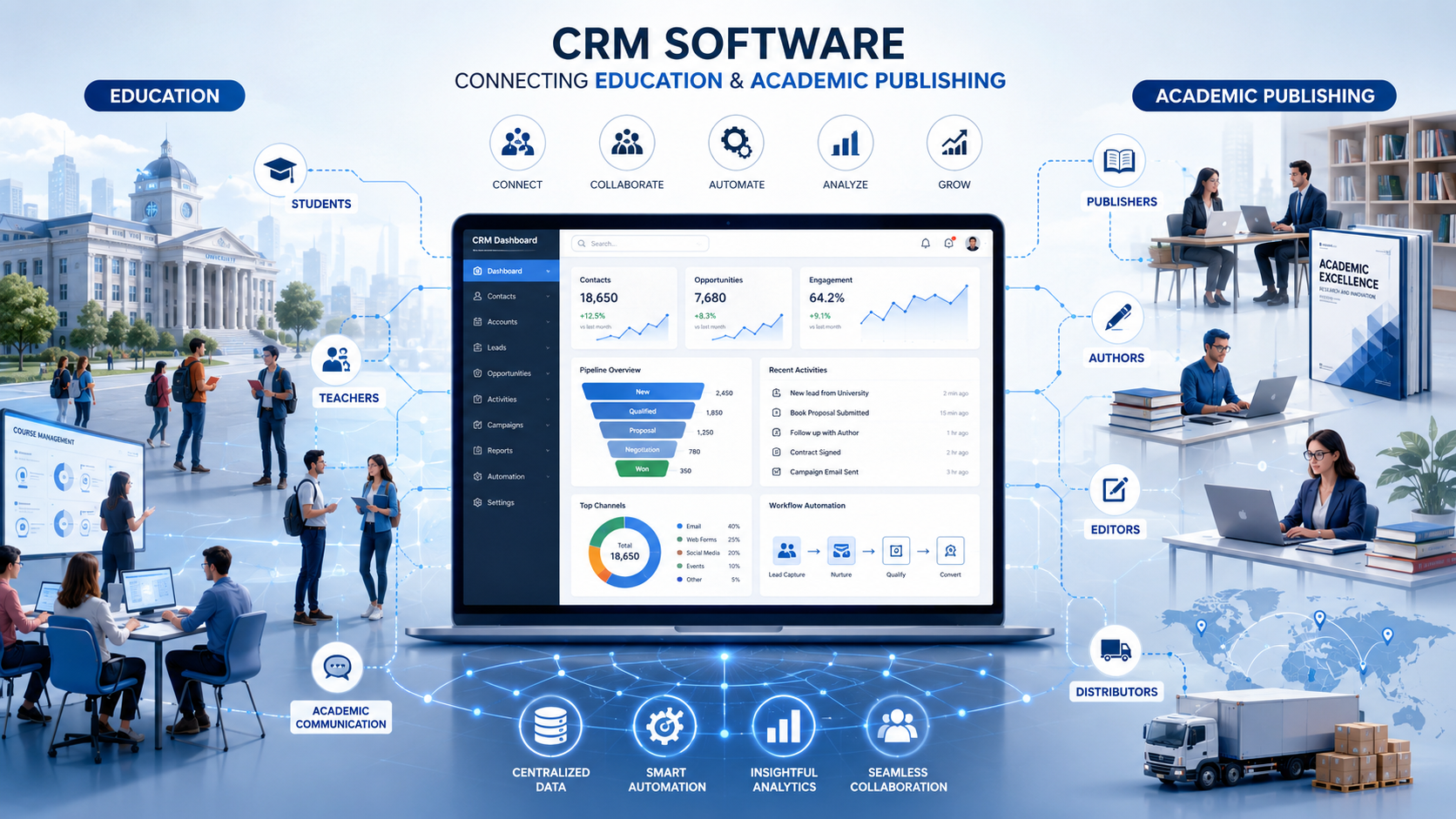
Common Problems Academic and Publishing CRM Software Solves
1. Fragmented relationships across departments
Sales, marketing, and editorial teams often work off separate spreadsheets for the same institution. A centralized Publishers CRM keeps every interaction — emails, calls, meeting notes, contract status — in one shared record, so nothing falls through the cracks when a rep changes territories or goes on leave.
2. Missed renewals and lapsed subscriptions
Institutional and library subscriptions renew on a cycle, but without automated reminders, renewal windows get missed and revenue quietly walks out the door. A Book Publishers CRM with built-in renewal tracking flags these opportunities before they lapse, not after.
3. Long, multi-stakeholder sales cycles
Course adoption decisions can take months and involve several people signing off. A Sales CRM for Publishers is built to track long pipelines with multiple decision-makers per deal, rather than assuming a single buyer closes fast.
4. Disconnected education-sector data
Publishers selling into schools, colleges, and universities need visibility into institution type, department, and academic calendar — details a generic CRM simply doesn't have fields for. CRM for Education functionality means your outreach timing actually lines up with budget cycles and academic terms.
5. Author and content-partner relationships getting lost
Publishers aren't just selling to institutions — they're also managing relationships with authors and content partners. A CRM for Book Publisher operations should track both sides: the commercial pipeline and the author/editorial relationship, without needing two separate tools.
What Good Academic CRM Software Should Include
Institution-level relationship mapping — see every contact, department, and stakeholder tied to one account
Renewal and subscription tracking — automated alerts before contracts or subscriptions lapse
Pipeline stages built for education sales — matching how course adoption and procurement actually happen
Segmentation by academic sector — schools, colleges, universities, libraries, and distributors handled differently
Author and partner tracking — not just buyer-side relationships, but the editorial and content side too
Reporting on what actually matters — adoption rates, renewal rates, and rep performance by institution type, not generic sales metrics
Publishers and academic institutions don't buy the way retail or SaaS customers do — the relationships are longer, more layered, and involve more people. Trying to manage that in a generic CRM Software platform means constant workarounds. A CRM purpose-built for this space, like VMESH CRM, gives publishing and academic sales teams a system that already understands institutional buying, renewal cycles, and multi-stakeholder relationships — so the team spends less time managing spreadsheets and more time closing the right conversations with the right people.
If missed renewals, scattered contact records, or slow-moving institutional deals sound familiar, it's worth asking whether your current tools were ever built for academic publishing in the first place.
Comments
Log in or sign up to join the conversation.