


You've probably noticed that Microsoft (MSFT) is in a serious drawdown going back quite a few months. This is far from unprecedented in Microsoft's tenure. At some point, it will bottom out, and I'm sure it will recover and eventually rip higher at some point. Obviously, I don't know how long any of that will take.
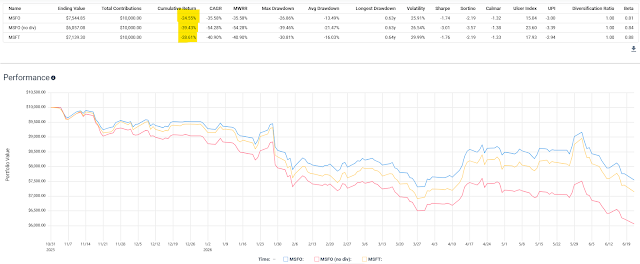
It seems like a good time to check in on how the YieldMax MSFT ETF (MSFO) is handling the drawdown. The crazy high-yielders are fascinating, but must be very difficult to own. The total return for MSFO has actually held up better than the common. The marketing pieces talk about covered call funds possibly going down less because of the distributions, and that is working out for MSFO this time on a total return basis.
Anyone taking out the distributions is down 40%. The nature of the crazy high-yielders is that they should not be expected to keep up with their distributions; they will continue to erode at some rate of speed and then reverse split.
Not all the YieldMax funds are crazy high yielders. The YieldMax U.S. Stocks Target Double Distribution ETF (DDDD) started trading earlier this year. It seeks to pay out twice the yield of SCHD, which currently yields 3.3%. SCHD is in my ownership universe. It's too soon to evaluate its ability to generate twice the yield, but at a six-point-something percent yield, it won't be on a fast path to eroding into a reverse split.
DDDD reminds me of the Pacer Metaurus US Large Cap Div Multiplier 400 ETF, which tracks the S&P 500 and tries to quadruple the yield. So far, it looks like it has done a little better than that.

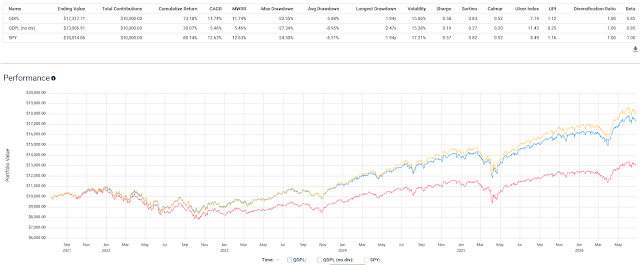
There are probably more wrong ways to get more yield (a large allocation to crazy high yielders) than correct ways, but it's worth continuing to look.



Comments
Log in or sign up to join the conversation.