


A month ago, in our previous Recession Watch discussion, we wrote that although there were economic risks associated with the price action in the energy market (the record-high diesel price, in particular) and Trump’s counterproductive international trade policies, it was still the case that none of the most useful US economic indicators were pointing to an imminent recession. Since then the evidence has become more mixed, most likely because the parts of the economy that are benefiting from AI-related investment are very much still in the boom phase, whereas many other parts of the economy are weak.
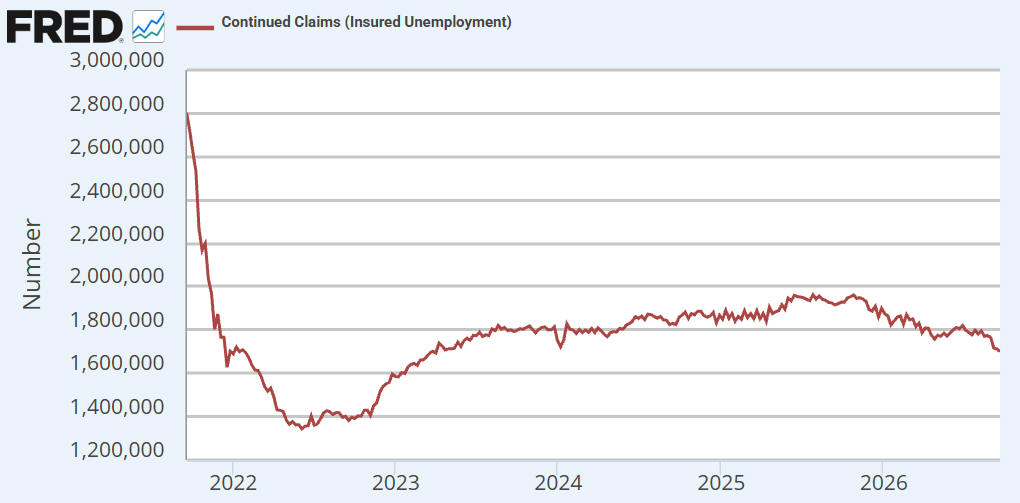
Turning to the data, the monthly US employment numbers released on Friday 2nd October were weak in absolute terms and relative to expectations but provided almost no useful information about the state of the economy. Traders focus on these numbers, though, because they influence the Fed. Continued Claims for Unemployment Insurance (CCUI) is a better indicator of the state of the labour market and this statistic points to strength, given that the number of people refiling for unemployment insurance is at a 3.5-year low. Here’s the relevant chart:
As an aside, largely in response to lower-than-expected numbers in an inflation report on Wednesday (the PCE Price Index) and the monthly employment report on Friday, the probability — according to the Fed Funds Futures market — of a Fed rate hike at the next FOMC meeting (28th October) plunged over the past week from 64% to 22%. We reiterate that this shift was a response to economic data that influence the Fed but don’t necessarily say much about the actual economy.
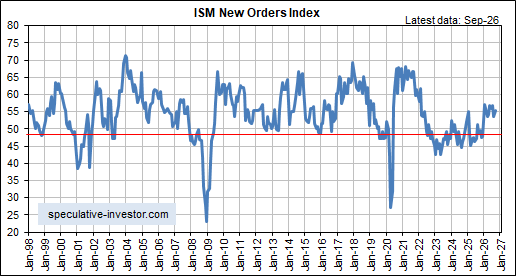
Also pointing to a modicum of economic strength is the ISM Manufacturing New Orders Index (NOI), which, as illustrated below, remains near the top of its 4-year range and a long way above the level that it would have to breach (48) to generate a new recession warning.
CCUI and the NOI are on the positive side of the ledger, but we noted above that US economic indicators have become more mixed over the past month. For example, on the negative side of the ledger we have:
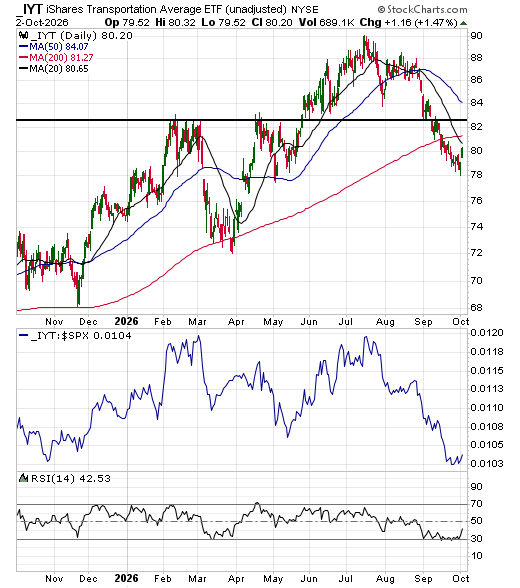
1. Some important cyclical sectors of the US stock market recently have been very weak, despite the boom in datacentre construction. The following daily chart of the iShares Transportation ETF (IYT) shows an example. This suggests that many parts of the economy are being hurt more by the high price of diesel and other cost pressures than helped by the AI-related investment boom.
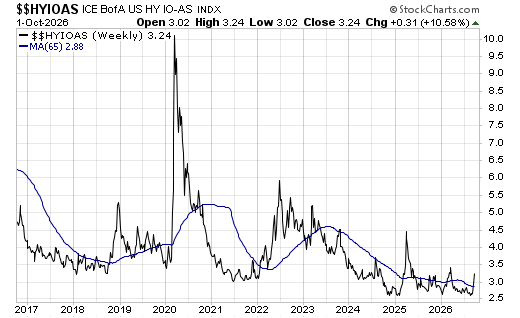
2. The High Yield Index Option Adjusted Spread (HYIOAS) has signalled an upward trend reversal by breaking above its 65-week MA (the blue line on the following chart), that is, credit spreads have begun to widen. This is a necessary but far from a sufficient condition for a recession.
The longer the war in the Middle East continues the more negative will be the consequences for the US economy, the consequences for many other economies around the world having already been severe. Furthermore, as things stand today the war is far more likely to escalate than to end within the next few months. That being said, to borrow a phrase from the world of central banking, we will be data dependent. Regardless of what we think will be the economic consequences of major policy blunders, we will defer to objective indicators that in combination have worked for decades. At this time, these indicators collectively are becoming more negative, but they are not signalling that a recession is imminent.

Comments
Log in or sign up to join the conversation.