

“The good news at the start of 2019 is that the risk of an outright global recession is low. The bad news is that we are heading into a year of synchronized global deceleration.”
(Nouriel Roubini, Project Syndicate, Feb 8, 2019)
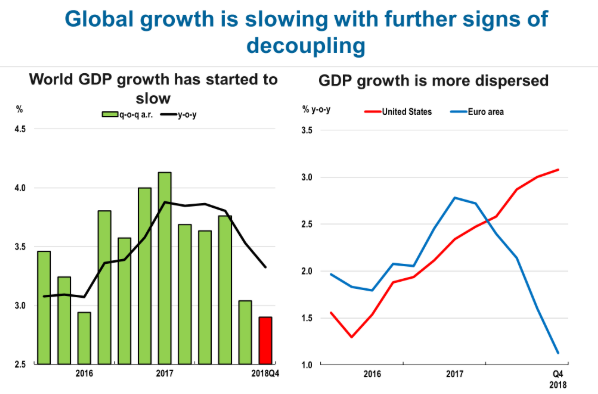
The global economy slowed to 3.6% growth in 2018, with the slowing most noticeable in Europe and Asia. The OECD projects the world economy to grow only 3.3% this year and 3.4% in 2020.
Even though economic growth optimism has been fading, an early slide into a world recession is unlikely. This is because of a series of positive actions that have been taken to offset the slowing in the global economy.
At the forefront is the fact that the US Federal Reserve has pivoted in a dovish direction. In addition, China has also introduced some macro stimulants which should help counter downward pressures on its economy. Finally, the US economy and its job market are both strong and continue to expand rather solidly.
Obviously, the European economic outlook is more worrisome, particularly since business and investor confidence has been dampened by tighter credit conditions as well as the unknown implications relating to the Brexit with the UK.
On the brighter side, and following the lead of the Fed, Mario Draghi has backed off (if only temporarily) on the ECB’s shift into quantitative tightening of its monetary policy.
As Britain approaches the possibility of a hard Brexit, European cities have been bracing for possible chaos at ports and have been wooing firms with operations in the UK to seek refuge on the Continent.
The latest data confirms that Brexit uncertainty has hurt the British economy. The UK economy grew at only at a 0.7% annual rate in the fourth quarter of 2018, its slowest pace since 2012. According to an OECD report, since the Brexit referendum, Britain has lost between 0.7% and 1.7% of its GDP.
The gloomiest projections relating to a hard exit suggest that Britain’s real GDP would sharply decelerate and that the pound could also fall even more sharply against the US dollar.
Nonetheless, a hard exit will also be painful for the 27 remaining member states in the European Union. Since each EC country has a unique trading relationship with Britain as far as the movement of goods, services, people and capital, the direct negative effects will be quite unequal among member states.
Canada’s economy recently shifted into a softer growth phase even though the job market is still quite strong. The Bank of Canada recently backed away from further raising interest rates, though it is possible that benchmark rate could also increase once more in the second half of 2019. Canada’s economy is very heavily exposed to a series of geopolitical risks, including the USMCA trade ratification process in Congress.
Economic growth in the fourth quarter of 2018 was noticeably slower in Germany, the UK, and Canada, and as the following table indicates, there are prospects for significantly slower growth in the US economy in 2019 and 2020.
In other words, in most countries, economic growth momentum has weakened, and risks have increased because of heightened trade tensions and the fact that in financial conditions have tightened over the past year.
Major World Economies At A Glance: 2018-2020
(Real GDP, Annual % Rates of Change)
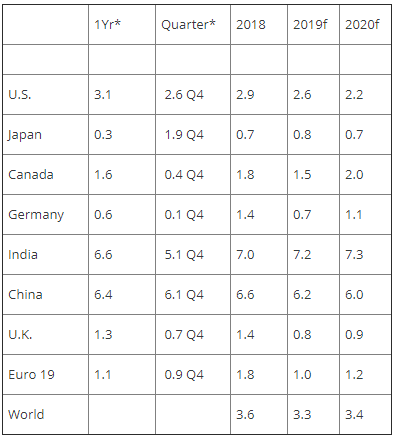
* 12 months % change and annual change.
(Click on image to enlarge)
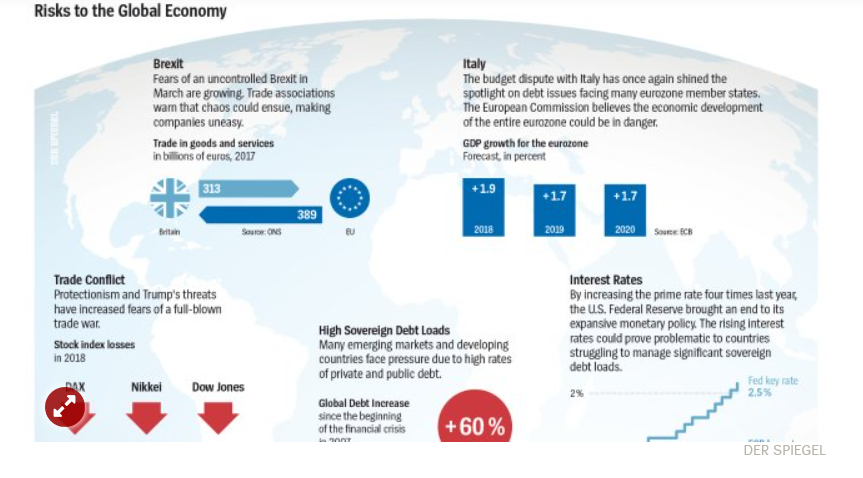
A Snapshot Summary Of Some Of The Risks Facing The Global Economy
(Click on image to enlarge)


Comments
Log in or sign up to join the conversation.