


Albert wrote in this week about a problem that can sometimes plague your investments. His email started, “Sometimes I like something that is too complicated for me to handle the taxes.”
I didn’t have to read any further to guess he was talking about the tax treatment of one of my favorite stocks—Enterprise Products Partners (EPD). The oil pipeline company is structured as a master limited partnership (MLP) which means you will receive a K-1 instead of a 1099 for tax reporting.
MLPs must generate at least 90% of their income from qualifying natural resource, energy, or real estate sources. They then pass this through to their shareholders, which are actually called unitholders. You’re not really holding shares here. Instead, you are one of many limited partners in the structure. A limited partner is one that buys units to provide capital while the general partners manage daily operations.
K-1s exist for entities like this. There are three types:
Form 1065 for partnerships
Form 1120-S for S corporations
Form 1041 for estates and trusts
All three pass the tax liability through to their owners or beneficiaries. A K-1 allows them to report each person’s specific share of income, deductions, and other items. That creates the tax problem.
Too Much Information
The K-1 is longer and more layered than most of the other tax documents you’ll receive. That’s because it’s essentially a summary of the whole business’ taxes, which creates the first hurdle.
Many investors don’t want to deal with a K-1 because it’s not issued until the first week in March. You have to wait for the MLP to gather all of its tax documents to then pass that information on to you. So, if you’re someone who likes to file early, this could be an easy reason not to invest in MLPs.
Once you get the K-1, you’ll see it is split into 3 sections.
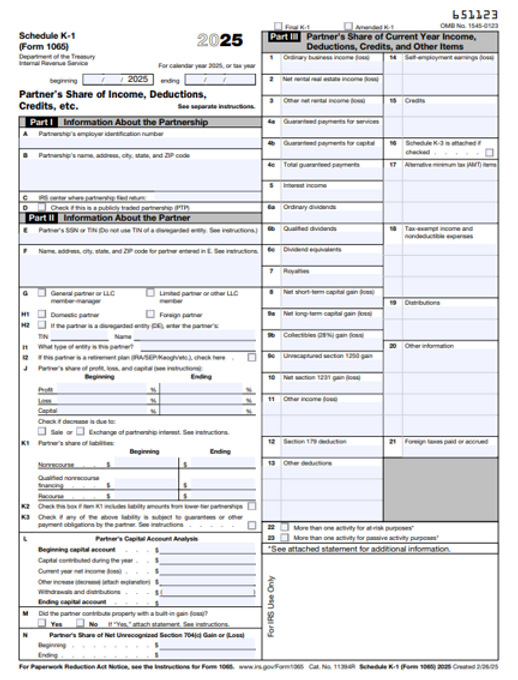
Parts I and II (the left side) are the easier ones to input. They cover information about the partnership, the partner (you), and your position. Part III, however, is where you’ll start to see entries that aren’t a single number. Some of them are sub-lettered with multiple entries. And some boxes will show “STMT” which requires you to enter a whole statement worth of information. Boxes 13, 18, and 20 usually require the most attention.
Additionally, you do not want to put an MLP in a tax-advantaged account. Owning these shares makes you part owner and can generate unrelated business taxable income (UBIT) which you will have to pay taxes on.
Some Common Confusion
Unfortunately, I do not have a manual or step-by-step guide to help you complete a K-1. Each person’s tax situation will vary, and each tax preparation software looks a little different. However, I do have a few tips if you are going to add EPD or another MLP to your portfolio.
A reminder: This is for general education purposes only and not intended, nor be considered, as tax advice. I am not a tax professional.
One of the most common confusions started in 2021 when the IRS mandated K-3s for MLPs. The K-3 breaks down information on the K-1 geographically. This has created a situation where box 16 is checked but sometimes the K-3 isn’t available until much later in the year.
EPD is a company that operates solely in the US, so a K-3 doesn’t really give any new data. Unless you are a foreign unitholder or intend to claim credit for foreign taxes paid, you don’t need to wait for this data. This is different if the MLP has foreign operations.
Another confusion is that some tax software will have you enter a box and then ask you follow-up questions. Now you have to make a judgment call instead of simply entering the information on the page.
One example is a page usually labeled “Describe the Partnership” or “Entity Questions.” These answers determine your loss limits, so you need to answer them accurately. If you hold the shares in your brokerage account, you’ll identify the partnership as a PTP or publicly traded partnership. And you’ll probably also select “all of my investment activity is at risk.” But there are other options on these screens which are dependent on your situation.
If you’re not intimidated by waiting until the first week of March to get your tax documents or completing the extra paperwork, then these types of investments might be for you.
If this all seems like an extra headache that you just don’t need, I’d look for ETFs such as the Alerian MLP ETF (AMLP) or Global X MLP & Energy Infrastructure ETF (MLPX) to get your pipeline exposure.



Comments
Log in or sign up to join the conversation.