

The market hasn’t seen an IPO for an income stock of this size and caliber in a long time. But, should you jump right in and purchase shares when this stock starts trading on Wednesday? Tim Plaehn digs through the finances and has the answer for you.
MGM Resorts International (NYSE:MGM) has announced it will spin off a real estate investment trust (REIT) to own about two-thirds of the casino company’s real estate assets. The new REIT, to be called MGM Growth Properties (NYSE:MGP), is scheduled to price after the stock market closes on Tuesday, April 19th, with the shares starting to trade on Wednesday. If MGP initially trades near the target price listed in the prospectus, this new REIT will be an attractive buy for income-focused investors.
Overview from the Prospectus
“Following the completion of this offering, we expect to be one of the leading publicly traded REITs engaged in the acquisition, ownership, and leasing of large-scale destination entertainment and leisure resorts, whose diverse amenities include casino gaming, hotel, convention, dining, entertainment, and retail offerings. In connection with this offering, we will acquire from MGM nine premier destination resorts in Las Vegas and elsewhere across the United States and one dining and entertainment complex which opened in April 2016. As of December 31, 2015, these properties collectively comprise 24,466 hotel rooms, approximately 2.5 million square feet of convention space, over 100 retail outlets, over 200 food and beverage outlets, and approximately 20 entertainment venues.”
Property Details
MGM Growth Properties will own seven properties on the Las Vegas Strip:
- Mandalay Bay
- The Mirage
- Monte Carlo
- New York-New York
- Luxor
- Excalibur
- The Park, a dining and entertainment complex located between New York-New York and Monte Carlo which opened in April 2016.

The Las Vegas properties represent about 24% of total rooms on the Strip and approximately 35% of the privately owned convention and meeting space on the Strip. The properties feature over 100 retail outlets, over 200 food and beverage outlets and approximately 20 entertainment venues.
Outside of Nevada, the REIT will own the MGM Grand in Detroit, the Gold Strike in Tunica, Mississippi, and the Beau Rivage in Mississippi.
All ten properties will be leased by subsidiaries of MGM under a single, triple-net Master Lease.
IPO Details
The initial public offering is for 50 million Class A shares of MGP, with an additional 7.5 million available for over allocation. If the full share allotment is taken, the offering will raise $1.1 billion and the REIT will take on debt of $3.2 billion. The net proceeds of $4 billion will be used by MGM Resorts to pay down outstanding debt. The 57.5 million Class A shares represent 27% of the total equity in MGM Growth Properties. The remaining equity will be owned by subsidiaries of the casino company. MGM Resorts will own a single Class B share with no economic interest, but with 51% of the voting rights. The midrange of the expected share price is $19.50 per share.
The Financials
Under the terms of the Master Lease, MGM will pay MGP a starting annual rent of $550 million per year. The rent consists of a Base Rent of $495 million and $55 million of Percentage Rent. The Base Rent has a 2% annual escalator. The Percentage Rent is fixed for six years, and then will be a percentage of revenue generated by the properties. The Master Lease has an initial lease-term of ten years with the potential to extend the term for four additional five-year terms at the option of the tenant. The Master Lease states that any extension of its term must apply to all of the properties under the Master Lease at the time of the extension. The lease has a triple-net structure, which requires the tenant to pay all costs associated with each property, including real estate taxes, insurance, utilities, and routine maintenance.
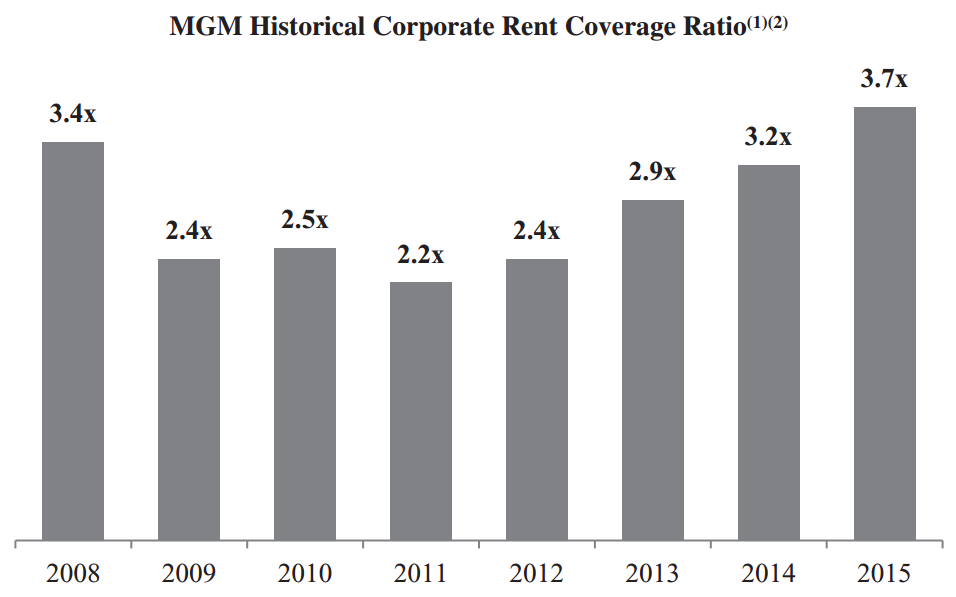
MGM has agreed to provide MGP and its subsidiaries with financial, administrative, and operational support services. Costs of these services will be reimbursed back to MGM. In 2015, the business operations of the properties to be owned by MGP generated EBITDA to provide 3.7 times rent coverage. Since the Great Recession, EBITDA has varied, but has been at least 2.2 times the lease annual rental rate.
Out of the $550 million in annual rent, MGP expects to generate $403 million in adjusted funds from operations (AFFO). This is the free cash flow available to pay dividends. The initial planned dividend rate is $0.3575 per share per quarter, or $1.43 per year. The annual dividend payments will be 80% of the projected AFFO. The prospectus states the initial dividend rate will be in effect for the first year after the IPO.
Investment Considerations
At the expected $19.50 share price, the initial dividend rate will give the MGP shares a 7.3% yield. The prospectus also states the company will have a pro forma net tangible book value of $22.61 per Class A share after this offering. Visible cash flow and dividend growth prospects come from the annual rent escalator and MGP’s rights of first offering on two projects under development by MGM: the MGM National Harbor, in Maryland near Washington, D.C. and MGM Springfield, in Massachusetts.
The REIT’s biggest risk is that the company will have a single tenant. MGM Resorts has struggled with profitability over the last several years. The $4 billion in debt reduction should help the MGM finances and having all of the properties under a single Master Lease offsets some of the single tenant risk. Longer term, MGP will need to buy non-MGM owned or controlled properties to hit the company’s stated goal of being a growth oriented REIT. We will just have to wait and see if the company can make that happen.
If MGP shares are available at close to $20 with a 7% yield, this IPO will be an attractive investment with a high yield and stable projected cash flow. If on the IPO date the share price zooms up to $30 or more, I would recommend not jumping on the new shares. It has been quite a while since an income stock of this size and quality has come into the market so there may be a bidding war for the shares. If the share price does zoom, there is a good possibility that the value may again drop into the low $20’s, which would be a better buying opportunity.
Finding stable companies that regularly increase their dividends is the strategy that I use myself to produce superior results, no matter if the market moves up or down in the shorter term. The combination of a high yield and regular dividend growth is what has given me the most consistent gains out of any strategy that I have tried over my decades-long investing career.


Comments
Log in or sign up to join the conversation.